


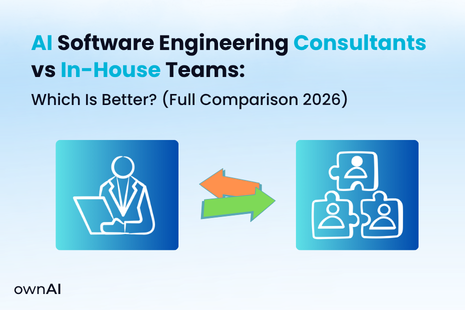
AI is no longer a side bet. It is now a core capital allocation decision that shapes growth, margins, and how fast your team ships.
And the moment you commit to investing, one question stops every leadership meeting cold: should you build an internal AI team, or bring in AI software engineering consultants to do the work?
The choice between AI software engineering consultants vs in-house teams is not just about staffing alone. It shapes your speed to market, your cost structure, your data control, and how quickly you can adapt when the technology shifts again next quarter.
According to a recent McKinsey State of AI report, 78% of organizations now use AI in at least one business function.
The companies winning are not the ones experimenting with AI. They are the ones who picked the right delivery model early and shipped to production while competitors were still recruiting.
So, if you’re confused between hiring AI software engineering consultants vs In-house team, then this guide will help you make the right choice.
In this guide, you will understand:
- What AI software engineering consultants actually do
- What is an in-house AI team?
- 10 key differences between AI software engineering consultants vs in-house teams
- Pros and cons of each model
- Which model to choose and when
- 6-step framework to make the right call for your business
By the end of this guide, you will know exactly which model fits your business, what it will cost, and what to do next.
AI Software Engineering Consultants vs In-House Teams: Quick-Answer Summary
Here is the side-by-side at a glance.
| Factor | AI Software Engineering Consultants | In-House AI Team |
|---|---|---|
| Setup time | 1 to 2 weeks | 6 to 12 months |
| Year-1 fully loaded cost | $150K to $500K | $800K to $1.2M+ |
| Speed to first production deployment | 2 to 8 weeks | 9 to 14 months |
| Expertise breadth | Cross-industry, multi-domain | Limited to hires made |
| Scalability | Up or down on demand | Bound by hiring cycles |
| Day-to-day control | Scope-defined, shared | Full internal control |
| IP and data ownership | Contract-defined | Fully internal |
| Knowledge retention | Requires a transfer plan | Stays within the team |
| Risk on the first project | Lower, vendor shares risk | Higher, all risk internal |
| Best for | Speed, pilots, niche skills, cost-controlled growth | Long-term AI strategy, regulated data, AI-as-product |
What Are AI Software Engineering Consultants?
AI software engineering consultants are external specialists who design, build, and ship AI systems for businesses without the overhead of full-time hires.
Instead of waiting six months to assemble a team, you plug into a partner that already has data scientists, ML engineers, MLOps specialists, and AI architects ready to start.
The right consulting partner does not just write code. They translate your business problem into an AI roadmap, decide which models actually solve it, build the data pipelines underneath, deploy the system to production, and monitor performance once it is live.
For a deeper breakdown of how a single consultant differs from a full consulting firm, you can read our guide on an AI consultant vs AI consulting company.
What Is an In-House AI Team?
An in-house AI team is a group of full-time employees who work only on your AI projects. The team usually includes data scientists, ML engineers, AI architects, data engineers, MLOps specialists, and a product manager who owns the AI roadmap.
Mature teams also add a domain expert who understands the industry in which the AI is being applied.
Building this team is a long-term commitment. You hire the talent, set up the infrastructure, license the tools, and continuously upskill people as the technology shifts.
When done well, it creates a permanent AI capability inside your business. When done poorly, it burns through 12 months of budget without producing anything you can ship.
AI Software Engineering Consultants vs In-House Teams: 10 Key Differences
Here is the complete side-by-side breakdown across the 10 factors that actually decide outcomes. Each one is a real business consequence, not a feature checklist:
1. Speed to First Production Deployment
Consultants ship in weeks because they have built similar AI systems many times before, on similar data and models. They arrive with pre-built components, proven architectures, and the muscle memory of dozens of past engagements, so the first working result usually lands inside the first sprint.
In-house teams need to hire engineers, onboard them, and learn your systems before any model gets trained. The full path from first hire to first production launch runs 9 to 14 months in most US markets, which hurts when competitors are already shipping.
2. Upfront Cost and Cash Flow
A consulting engagement is a clear, controllable line item. You scope the work, agree on milestones, and pay only when deliverables land, so cash flow stays steady with no heavy upfront spending before you see real output.
An in-house team is a fixed monthly cost that runs whether work is shipping or not. Salaries, benefits, equipment, and software licenses keep adding up even during slow phases, which is hard for SMBs to justify against AI use cases that have not yet generated measurable ROI.
3. Expertise Breadth and Specialization
Consultants bring a deep bench across industries, model types, and deployment patterns. If your project shifts from predictive analytics to generative AI, the partner pivots quickly because someone on the team has shipped that exact pattern before, giving you expertise that would take years to build internally.
Your internal team is bound by who you hired on day one. If they specialize in one AI area and the next project needs a different one, you either spend months retraining or restart hiring, which limits how fast your AI roadmap can evolve.
4. Scalability Under Changing Workload
Consulting engagements scale up for a launch and scale down for maintenance. When a major build needs five engineers in 30 days, the partner pulls them from a wider pool, and when the build ends, the team contracts without layoffs or budget pain.
In-house teams cannot flex that fast. Hiring takes 45 to 60 days per senior role plus 60 to 90 days of ramp-up, and when demand drops, you carry idle headcount or face layoffs that hurt morale and trigger replacement costs later.
5. Control Over Day-to-Day Execution
In-house teams give you total control over priorities, sprint planning, and reprioritization. You can pull engineers off one project mid-sprint and reassign them without renegotiating scope or signing change orders, so daily decisions move fast.
Consultants work within an agreed statement of work and need clean briefs, not constant reprioritization. If your project requires daily strategic shifts, the consulting model creates friction, and the fix is a clear scope upfront with weekly review checkpoints, not constant intervention.
6. Intellectual Property and Data Ownership
In-house teams keep every algorithm, dataset, and pipeline inside your firewall by default. There is no contract debate about who owns what, and no concern about a vendor reusing your work, which is foundational for businesses where AI is part of the product.
With consultants, IP and data ownership depend on the contract you sign. A well-drafted master services agreement gives you the same outcome, but the legal work has to happen upfront, or you risk shared rights and dependency on the partner's proprietary tooling later.
7. Security, Compliance, and Risk Posture
In-house teams operate inside your existing security perimeter, audit logs, and compliance documentation. For regulated industries like healthcare and fintech, that internal control simplifies regulator conversations and shrinks the audit surface area significantly.
Consultants match this posture by working inside your environment under strict data agreements and VPC-deployed engagements. The right partner brings SOC 2 or ISO 27001 by default, while the wrong partner treats security as an afterthought, which is where most compliance failures originate.
8. Knowledge Retention and Institutional Memory
Internal teams retain everything they learn over time. Patterns, edge cases, and tribal knowledge accumulate inside the organization, so after three years, the team understands your business deeply and ships new projects faster because the foundational learning is already there.
When a consultant finishes the engagement, that knowledge can walk out the door unless transfer is built into the contract. Documentation, training, and structured handoff prevent this loss, but they must be deliverables, which is exactly what the hybrid model is designed to handle.
9. Access to Tools, Frameworks, and Infrastructure
Consultants come with pre-built libraries, MLOps accelerators, evaluation frameworks, and proven deployment architectures. They license commercial tooling at scale and reuse patterns for monitoring and retraining, which often shaves weeks off every engagement.
Internal teams build the same tooling from scratch or license commercial alternatives, adding $80K to $150K to year-one infrastructure cost. Over time, that tooling compounds across projects, but the upfront build cost is rarely captured in initial budget plans, which is why so many in-house projects overrun.
10. Long-Term Cost Curve
Under 18 months, consultants cost 40% to 60% less because you skip recruiting fees, ramp-up time, infrastructure setup, and management overhead. Cash flow stays flexible with no carrying cost during slow quarters, so the math clearly favors consultants for most SMBs in this window.
Beyond 24 months of continuous AI work, in-house teams pull ahead. Infrastructure amortizes across projects and per-project cost drops sharply, with the break-even point landing between months 18 and 30, which is exactly what the hybrid model is built to handle.
Also Read: AI Development Company vs In-House Team: Which One to Choose?
8 Advantages of Hiring AI Software Engineering Consultants
Production-ready work from week one: You skip the months of waiting for a team to get up to speed. Consultants arrive with proven methods, ready-to-use components, and the experience to ship fast, so your first result lands inside the first sprint.
Flexible cost that follows your roadmap: Pay only for what you need, when you need it. Scale up for a build, scale down for maintenance, pause if priorities change, with no severance pay, idle salaries, or hiring cycles to restart later.
Patterns and playbooks from many industries: Your partner has already built AI for retail, finance, healthcare, and SaaS. They bring solutions your internal team would only learn after years of trial and error, which often opens up options you would not have thought of yourself.
Quick access to top AI talent: Senior ML engineers and RAG specialists are some of the hardest people to hire in tech. A consulting engagement gives you that talent on day one, without competing with Google, Meta, and well-funded AI startups for the same few candidates.
Team size that flexes with each phase: AI projects need more people during the build and fewer during operations. Consulting partners adjust to that reality. You get five engineers for the build, drop to two for monitoring, and scale back up when the next project starts.
Lower risk on your first AI project: A specialized partner has shipped a project before. They know which ideas usually fail, where data issues break production, and what governance gaps cause rework, which makes your first AI initiative much safer to launch.
Ready-made tools, frameworks, and infrastructure: The right partner brings reusable building blocks for data pipelines, MLOps, monitoring, and evaluation. You skip months of setup and use proven tooling instead of building it from scratch, which is how our custom AI development approach works.
Your internal team stays focused on the business: Your operations, sales, and product teams stay out of AI implementation work. The consulting partner handles the technical side while your team keeps its attention on the business outcomes the AI is meant to deliver.
5 Limitations of AI Software Engineering Consultants
Less daily control over execution: Consultants work against scope, not your daily standups. If you want to direct every small decision in real time, the model will feel slow. The fix is a clear brief upfront, weekly checkpoints, and trust in the partner's process.
Knowledge transfer needs upfront planning: When the engagement ends, what the team learned can walk out the door with them. The fix is to build documentation, training, and handoff sessions into the contract from day one, not added in at the end.
Data security needs strong vendor controls: Sensitive data leaving your environment creates risks that internal teams do not face. Strong NDAs, role-based access, audit logs, and ideally on-premise or VPC-deployed work close most of the gap, but you need to verify the partner's security setup before signing.
Coordination across time zones takes effort: Distributed teams need clear communication channels and async-first workflows. Without them, time zone gaps create delays. Most experienced firms run nearshore or follow-the-sun models to remove this friction. Our nearshore software development guide covers this trade-off in detail.
Risk of long-term vendor dependency: If you delegate every update, fix, and enhancement to a partner indefinitely, your business becomes structurally dependent on them. The hybrid model fixes this by handing ownership to an internal team once the AI capability is proven and stable.
8 Advantages of an In-House AI Team
Deep business context in every model: Internal teams live inside your processes, data, and culture. They know which features matter, which metrics drive revenue, and which edge cases regularly cause problems, which produces models that fit your business instead of generic ones.
Full control over priorities and roadmap: You set the direction, change priorities on the fly, and move engineers between projects without renegotiating scope. For organizations with fast-changing AI priorities, that internal control is genuinely valuable.
Complete ownership of IP, models, and data: Every algorithm, dataset, and pipeline stays inside the company by default. For businesses where AI is part of the product itself, this ownership is not optional; it is the foundation.
Tight alignment across departments: Internal AI engineers join your sales standups, product reviews, and customer feedback sessions. They build trust with the people whose work the AI will change, and that alignment is exactly where most AI investments succeed or fail.
Faster iteration on your data: Once the team knows your data, retraining cycles get shorter. New features ship faster because the team already understands the schema, the edge cases, and what production has been doing for the last six months.
Stronger compliance for regulated industries: In healthcare, fintech, and insurance, internal teams can build compliance directly into model development workflows. The audit trail, risk reviews, and regulatory documentation all live inside your governance system, not a vendor's.
Long-term cost efficiency at scale: If your AI roadmap stretches across 24+ months and includes multiple production systems, internal teams flatten the cost curve. Infrastructure spreads across projects, and the per-project cost drops sharply over time.
Compounding institutional knowledge: Every project teaches the team something new. Patterns get captured, libraries get built, and each new project ships faster than the last. After three years, the team is far more productive than any external partner on your specific stack.
5 Limitations of an In-House AI Team
High year-one cost before any output: A small three-person AI team runs $800K to $1.2M fully loaded in year one before a single model reaches production. For SMBs, that upfront cost is hard to justify against AI use cases that have not yet proven ROI.
6 to 12-month hiring timeline: Senior AI engineers take 45 to 60 days each to hire, and you usually need three to five hires for a functional team. Add onboarding and ramp-up, and you are looking at most of a year before the team works as a unit.
Talent retention pressure in a tough market: Annual attrition for ML engineers runs 15% to 25%. Losing one senior engineer eight months in, and the recruiting and ramp-up cycle restarts, which is a real cost rarely captured in early budget plans.
Limited exposure to other industries: An internal team only sees your problems, your data, and your stack. Without an outside perspective, the team can repeat industry-wide mistakes that a partner who has worked across 50 projects would have flagged early.
Slow to scale up or down with demand: When a major launch needs five extra engineers in 30 days, internal hiring cannot deliver. When a project ends, and capacity sits idle, layoffs bring cost and morale damage. Internal teams trade flexibility for ownership.
That covers the trade-offs on both sides. Now, let us look at what each model actually costs over a full year.
Cost Comparison: AI Software Engineering Consultants vs In-House Teams
Cost is the lens most leadership teams reach for first. Here is what the real numbers look like across both models.
| Cost Category | AI Software Engineering Consultants | In-House AI Team (3-person) |
|---|---|---|
| Year 1 fully loaded cost | $150K to $500K | $800K to $1.2M+ |
| Recruiting and onboarding | $0 | $90K to $150K |
| Time to first deployment | 2 to 8 weeks | 9 to 14 months |
| Infrastructure and tooling | Included | $80K to $150K |
| Year 2 cost (continued work) | $200K to $400K | $700K to $1M |
| Year 3 cost | $200K to $400K | $700K to $1M |
| 3-year total | $550K to $1.3M | $2.2M to $3.2M |
Also Read: AI Agent Development Cost in 2026: Complete Breakdown
How to Choose Between AI Software Engineering Consultants and In-House Teams: 6-Step Framework
Here’s the step-by-step process to choose between AI software engineering consultants vs in-house teams:
Step 1: Define How Central AI Is to Your Business
Ask the honest question: Is AI a core product or a support function? If your competitive moat is the AI itself, plan for in-house capability. If AI improves operations but is not the product, consultants or hybrids usually win.
Step 2: Assess Your Data and Infrastructure Readiness
Before picking a model, audit your data quality, structure, and accessibility. If your data lives in five disconnected systems with inconsistent schemas, fix the foundation first. Bad data ruins both consulting engagements and internal teams equally fast.
Step 3: Map Timeline Against Competitive Pressure
If you need production output in 90 days, internal hiring cannot deliver. If you have 18 months and want long-term capability, consultants alone leave you exposed at the end. Your timeline against your competitive window picks the model.
Step 4: Calculate Total Cost of Ownership for Both Models
Build the full three-year cost picture, not just year-one numbers. Include recruiting, infrastructure, management overhead, and the cost of waiting. Compare against the equivalent consulting engagement scope. The numbers usually decide.
Step 5: Evaluate Compliance, Security, and Data Sensitivity
Healthcare, fintech, and defense work often default toward in-house. The right consulting partner can match the security posture, but verify it specifically before signing. Compliance gaps surface in audits, not in proposals.
Step 6: Plan for Long-Term Capability Building
Whichever model you start with, plan how AI capability grows inside your business over three years. Pure consulting without a transition plan creates dependency. Pure in-house without external exposure creates blind spots. Hybrid plans solve both.
When AI Software Engineering Consultants Are the Better Choice?
- You need results in weeks, not months, because competitive pressure will not wait 12 months for an internal team to assemble.
- You have a defined, bounded problem like a recommendation engine or document automation system that a consulting engagement can scope and deliver cleanly.
- Your AI roadmap is exploratory, and you want to validate use cases before committing to a permanent team.
- Your internal team lacks AI expertise, and you cannot reliably attract senior ML engineers against tier-1 tech employers.
- You need niche skills like RAG, computer vision, or agentic systems for a specific project rather than continuous work.
- AI supports your operations but is not your core product, so a permanent team is hard to justify financially.
- Your budget is fixed, and you want predictable line items instead of carrying ongoing salary and infrastructure costs.
If you want a deeper view on selecting the right partner, our guide on how to choose a top AI consulting firm walks through the evaluation criteria.
When an In-House AI Team Is the Better Choice?
- The algorithms themselves are the business and your main competitive edge.
- Your data is highly regulated and cannot leave your environment under any vendor agreement.
- You have continuous AI needs over 24+ months that justify the upfront internal investment.
- You can attract and retain senior AI talent against tier-1 employers in your market.
- You need full ownership of IP, model architecture, and the long-term roadmap.
- Your industry context is so specialized that no external partner can match the business depth required.
- You already have data infrastructure, MLOps, and engineering leadership ready to support an internal AI function.
Also Read: How to Choose an AI Strategy Development Consulting Partner?
Why Businesses Trust ownAI for AI Software Engineering Consulting?
Choosing the right AI partner is the difference between AI that ships to production and AI that stays stuck in pilots.
ownAI is built for one outcome: turning AI into measurable business results, fast. We work with founders, CTOs, and operations leaders who need production-grade AI without the 12-month runway of building an internal team from scratch.
Every engagement starts with the business problem, not the technology. We design a roadmap around your goals and ship systems to production in weeks. Your internal team owns what we built once the engagement ends.
What makes ownAI different:
- 5+ years building production AI systems, with team experience averaging 6+ years per engineer
- 30+ businesses assisted across 7+ countries, including the US, UK, Austria, France, and the UAE
- ISO-certified delivery with structured discovery, data strategy, build, deployment, and optimization
- Recognized by Clutch as a top API development company within 2.5 years of founding
- End-to-end ownership from AI consulting to AI and ML solutions deployment and continuous optimization
- Business-first approach focused on outcomes, not hype, with measurable ROI tied to every milestone
Stuck on the build vs partner decision? Book a free consultation with our AI experts today and get a clear, practical roadmap for your AI initiative in 30 minutes.
Conclusion
The choice between AI software engineering consultants vs in-house teams is not about which model is better in the abstract. It is about which model fits your timeline, your data, your industry, and how central AI is to your business.
Consultants win on speed, breadth, and cost control under 18 months. Internal teams win on ownership, long-term economics, and compounding knowledge. The hybrid model wins for most businesses scaling AI for the first time.
We hope this guide helped you understand the real trade-offs between AI software engineering consultants vs in-house teams, the true cost of each model, and how to choose with confidence.
Now it is your turn to apply the framework to your business and pick the model that gets you to production fastest.
If you are ready to move from comparison to action, connect with our experts to build a clear AI delivery plan tailored to your timeline, budget, and growth goals.
Frequently Asked Questions
1. What is the difference between AI software engineering consultants and an in-house AI team?
AI software engineering consultants are external specialists who design and ship AI systems on a project or engagement basis. An in-house AI team is full-time employees who work only on your AI initiatives. Consultants offer speed and breadth, in-house teams offer ownership and continuity.
2. How long does it take to build an in-house AI team?
Hiring three to five senior AI engineers typically takes 6 to 12 months in most US markets, with another 3 to 6 months for onboarding and ramp-up. The first production deployment from a brand-new in-house team usually lands 9 to 14 months after the hiring kickoff.
3. Are AI software engineering consultants more cost-effective than hiring in-house?
Under 18 months, consultants are typically 40% to 60% cheaper because there is no recruiting, ramp-up, or management overhead. Beyond 24 months with continuous AI work, the cost curves cross, and in-house teams pull ahead on total cost.
4. Can a business start with AI software engineering consultants and transition to in-house later?
Yes, this is the hybrid model, and it is the most common path for businesses scaling AI for the first time. Consultants handle the early build, then transfer knowledge and ownership to an internal team that takes over in 12 to 18 months.
5. Which model is faster: AI software engineering consultants or in-house teams?
Consultants are 3 to 5 times faster to the first production deployment. A consulting engagement typically ships in 2 to 8 weeks, while an in-house team needs 9 to 14 months from hiring kickoff to first deployment. Speed is the single biggest advantage of the consulting model.
6. How do you protect IP and data when working with AI software engineering consultants?
Strong contractual protections cover most of the risk: clear IP ownership clauses, NDAs, role-based access, audit logs, and ideally on-premise or VPC-deployed engagements for sensitive data. Verify the partner's security posture before signing and treat compliance as a deliverable.
7. When should a small or mid-sized business choose AI software engineering consultants over in-house?
SMBs should choose consultants when they need fast results, lack internal AI expertise, want to validate use cases before committing to permanent hires, or operate in a competitive market where the cost of waiting is high. The hybrid path is usually the smartest long-term fit.
8. What is the hybrid model, and is it suitable for SMBs?
The hybrid model starts with consultants for strategy and initial deployment, then transfers ownership to an internal team built gradually over 12 to 18 months. It is highly suitable for SMBs because it delivers fast production output while building permanent capability without a 12-month runway of pure hiring costs.




 Turn your idea into MVP in 8-16 weeks