


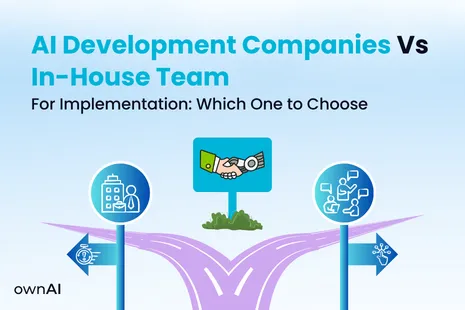
Every business wants AI, but very few execute it well.
Not because the technology is complex. But the first decision is often wrong.
Before you build anything, you have to answer one question:
Do you build AI-powered solutions internally, or partner with experts who have already done it successfully?
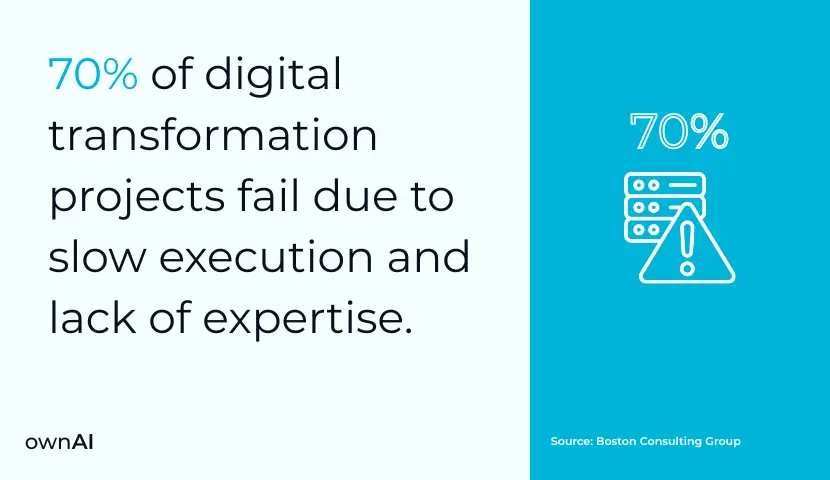
Build an in-house team too early, and you may spend months hiring, setting up, and still struggle to deliver results.
On the other hand, relying completely on an AI development company, you might move fast but lose control over long-term capabilities.
Both approaches can work. But they come with very different trade-offs.
That's why understanding the difference between the two approaches and which one is suitable for your business is crucial.
In this guide, you'll understand both approaches, key differences between AI development companies vs in-house teams for implementation, where each approach works, and how you can choose the best one for your business.
So, without any further delay, let's dive in!
AI Development Companies vs In-House Teams: Quick Comparison
Here’s the quick difference between AI Development Companies Vs In-House Team for implementation that businesses must know:
| Aspect | AI Development Company | In-House Team |
|---|---|---|
| Speed to Start | Start immediately with ready experts | Takes months to hire and set up |
| Time to Market | Faster due to experience and frameworks | Slower due to the learning curve |
| Cost Structure | Flexible, project-based spending | High fixed costs and ongoing expenses |
| Expertise | Access to diverse, specialized talent | Limited to the hired team’s skills |
| Control | Shared control needs coordination | Full control over decisions and execution |
| Scalability | Easy to scale up or down anytime | Difficult and slow to scale |
| Flexibility | Highly flexible for changing needs | More rigid and long-term focused |
| Risk Level | Lower risk with proven processes | Higher risk due to skill gaps or delays |
| Business Alignment | Needs onboarding to understand context | Deep understanding of internal workflows |
| Best For | Fast execution, MVPs, cost efficiency | Long-term strategy, core AI capabilities |
What is an AI Development Company?
An AI development company is an external team of experts that helps businesses build and use AI without creating everything internally.
Instead of hiring your own data scientists and engineers, you work with specialists who already know how to turn ideas into working AI solutions. They handle everything from planning and model development to deployment and ongoing support.
In simple terms, they help you go from “we want to use AI” to “AI is actually working in our business” faster and with less effort.
Key Services Offered by an AI Development Company
Here are the most important services you can expect:
AI Strategy and Planning: They help you identify where AI fits in your business and create a clear roadmap to implement it step by step.
Custom AI Solution Development: Build tailored AI systems designed specifically for your business problems instead of using generic tools.
Machine Learning Model Development: Create and train micromodels that can predict outcomes, detect patterns, and support smarter decision-making.
Generative AI Solutions: Develop tools that can generate content like text, images, or code based on your business needs.
Chatbots and Conversational AI: Build intelligent assistants that handle customer queries, automate support, and improve user experience.
Computer Vision Solutions: Enable systems to analyze images and videos for tasks like detection, recognition, and automation.
AI Integration with Existing Systems: Connect AI solutions with your current tools like CRM, ERP, or internal platforms for smooth operation.
Model Deployment and Ongoing Optimization: Ensure AI systems run efficiently after launch with continuous monitoring, updates, and improvements.
6 Benefits of Hiring an AI Development Company
Here are six major benefits of hiring an AI development company:
1. Instant Access to Expert Talent
You don’t need to spend months hiring or worrying about skill gaps. You get a complete team of experienced AI professionals who already know how to solve real AI challenges, which saves time and avoids early mistakes.
2. Faster Time to Market
AI development companies come with ready frameworks, tools, and workflows. This allows you to move quickly from idea to execution, helping you launch faster and capture opportunities before competitors.
3. Cost Efficiency Without Heavy Investment
Instead of investing in hiring, training, and infrastructure, you pay for the work delivered. This keeps your costs predictable and makes it easier to start AI projects without large upfront spending.
4. Easy Scalability and Flexibility
Your AI needs will change over time. With an external partner, you can scale resources up or down based on demand without dealing with hiring or downsizing challenges.
5. Proven Experience Across Industries
These companies have already worked on multiple use cases. They bring practical knowledge of what works and what doesn’t, helping you avoid trial and error and build better solutions faster.
6. Lower Risk of Failure
AI projects can fail due to poor planning or execution. With experienced teams and tested processes, AI development companies reduce risks and ensure smoother delivery and better outcomes.
5 Drawbacks of Hiring an AI Development Company
Here are five major drawbacks of hiring an AI development company:
1. Limited Direct Control
Since the team is external, you are not involved in the day-to-day decisions. This can make it harder to monitor progress closely or make quick changes unless communication is well structured.
2. Risk of Long-Term Dependency
If knowledge transfer is not planned properly, you may rely on the partner for updates, maintenance, and future improvements, which can limit your internal capability over time.
3. Data Security and Privacy Concerns
Working with an external team often means sharing sensitive business or customer data. Without proper agreements and safeguards, this can create risks around data protection and compliance.
4. Communication and Alignment Challenges
If expectations, goals, or workflows are not clearly defined, it can lead to misunderstandings. This may slow down progress or affect the quality of the final solution.
5. Choosing the Wrong Partner
Not every AI company delivers real value. Selecting an AI development company without proper evaluation can result in delays, poor implementation, and wasted investment.
What is an In-House Team?
An in-house AI team is a group of full-time employees within your organization who are responsible for building, managing, and improving AI solutions internally.
These teams typically include data scientists, machine learning engineers, and AI specialists who work closely with your business, understand your workflows, and align every solution with your goals.
The key advantage is ownership. You have complete control over your data, models, and decision-making, and all knowledge stays within your company.
In simple terms, an in-house team means developing your AI capabilities from within, with a long-term focus on control, customization, and continuous growth.
6 Benefits of an In-House AI Team
Here are some key benefits of having an in-house AI team:
1. Full Control and Ownership
You have complete control over how AI is built, used, and improved. All data, models, and decisions stay within your organization, which is especially important if AI is central to your product or strategy.
2. Strong Business Alignment
Your internal team understands your processes, customers, and goals deeply. This helps them build solutions that actually fit your business instead of generic systems that need adjustments later.
3. Better Data Security
Since everything is handled internally, sensitive data does not need to be shared with external parties. This reduces the risk of leaks and makes it easier to meet compliance and privacy requirements.
4. High Level of Customization
In-house teams can build AI exactly the way your business needs it. You are not limited by external constraints, which allows you to create more tailored and effective solutions.
5. Long-Term Capability Building
Over time, your team builds strong internal expertise. This knowledge stays within your company and becomes a long-term advantage as your AI systems grow and improve.
6. Faster Internal Collaboration and Iteration
Working within the same organization makes communication easier. Your team can quickly test ideas, make changes, and solve problems without delays, leading to faster improvements.
5 Drawbacks of an In-House AI Team
Here are some major drawbacks of having an in-house AI team:
1. High Cost and Ongoing Investment
Building an internal AI team is expensive. You need to invest in salaries, hiring, training, tools, and infrastructure. These costs continue long-term, even if projects slow down or change.
2. Difficulty Hiring and Retaining Talent
AI professionals are in high demand and hard to find. Hiring the right people can take months, and even after that, retaining them is a challenge as competitors offer better opportunities.
3. Slow Time to Get Started
Creating a team from scratch takes time. From recruitment to onboarding and setup, it can take several months before you even begin building real AI solutions.
4. Limited Expertise Across All Areas
AI includes multiple domains like machine learning, NLP, and computer vision. A small in-house team may not have deep expertise in all areas, which can limit what you can build.
5. Risk of Underutilization and Wasted Investment
If priorities change or projects slow down, your internal team may not be fully utilized. This makes it a costly investment that does not always deliver consistent returns.
AI Development Companies vs In-House Teams: In-Depth Comparison
Let’s do a detailed comparison between AI development companies vs in-house team for implementation and find out which is best suited for your business:
1. Cost Structure and Financial Commitment
Working with an AI development company converts high fixed costs into flexible spending. You don’t need to invest in hiring, infrastructure, or long-term salaries. Instead, you pay for defined outcomes or project phases. This makes it easier to start, control budgets, and reduce financial risk, especially when you are still validating AI use cases.
An in-house team requires a significant upfront and ongoing investment. You need to hire expensive talent, set up infrastructure, and continuously spend on tools, training, and retention. These costs remain constant regardless of project output, which makes it a long-term financial commitment rather than a flexible option.
2. Speed of Execution and Time to Market
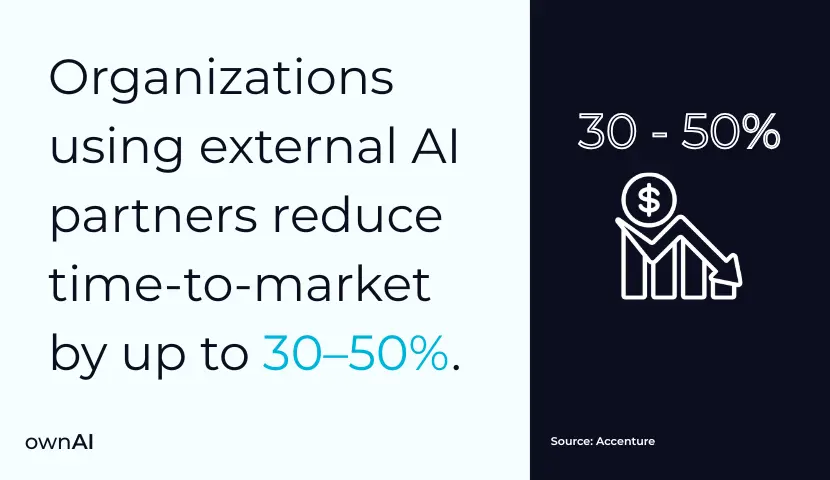
External teams are built for execution. They already have the talent, frameworks, and workflows in place, which allows them to start immediately and deliver faster. This speed helps you test ideas quickly, launch sooner, and take advantage of market opportunities before competitors.
Building internally takes time. Hiring alone can take months, followed by onboarding, system setup, and alignment with business goals. This delay slows down execution and can result in missed opportunities, especially in fast-moving industries where speed directly impacts growth.
3. Depth of Expertise and Innovation Capability
You gain access to specialists across multiple AI domains like machine learning, NLP, computer vision, and MLOps. These teams have already worked on different industries and use cases, so they bring proven approaches and avoid common mistakes. Their exposure helps you build better solutions faster.
Your capabilities depend entirely on who you hire. While internal expertise grows over time, early-stage teams often lack diversity in skills. Keeping up with rapidly evolving AI technologies also requires continuous learning and investment, which can slow down innovation.
4. Control, Customization, and Intellectual Property
You get tailored solutions, but control is shared. Execution depends on communication, contracts, and alignment. While good partners ensure transparency and security, decision-making is not entirely in your hands, and ownership needs to be clearly defined.
You have complete ownership of your data, models, and systems. Everything is built according to your standards and stays within your organization. This is critical if AI is part of your core product, involves sensitive data, or needs strict compliance and governance.
5. Scalability and Operational Flexibility
External partners offer high flexibility. You can scale resources up when demand increases and scale down when the work is done. This allows you to adapt quickly without worrying about hiring delays or long-term commitments.
Internal teams are harder to scale. Hiring new talent takes time, and reducing team size is not easy. This lack of flexibility can increase operational pressure and make it difficult to respond quickly to changing business needs.
6. Risk, Maintenance, and Long-Term Sustainability
They reduce execution risk by using proven processes, experienced teams, and structured delivery models. They also handle maintenance, monitoring, and optimization, ensuring your systems perform well over time. However, dependency can become a concern if knowledge transfer is not planned.
You take full responsibility for everything, from development to maintenance. While this builds strong internal capability over time, it also increases risk. Skill gaps, employee turnover, or poor planning can slow progress and impact outcomes.
How to Decide Which Is the Right One? 6 Key Factors
Here are six factors to consider while choosing the right approach for your business between AI development companies vs in-house team for implementation:
1. Speed to Execution
If your goal is to launch quickly, test ideas, or capture market opportunities, an AI development company is the better choice. They are ready to start and deliver faster. In-house teams take time to hire, set up, and align before any real progress begins.
2. Role of AI in Your Business
If AI is a core part of your product or long-term strategy, building an in-house team gives you better control and ownership. If AI is mainly used to improve operations or add features, an external partner can handle it efficiently.
3. Budget and Cost Structure
AI development companies help you avoid heavy upfront investment and keep spending flexible. In-house teams require continuous investment in salaries, tools, infrastructure, and training, which makes it a long-term financial commitment.
4. Internal Expertise and Capability
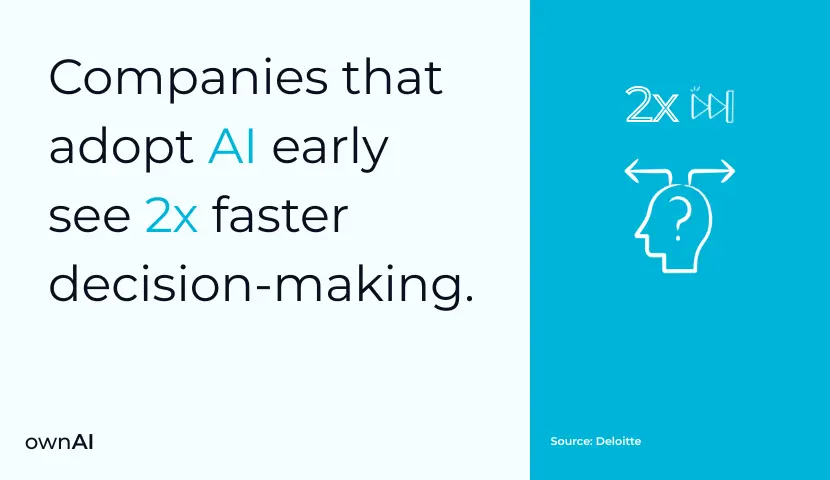
If you don’t already have experienced AI talent, building internally can slow you down and increase the risk of mistakes. External partners bring proven expertise, helping you move faster and build the right solutions from the start.
5. Scalability and Flexibility
Business needs change over time. AI development companies allow you to scale resources up or down easily based on demand. In-house teams are harder to adjust, as scaling requires hiring and downsizing is not simple.
6. Control, Ownership, and Risk
In-house teams give you full control over data, models, and decisions, which is important for sensitive or core systems. External partners reduce execution risk and speed up delivery, but require proper coordination to maintain alignment and ownership.
AI Development Companies vs In-House Teams: Which One Is Best?
There is no single right answer. The right choice depends on where your business is today and what you need from AI right now. Here’s how to decide clearly between AI development companies vs in-house team for implementation:
Choose an AI development company if:
- You want to launch AI quickly without spending months on hiring and setup
- You don’t have internal AI expertise and want to avoid costly mistakes
- You prefer flexible, project-based costs instead of long-term commitments
- Your goal is to test ideas, build MVPs, or validate use cases fast
- You need the ability to scale resources up or down based on demand
Choose the in-house team if:
- AI is a core part of your product or long-term business strategy
- You need full control over data, models, and decision-making
- You are ready to invest in hiring, infrastructure, and ongoing development
- Your AI needs are continuous and not limited to short-term projects
- You want to build internal expertise and long-term competitive advantage
Why Businesses Trust ownAI for AI Implementation?
Most businesses don’t struggle with ideas. They struggle with turning those ideas into something that actually works.
ownAI bridges that gap.
The approach is simple. Understand your business first, identify what actually needs to be built, and then deliver AI solutions that work in real conditions, not just on paper.
Here is what makes ownAI a trusted AI partner:
- Built for execution, not just strategy
- Faster path from idea to implementation
- Strong product and engineering mindset
- Clear focus on business outcomes
- End-to-end support without complexity
If you are serious about implementing AI but want to avoid delays, wasted investment, or trial and error, the right partner makes all the difference.
Book a free consultation with our AI experts today and get a clear, practical path to turn your AI idea into a working solution.
Conclusion
Choosing between AI development companies vs in-house teams for implementation is not about which is better. It is about what fits your business right now.
If you move too early with an in-house team, you risk spending time and money without real results. If you rely only on external partners without a plan, you may lose control in the long run. The key is to understand your current stage, your goals, and how fast you need to move.
For most businesses, the smartest approach is to start with speed, learn what works, and then build capabilities over time. This helps you avoid costly mistakes while still moving forward with confidence.
We hope this guide helped you clearly understand the difference between AI development companies vs in-house teams for implementation, and how to choose the right partner from the AI development companies list for your business.
Now the next step is to hire an experienced AI development company and let the professionals help you from scratch.
FAQs
1. Should I start with an AI development company or build an in-house team first?
In most cases, starting with an AI development company is the smarter move. It helps you avoid early hiring mistakes, test real use cases, and see what actually works before committing heavy resources. Once you have clarity on where AI delivers value, you can decide whether to build an in-house team for long-term ownership.
2. What costs do businesses usually underestimate in an in-house AI setup?
Most businesses only think about salaries, but the real cost goes much deeper. Hiring takes time, infrastructure is expensive, cloud usage grows quickly, and tools, data pipelines, and ongoing training add continuous expenses. Even if your AI projects slow down, these costs don’t stop, which makes it a long-term financial commitment.
3. How quickly can I see results with each approach?
With an AI development company, you can start building within days and see early results in a few weeks, especially for MVPs or pilot projects. In-house teams take much longer because you first need to hire, onboard, set up systems, and align everything. In reality, it can take several months before you see meaningful output.
4. When does it make sense to invest in an in-house AI team?
It makes sense when AI is no longer an experiment but a core part of your business. If your product depends on AI, requires continuous improvement, and needs deep customization, then building an in-house team gives you better control and long-term value.
5. What kind of AI projects are better handled by external partners?
Projects that need speed, clarity, and quick validation are best handled externally. This includes MVPs, automation use cases, data-driven insights, and early-stage AI initiatives. External teams help you move faster and avoid trial and error during the most critical phase.
6. How can I avoid dependency on an external AI partner?
Dependency happens only when you don’t plan ahead. Keep your internal team involved, ask for proper documentation, and ensure knowledge transfer is part of the process. This way, you can take control whenever needed instead of relying completely on the partner.
7. What is the biggest risk if I choose the wrong approach?
The biggest risk is wasting time and money without getting results. Building in-house too early can delay everything and drain resources. Choosing the wrong partner can lead to poor execution. In both cases, you lose momentum, which is critical when adopting AI.
8. Do most businesses stick to one approach or combine both?
Most successful businesses don’t rely on just one approach. They start with an AI development company to move fast and reduce risk, then gradually build in-house capabilities as they grow. This gives them the best of both worlds, i.e., speed in the beginning and control in the long run.





 Turn your idea into MVP in 8-16 weeks