


AI is no longer an experiment for most businesses. It is a serious investment that can improve efficiency, reduce operational costs, and support better decision-making.
But success with AI does not start with tools or models. It starts with choosing the right partner.
Many companies rush into AI development and hire too quickly. Some bring in individual consultants, while others consider an AI consulting firm. While both offer AI expertise, they serve very different purposes.
Understanding AI consultant vs AI consulting company differences helps you choose the right model based on your current stage, goals, and readiness.
An AI consultant acts as a focused specialist. One expert helping you think clearly and avoid mistakes.
An AI consulting company acts as a delivery partner. A full team that can design, build, and scale AI systems end-to-end.
Knowing the difference early saves time, money, and frustration.
In this guide, you will learn:
- What an AI consultant does
- What an AI consulting company does
- Their roles and responsibilities
- Key differences between the two
- Pros and cons of each option
- Cost considerations
- How to choose the right fit for your business
So, without any further delay, let’s dive in.
What is an AI Consultant?
An AI consultant is a strategic expert who helps businesses make the right decisions about artificial intelligence before any development begins.
Their role is not to build AI models or sell tools. It is to bring clarity where confusion exists.
AI consultants work closely with founders, leaders, and decision makers to understand business problems first. Only then do they evaluate whether AI is actually needed.
In many cases, they help companies avoid AI altogether when simpler solutions deliver better results.
They focus on asking the hard questions, like:
- What problem are you solving?
- Is the data good enough?
- Will AI create measurable value?
This is where many AI projects fail, not because of technology. But the decision to use AI was never validated.
An AI consultant helps prevent this mistake. They assess readiness, identify high-impact use cases, and define a realistic AI roadmap that aligns with business goals.
In simple terms, an AI consultant helps you think clearly, spend wisely, and avoid building the wrong thing.
Key Responsibilities of an AI Consultant
Strategic AI Roadmapping: Look at how your business works today and where AI can actually help. Builds a clear plan so AI supports real goals, not guesswork.
Use Case Identification: Finds AI opportunities that solve real problems. Removes ideas that sound exciting but deliver little value.
Tool and Vendor Selection: Helps you choose AI tools and partners that fit your needs. Prevents costly mistakes with tools that are too complex or unnecessary.
Feasibility and ROI Assessment: Checks if your data, systems, and budget are truly ready. Helps you decide if AI is worth the investment before moving forward.
Implementation and Proof of Concept Guidance: Supports early pilots and planning. Ensures AI solutions work in real workflows, not just in demos.
Training and Adoption Enablement: Helps your team understand and trust AI tools. Makes adoption smoother by building confidence and practical skills.
What is an AI Consulting Company?
An AI consulting company helps businesses turn AI ideas into working solutions that run in the real world.
They are not just advisors. They are builders and executors.
Instead of focusing only on strategy, an AI consultant company goes beyond strategy and takes care of execution.
They design, build, and deploy AI systems using a full team of engineers, data experts, and project managers.
These AI companies are usually hired when a business already knows what it wants from AI and is ready to act. The goal is no longer exploration. The goal is execution, reliability, and scale.
Simply put, an AI consulting company helps you move from planning to production and makes sure AI actually works inside your business.
Key Responsibilities of an AI Consulting Company
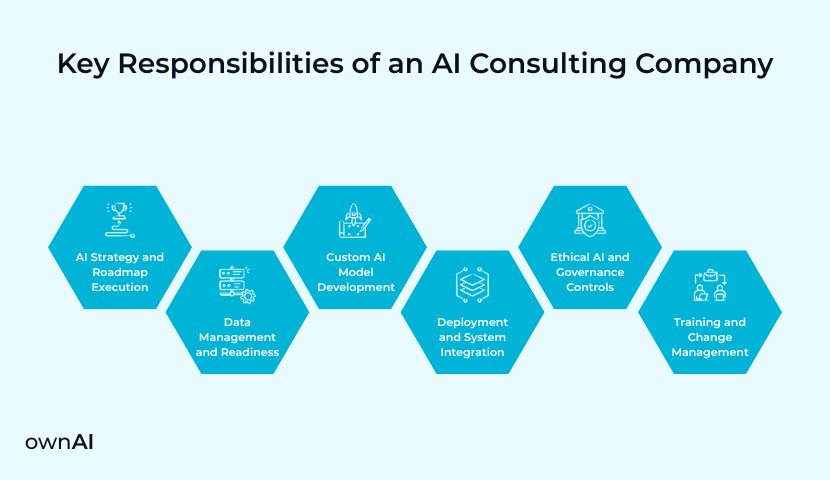
AI Strategy and Roadmap Execution: Evaluates business needs and defines a clear, phased AI plan. Keeps execution aligned with measurable ROI and long-term goals.
Data Management and Readiness: Audits, cleans, and prepares data for AI training. Ensures models are built on accurate and reliable data.
Custom AI Model Development: Designs and builds AI solutions tailored to real business problems. Focuses on production-ready models, not experiments.
Deployment and System Integration: Deploys AI solutions into live environments. Integrates them smoothly with existing tools and infrastructure.
Ethical AI and Governance Controls: Implements privacy, security, and bias prevention frameworks. Protects the business from compliance and reputational risks.
Training and Change Management: Trains teams to use AI tools effectively. Supports adoption and helps teams transition to AI-driven workflows.
AI Consultant Vs AI Consulting Company Differences
Here’s the in-depth AI consultant vs AI consulting company differences you need to know:
| Factor | AI Consultant | AI Consulting Company |
|---|---|---|
| Core Purpose | Helps businesses decide if AI makes sense and where it can add value | Helps businesses build, deploy, and operate AI systems in real environments |
| When to Hire | Hired early when ideas are still being explored or validated | Hired when the business is ready to execute and scale AI |
| Scope of Work | Focuses on strategy, assessment, and decision support | Handles strategy, plus full implementation and ongoing support |
| Execution Ownership | Shares recommendations but does not own delivery | Owns delivery and ensures solutions work in production |
| Team Structure | Usually, one expert or a small advisory group | A full team with engineers, data experts, and delivery managers |
| Data and Systems | Reviews existing data and systems to assess readiness | Builds data pipelines and integrates AI into live systems |
| Scalability Support | Limited involvement as systems expand | Designed to support growth across teams and functions |
| Governance and Compliance | Advises on responsible and compliant AI use | Implements monitoring, controls, and compliance frameworks |
| Cost Level | Lower initial spend with advisory-based pricing | Higher investment due to delivery and team involvement |
| Best Fit For | Businesses seeking clarity before investing | Businesses ready to run AI across the organization |
Pros and Cons of an AI Consultant
Pros
Specialized AI Expertise: Access to experienced AI professionals without the cost and commitment of building a full in-house team.
Faster Strategic Clarity: Helps businesses quickly understand where AI fits and what problems it should solve.
Lower Long-Term Commitment: Short-term engagements reduce hiring risk and keep costs controlled.
Objective Outside Perspective: Brings unbiased insights and challenges assumptions that internal teams may overlook.
Value Focused Decision Making: Prevents investment in AI initiatives driven by trends rather than real business value.
Cons
Can Be Expensive Short Term: Hourly or project-based fees can add up quickly, especially for longer engagements.
Limited Understanding at First: Consultants need time to fully understand internal processes, teams, and culture.
Risk of Dependency: Progress may slow if knowledge is not properly transferred after the engagement ends.
Data and Security Concerns: Sharing sensitive business data requires strong privacy and protection measures.
Possible Internal Resistance: Teams may hesitate to accept direction from external advisors without clear communication.
Limited Hands-On Technical Depth: Some consultants focus on strategy and may not be fully aware of current LLM limitations, tooling constraints, or real-world development practices.
Pros and Cons of an AI Consulting Company
Pros
Immediate Access to a Skilled AI Team: You get experienced engineers and specialists without spending months on hiring and training.
Faster Execution and Delivery: Proven processes help move AI projects from planning to production much more quickly.
End-to-End Ownership: The AI consulting company takes responsibility for building, deploying, and running AI systems.
Lower Technical Risk: Complex architecture, integration, and deployment are handled by experienced professionals.
Built-in Compliance and Security: Teams follow data privacy and governance practices to reduce legal and reputational risk.
Cons
High Upfront Investment: Initial costs can be high, especially for small or short-term projects.
Dependence on External Teams: Long-term reliance may slow down internal skill development.
Limited Understanding of Internal Culture: External teams need time to fully understand business workflows and decision styles.
Reduced Day-to-Day Control: Outsourcing execution means less direct involvement unless communication is tightly managed.
System Integration Complexity: Connecting new AI solutions with older systems can be challenging and time-consuming.
Why Consulting First Makes Every AI Project Smarter?
Here are five reasons why consulting services makes every AI project smarter:
1. Strategic Clarity
Consulting helps businesses think before they act. It brings clarity on what problem AI should solve. It also helps decide if AI is even needed. This avoids building solutions with no real business value.
2. Faster Execution
Clear direction saves time. Consulting defines goals early. Teams know what to build and why. This reduces rework and speeds up delivery.
3. Cost Control
AI can get expensive very fast. Consulting helps validate ideas early. It prevents spending money on the wrong tools or projects. Budgets stay under control.
4. Lower Risk and Stronger Compliance
AI deals with sensitive data. Consulting helps businesses follow privacy rules. It also reduces ethical and legal risks. This protects the company as AI scales.
5. Better Adoption Through Knowledge Transfer
AI only works when people use it. Consulting helps teams understand AI tools. Training builds trust and confidence. This ensures long-term success.
How to Choose Between an AI Consultant vs AI Consulting Company?
Here are some key factors that help you decide which one to choose:
1. Clarity of Your AI Goals
If you are still unsure what AI should solve, start with a consultant. They help define the problem and direction. If goals are already clear, a consulting company can move straight to execution.
2. Project Size and Complexity
Small or focused initiatives work well with a consultant. Large projects with multiple systems need a consulting company. Complexity increases the need for a full team.
3. Data Readiness
Messy or incomplete data needs guidance first. A consultant helps prepare and validate it. Clean and ready data allows a consulting company to execute faster.
4. Internal Skills and Capability
If your team lacks AI knowledge, consulting helps with decisions. If your team lacks delivery capacity, a consulting company fills that gap.
5. Speed and Timeline Pressure
When speed matters but direction is unclear, consulting comes first. When speed matters, and plans are defined, a consulting company delivers faster.
6. Budget and Risk Comfort
Limited budgets benefit from early consulting. It reduces risk and waste. Approved implementation budgets suit consulting companies that focus on delivery and scale.
6 Key Questions to Ask Your Business
1. What business problem are we trying to solve with AI?
If the problem is not clear, AI will not deliver value. This question keeps decisions grounded in real outcomes.
2. Are our AI goals clear, or are we still exploring possibilities?
Clear goals point toward execution. Unclear goals signal the need for consulting first.
3. Do we have the right data to support AI initiatives?
AI depends on data quality and availability. Without it, even the best models will fail.
4. Do we have the internal expertise to execute and manage AI?
If knowledge is missing, consulting helps. If execution capacity is missing, a consulting company is needed.
5. What timeline are we working with?
Short timelines with unclear direction need clarity first. Defined goals with urgency require execution support.
6. How will we measure success and ROI?
Without clear success metrics, AI projects lose direction. This question ensures accountability from day one.
Cost Analysis: AI Consultant vs AI Consulting Company
Cost plays a major role when understanding between an AI consultant vs AI consulting company differences. The difference is not just in price. It is also in how and when you spend.
Initial Investment
AI consultants usually require a lower starting budget. They often work hourly or on short engagements. This makes it easier to control early costs.
AI consulting companies need a higher upfront investment. This includes planning, team allocation, and detailed project setup.
Ongoing Expenses
With an AI consultant, spending usually ends once the engagement is complete. You pay again only if further guidance is needed.
With an AI consulting company, costs continue over time. These include development work, system updates, monitoring, and ongoing support.
Cost Predictability
Consultant costs are flexible but can vary based on time and scope changes. This suits early exploration and decision-making.
AI Consulting companies usually work with fixed pricing or milestones. This offers better visibility for larger and long-term projects.
Return on Investment
AI consultants deliver value by helping you avoid poor decisions. This often leads to faster short-term benefits and lower risk.
AI consulting companies focus on long-term value. They build AI systems meant to scale and support the business over time.
Why Do Businesses Choose ownAI for AI Solutions?
Businesses do not partner with AI companies for ideas alone. They partner for results.
ownAI helps companies turn AI ambition into systems that actually work.
But before proposing any solution, ownAI first evaluates whether AI is truly needed. If AI does not add clear business value, we do not recommend building it.
What makes ownAI different?
- End-to-End Ownership With Clear Accountability
- AI Driven by Business Outcomes
- Production Ready AI for Real World Operations
- Built to Scale Without Rework
- Security and Compliance at the Core
Whether you are starting with AI or scaling existing initiatives, ownAI brings clarity before execution and accountability throughout delivery.
If you want AI that delivers results, not just promises, this is the right place to start.
👉 Book a free consultation with ownAI experts today and get a clear plan for how AI can work for your business.
Conclusion
Choosing between an AI consultant and an AI consulting company is not about which option sounds better. It is about what your business truly needs right now.
If you are still figuring out where AI fits, an AI consultant helps bring clarity. They help you think before you build and avoid costly mistakes.
If your goals are clear and you are ready to move forward, an AI consulting company helps turn plans into working systems. They bring the team and structure needed to deliver results at scale.
Many AI projects fail because businesses rush this decision. They move too fast without direction or invest before validating their ideas.
We hope this guide helped you clearly understand the AI consultant vs AI consulting company differences and make a more confident choice. The right partner at the right time can make all the difference in your AI journey.
Now, it's your turn to find the right AI partner and let the professional handle your work.
FAQs
1. Should I start with an AI consultant or an AI consulting company?
Start with an AI consultant when you are unsure about direction. They help you understand the problem and decide if AI is the right solution. This step prevents wrong investments. An AI consulting company is the right choice only when the problem is clear, and you are ready to build and scale.
2. How do I know if my business is ready to use AI?
Your business is ready when three things are clear. You know the exact problem you want to solve using AI. You have authenticated & right data to share with LLM which relates closely to that problem. You also know how success will be measured. If any of these are missing, AI will struggle to deliver value.
3. What happens if I skip AI consulting and go straight to execution?
Most businesses end up building something that looks impressive but solves nothing. This happens because assumptions were never validated. Data gaps appear later. Direction changes midway. Fixing these issues after execution costs more time and money.
4. Is AI consulting useful for small or mid-sized businesses?
Yes. It is often more important for them. Smaller teams have limited budgets and less room for mistakes. Consulting helps them focus on one high-impact use case instead of trying to do everything at once.
5. How much data do I need before starting an AI project?
There is no universal number. What matters is whether the data is clean, relevant and authentic. Poor-quality data leads to poor results. Even smaller datasets can work well when they are accurate and aligned with the problem.
6. How long does it take to see results from AI consulting or implementation?
AI consulting usually delivers clarity within a few weeks. You quickly understand what is possible and what is not. Implementation takes longer because systems need to be built and adopted. Clear planning always reduces delays later.
7. Will my internal team be able to manage AI systems after delivery?
Yes, if knowledge transfer is planned from the start. Training and documentation help teams understand how systems work. This reduces long-term dependency on external partners and builds internal confidence.
8. How should success and ROI be measured in AI projects?
Success should be measured by business impact. Look at the time saved, costs reduced, and better decisions being made. Technical metrics matter less if business outcomes do not improve.





 Turn your idea into MVP in 8-16 weeks