


In the last three years, thousands of companies have invested in artificial intelligence, expecting massive efficiency gains.
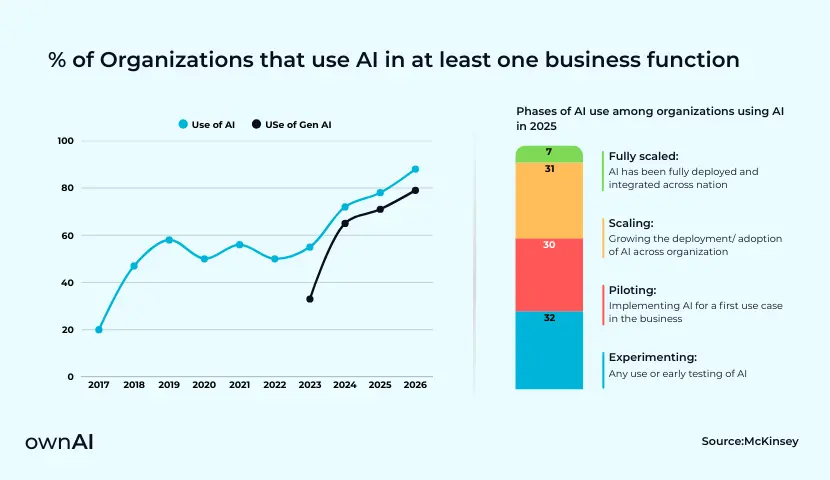
In fact, a recent McKinsey report shows that 78% of organizations have already integrated at least one AI solution into their business operations.
If you're wondering how to choose a top AI consulting firm, you're not alone. Many companies invest in AI but struggle to select the right partner who can deliver real business value.
This guide explains exactly how to evaluate and choose the right AI consulting firm, including technical criteria, red flags, cost expectations, and a practical framework.
So, without any further delay, let’s dive in!
Why Choosing the Right AI Consulting Partner is Crucial for Success?
Here are five reasons why choosing the right AI consulting firm is crucial for success:
Tailored Strategy and ROI: A qualified partner aligns AI initiatives with specific KPIs, such as increased revenue, reduced costs, and improved customer experience, rather than offering one-size-fits-all solutions.
Domain Knowledge and Risk Management: They understand specific market dynamics, regulatory compliance, and data privacy issues (e.g., GDPR, ethical AI), which prevents legal penalties and reputation damage.
Faster Time-to-Market and Scalability: They provide access to specialized talent and agile methodologies that accelerate deployment and ensure systems can grow with the business.
Technical Proficiency and Data Governance: The right partner navigates complex IT infrastructure, manages data quality, and integrates AI tools effectively, avoiding failed pilot projects.
Change Management and Adoption: They ensure that AI solutions are not just technically sound but also embraced by employees, maximizing the return on investment.

5 Core Technical Capabilities Every AI Consulting Firm Must Have
Choosing the right AI consulting firm is a critical strategic decision, as 85% of AI projects fail without the proper expertise, often resulting in wasted budgets and unscalable prototypes.
A strong partner brings specialized skills in machine learning (ML), data engineering, and MLOps, bridging the gap between academic AI concepts and production-ready business solutions.
Here are the key technical qualities and criteria to look for in an AI development partner:
1. Technical Expertise and AI-Specific Capability
Full-Stack AI Skills: Proficiency in Machine Learning (ML), Deep Learning (DL), Natural Language Processing (NLP), and Computer Vision.
Modern AI Architectures: Experience with LLMs, retrieval-augmented generation (RAG) systems, and agentic AI frameworks.
Framework Fluency: Expertise in PyTorch, TensorFlow, JAX, and Hugging Face.
MLOps and Production Readiness: Ability to move beyond Proof of Concept (POC) to deployment, monitoring, and retraining to handle "model drift".
Cloud Infrastructure: Proven experience with major cloud platforms (AWS, Azure, GCP).
2. Proven Track Record and Measurable Outcomes
Industry-Specific Experience: Look for partners who understand your sector's unique data patterns, regulatory requirements, and operational workflows.
Case Studies with ROI: Evidence of previous projects, focusing on metrics such as cost reduction, efficiency gains, or revenue growth, rather than just technical descriptions.
Long-Term Support: Experience in maintaining, monitoring, and optimizing AI systems post-deployment.
3. Data Governance, Security, and Ethics
Regulatory Compliance: Strict adherence to GDPR, HIPAA, or CCPA, especially for sensitive data.
Security by Design: Implementation of data anonymization, encryption at rest and in transit, and secure data handling.
Ethical AI Practices: Processes to identify and mitigate bias in AI models, ensuring fair and transparent outcomes.
Intellectual Property (IP) Protection: Clear contracts stating that custom models and code belong to your business.
4. Strategic Approach and Collaboration
Production-First Mindset: A partner who focuses on scalability, data latency, and edge-case handling from day one, rather than just building a demo.
Strategic Advisory: They should help define the right AI use cases and validate feasibility before writing code.
Transparent Communication: Regular, documented updates and collaborative workflows (e.g., Agile, Scrum).
Flexibility: Adaptability to change project scope based on real-world results and evolving technologies.
5. Team Composition and Project Management
Multidisciplinary Teams: A balanced team of AI architects, ML engineers, data engineers, QA specialists, and product managers.
Clear Project Methodology: A structured approach that includes a discovery phase to validate feasibility.
Transparent Pricing: Clear, itemized cost breakdowns including development, infrastructure, and ongoing inference expenses.

What Does an AI Strategy Development Consultant Actually Do?
An AI strategy development consultant acts as a bridge between business goals and technical AI execution, creating actionable and high-ROI AI roadmaps.
They identify key use cases, evaluate and clean data, manage implementation risks (bias/compliance), and upskill teams for adoption.
They ensure AI initiatives drive tangible value and, crucially, improve operational efficiency over time.
Their role involves:
Align AI opportunities with business goals: They analyze your industry, market trends, internal workflows, and customer expectations to identify where AI can create core business value.
Strategic Roadmapping: Assessing current business processes, identifying bottlenecks, and defining which AI tools to adopt and when.
Data Assessment & Governance: Evaluating existing data infrastructure to ensure it is "AI-ready" (clean, accessible, and high-quality) and establishing governance to manage data risks.
Use Case Identification & Prioritization: Analyzing current business problems to identify where AI can offer the highest return on investment (ROI), such as automation, predictive analytics, or enhanced customer experience.
Vendor/Tool Selection: Guiding companies to select the right AI technologies, tools, vendors, and infrastructure.
Training your internal team: AI is only as good as the people using it, so a consulting firm can train employees to maximize AI’s potential, facilitate adoption, and minimize disruption. Forbes has already predicted that 70% of employees across sectors will need reskilling by 2026, and part of this need can be attributed to AI adoption.
Common Pitfalls to Avoid When Choosing an AI Partner
Here are the frequent mistakes to avoid when choosing an AI partner:
Ignoring Domain/Industry Expertise: Selecting a partner without experience in your industry can result in solutions that do not address your unique challenges.
Neglecting Data Security and Privacy: Failing to vet a partner’s security standards can lead to critical data breaches and regulatory non-compliance.
Focusing Only on Cost: Choosing based on the lowest price often leads to subpar, non-scalable, or unsustainable AI tools.
Choosing a firm that only builds prototypes: Some AI consulting firms only build Proof of Concept (PoC) models that never reach production. Always ensure the firm has experience deploying AI systems at scale.
Lack of Clear Objectives: Partnering without a clear vision or measurable KPIs often results in wasted resources and failed initiatives.
Underestimating Change Management: Overlooking the need for organizational change management can lead to low adoption rates and internal resistance.
Ignoring Scalability and Maintenance: Choosing a solution that works for a prototype but cannot handle long-term, enterprise-level scaling.
Ignoring Ethical Considerations: Partnering with companies that do not prioritize fair, transparent, and ethical AI development.
Skipping Post-Project Support: AI isn’t “set it and forget it” - you need continuous improvement.
Top 10 Factors to Consider While Choosing an AI Consulting Firm
If you’re confused how to choose a top AI consulting firm then here are ten key factors to consider while choosing a top AI consulting firm for your business:
1. Industry-Specific Experience
AI solutions are not one-size-fits-all. An AI consulting company that specializes in e-commerce recommendation engines might not be familiar with the specific challenges of AI in financial services or healthcare.
Here’s why industry knowledge matters:
Regulatory Understanding: Different industries have their own set of regulations (such as HIPAA for healthcare or PCI-DSS for payments) that affect how AI systems are built, used, and monitored.
Domain Knowledge: Top AI consulting firms with experience in your industry will understand the terminology, processes, and challenges, which helps speed up the project and reduces mistakes.
Relevant Case Studies: Ask for specific examples of their work in your sector. If they can’t provide these, they might be learning as they go, costing you valuable time and money.
2. Check Client Feedback and Third-Party Reviews
Beyond case studies, client reviews give you an unbiased view of the company’s performance. Look for patterns in feedback, positive or negative, to get a sense of their reliability, communication style, and client satisfaction. Additionally, a portfolio with reputable clients is a good sign of trust and credibility.
3. Verify Expertise in Cloud Deployments
Since most AI systems are deployed on the cloud, ensure the company has experience with cloud platforms like AWS, Google Cloud, or Azure. Their knowledge should cover security, scalability, and performance optimization.
4. Consider Post-Deployment Support
AI systems require continuous support after deployment, including model maintenance, monitoring, updates, and retraining. A partner who offers strong post-launch services shows they care about your long-term success.
5. Focus on Long-Term Value, Not Just Cost
While price is important, the cheapest option isn’t always the best. Focus on long-term value by evaluating factors like scalability, support, and ROI. A low-cost solution could end up costing more in maintenance or lead to poor performance down the line.
6. Time Zone Compatibility and Collaboration
Check the time zone overlap between your team and the AI firm. A reasonable overlap allows for easier communication and faster problem-solving. If there are time zone differences, ensure they have a clear communication plan in place.
7. Understand Pricing Models and Hidden Costs
Top AI consulting companies often have different pricing structures. Be clear about how they charge for AI consulting services:
Fixed Price: Works well for projects with clear requirements, but can be inflexible if the scope changes.
Time and Materials: Offers flexibility but may be harder to predict costs.
Milestone-Based: Ties payments to the completion of specific project stages.
Also, make sure you understand any additional costs like retraining, upgrades, or ongoing support.
8. Ask for References and Track Record
Always ask for client references and take the time to check them. Ask questions like:
- Did the project meet your expectations?
- What was your experience working with this firm?
- Would you work with them again?
Real feedback can provide insight into the company’s reliability and effectiveness.
9. Assess AI Strategy and Problem Discovery Process
Many AI consulting firms start building AI models without fully understanding the real business problem. A reliable AI partner should first run a discovery process to check whether AI is actually the right solution. This step helps ensure the project focuses on solving the right problem from the beginning.
Before development starts, the consulting firm should assess your data, possible AI use cases, and expected business value. They should also evaluate if your systems and workflows can support the AI solution. This discovery phase helps avoid investing in AI projects that may not deliver real results.
10. Assess Communication and Reliability
From the first contact, pay attention to how the company communicates. Do they respond promptly? Are they clear about timelines, costs, and challenges? Do they explain technical concepts in a way that makes sense? Strong communication is key to a successful partnership.
By considering these 10 key factors, you’ll get an idea how to choose a top AI consulting firm for your business.

Red Flags When Choosing an AI Consulting Firm
Choosing the wrong AI consulting firm can lead to failed projects, wasted budgets, and AI systems that never deliver real value.
Recognizing early warning signs can help you avoid unreliable vendors and understand how to choose a top AI consulting firm that can actually deliver scalable AI solutions.
Here are some early warning signs to notice when choosing an AI consulting firm:
Promises unrealistic results: If a firm claims it can transform your business with AI in a very short time, be cautious. Real AI implementations require time for data preparation, testing, and gradual improvement.
No real case studies: A credible AI consulting firm should show real examples of previous projects and measurable results. Without proof of past work, it is difficult to trust their capabilities.
One size fits all approach: AI solutions should be designed around your business processes and data. A generic approach often leads to weak performance and poor outcomes.
Focus only on tools instead of business goals: Some firms talk only about technologies and frameworks. A strong AI partner focuses first on solving real business problems and delivering measurable value.
Lack of industry-specific knowledge: AI use cases differ across industries. A firm without domain experience may struggle to understand your data, regulations, and operational challenges.
Cannot explain AI clearly: Experienced consultants should be able to explain their approach in simple terms. If explanations are confusing, it may indicate a weak understanding.
Vendor lock in risk: Some firms build solutions that force you to rely on their proprietary platforms. This can limit flexibility and increase long term costs.
Guarantees specific results or ROI: No company can guarantee exact model accuracy or ROI in AI projects. Reliable consulting firms focus on strong processes rather than unrealistic promises.
Questions to Ask Before Choosing an AI Consultant Firm
Here are some key questions to ask your potential AI consulting firm:
Can you walk me through a project similar to ours that you completed? What worked well, and what didn’t?
Can you share real AI implementation case studies?
Who will work on our project? Can we meet them before we sign the contract?
What is your process for discovering whether AI is the right solution for our needs?
What happens if the data we have doesn't support the use case we expected?
What will we own once the project ends? Do we get the code, models, and documentation?
Can you share an example of a project you turned down? Why didn’t you move forward with it?
What kind of support do you offer after the initial project is completed? Are there any costs involved?
How do you measure success for a project like ours? What metrics do we track together?
How long do you expect the project to take, and what will it cost?
Which AI technologies and frameworks do you specialize in?
How do you ensure data privacy and security during and after the project?

Benefits of Hiring an AI Consulting Firm
Here are some major benefits of hiring an AI consulting firm:
1. Avoid Expensive AI Project Failures
Many AI projects fail due to poor data, unclear goals, or weak technical planning. AI consultants evaluate these risks early and design a realistic implementation plan. This helps businesses avoid wasted budgets and unsuccessful deployments.
2. Faster AI Implementation and Results
Experienced consultants follow proven frameworks to move from idea to deployment faster. Instead of spending months experimenting, businesses can launch AI solutions more quickly and start seeing measurable value sooner.
3. Align AI With Real Business Objectives
AI should support business outcomes, not just technology adoption. Consultants ensure AI initiatives are tied to goals such as revenue growth, operational efficiency, or improved customer experience.
4. Build a Sustainable Competitive Advantage
A strong AI strategy helps companies build scalable systems that continue improving over time. This allows businesses to innovate faster and stay ahead of competitors using data-driven insights.
5. Smarter Use of Budget and Resources
AI consultants help companies identify the highest impact opportunities first. This prevents businesses from investing in low-value experiments and ensures resources are focused on initiatives that deliver real returns.
6. Reduce Technical, Security, and Compliance Risks
AI systems involve complex risks such as data privacy issues, regulatory requirements, and model bias. Consultants design systems with proper governance, security practices, and compliance controls from the start.
7. Access Deep AI Expertise
Hiring and building an internal AI team takes time and significant investment. Consulting firms provide immediate access to experienced AI engineers, data scientists, and strategists who understand real-world implementation challenges.
8. Improve Operational Efficiency
AI automates repetitive processes, analyzes large datasets, and improves decision-making. This helps organizations reduce manual work, improve productivity, and operate more efficiently.
Real AI Consulting Use Cases Across Industries
AI consulting firms help businesses use AI to improve operations, automate tasks, and make better decisions. Here are some common AI use cases across different industries.
Healthcare: AI analyzes medical images and patient data to help doctors detect diseases faster and improve diagnosis accuracy.
Finance: AI detects fraudulent transactions and unusual activity, helping financial institutions reduce risk and maintain compliance.
Retail: AI recommends products to customers and predicts product demand, helping businesses increase sales and manage inventory better.
Manufacturing: AI predicts equipment failures before they happen, reducing downtime and improving production efficiency.
Customer Support: AI chatbots answer common customer questions instantly, improving response time and lowering support costs.
Marketing: AI analyzes customer data to segment audiences and improve targeting for more effective marketing campaigns.
Cost of Hiring an AI Consulting Firm
The average cost of hiring an AI consulting firm ranges between $100 to $350+ per hour. However, the final cost depends on the project complexity, scope, and the expertise of the consulting team.
Here’s a breakdown of what you can expect to pay:
Hourly Rate Pricing
| Consultant Level | Hourly Rate | Typical Work Scope |
|---|---|---|
| Junior / Entry-Level Consultant | $100 – $250 | Data preparation, simple automation, and basic machine learning tasks. |
| Mid-Level Consultant | $250 – $450 | AI features integrations, moderate NLP models, and predictive analytics solutions. |
| Senior / Expert Consultant | $450 – $700+ | Machine learning systems, AI strategy development, complex models, and large-scale AI implementations. |
Project-Based Pricing
| Project Type | Estimated Cost | Typical Deliverables |
|---|---|---|
| Small Projects / Proof of Concept (POC) | $10,000 - $50,000 | Chatbots, small automation tools, and AI strategy workshops |
| Medium Projects | $50,000 - $200,000 | Custom ML models, integrations, and data pipeline improvements |
| Enterprise Transformation | $200,000 - $1,000,000+ | Enterprise AI systems, organization-wide automation, and large deployments |
Common Pricing Models
| Pricing Model | Typical Cost | Best Use Case |
|---|---|---|
| Hourly Rate | Varies by consultant ($100 - $1,200+) | Flexible scope, research, advisory, or undefined projects |
| Project-Based (Fixed Fee) | Based on the project scope | Clear deliverables and timelines |
| Monthly Retainer | $3,000 - $25,000+ per month | Ongoing AI maintenance, optimization, and fractional AI leadership |
| Value-Based Pricing | 10% - 40% of ROI | Projects where AI produces measurable revenue increases or cost savings |
Why is a Long-Term AI Partner Better than a Short-Term Vendor?
Below are the key reasons why a long-term AI partnership is more effective:
| Factor | Long-Term AI Partner | Short-Term AI Vendor |
|---|---|---|
| Business Alignment | Works closely with your team and aligns AI initiatives with long-term business goals. | Focuses only on completing the specific task defined in the contract. |
| Relationship Type | Builds a long-term partnership and collaborates continuously with your organization. | Operates on a short-term, project-based engagement. |
| Understanding Your Business | Develops a deeper understanding of your workflows, data, and operations over time. | Has a limited understanding of your business environment. |
| AI Lifecycle Support | Supports the full lifecycle, including development, deployment, monitoring, and updates. | Usually responsible only for development and initial delivery. |
| Continuous Improvement | Regularly improves and optimizes AI models to maintain performance and accuracy. | Improvements usually require a new project or contract. |
| Model Maintenance | Continuously monitors model performance and re-trains models when needed. | Maintenance is often not included after project completion. |
| Innovation Support | Proactively suggests new AI opportunities and improvements. | Only delivers what is defined in the project scope. |
| System Integration | Integrates AI with existing tools, platforms, and enterprise data systems. | Integration may be basic or limited to the immediate project. |
| Risk & Compliance | Helps ensure security, data privacy, and compliance standards are maintained. | Focus is primarily on delivering the project. |
| Knowledge Retention | Builds long-term knowledge about your systems and data. | Limited knowledge due to short engagement duration. |
| Cost Efficiency Over Time | Reduces long-term costs through optimization and continuous improvements. | May lead to higher long-term costs due to rework or inefficiencies. |
| Support Availability | Provides ongoing support, monitoring, and updates. | Support may end once the project is delivered. |
| Adaptability | Adjusts AI solutions as business needs evolve. | Changes usually require new agreements or vendors. |
| Long-Term Value | Builds sustainable AI capabilities and competitive advantage. | Delivers short-term results with limited long-term impact. |
Why is ownAI the Best AI Consulting Firm?
AI can transform business operations, but only when it is implemented correctly. That is why selecting the right AI consulting partner is critical for building scalable, reliable, and high-impact AI solutions.
ownAI helps businesses turn AI ideas into scalable, production-ready solutions that deliver real business results.
Their team focuses on solving practical problems, improving efficiency, and building AI systems that align with your business goals.
Why do businesses choose us?
Custom AI for Your Business: AI solutions are designed to fit your specific needs and business processes.
Complete Support from Start to Finish: ownAI handles everything from strategy and development to deployment and ongoing improvements.
Built to Work at Scale: Solutions are designed to grow with your business without extra costs or rework.
Strong Focus on Security: Data protection and compliance are part of every project, keeping your business safe.
Solutions That Deliver Results: Every project aims to improve efficiency, decision-making, and overall business performance.
Clear, Practical Advice: ownAI recommends AI only when it adds real value, avoiding unnecessary or costly projects.
Our team specializes in AI strategy consulting, machine learning development, and enterprise AI integration.
So, if you want AI that actually works and drives results, ownAI is the partner you can trust.
Book a free consultation with our AI experts today to see how AI can transform your business.
Conclusion
Choosing the right AI consulting firm is critical to turning AI investments into real business results. The right partner helps you build scalable solutions, avoid costly mistakes, and achieve measurable outcomes.
We hope this guide helps you understand how to choose a top AI consulting firm and make a confident decision for your AI journey.
Now, it's your turn to follow the given steps, consider the factors, and find a reliable AI consulting firm for your business.
FAQs
1. Why should I define my business needs before hiring an AI partner?
Before engaging with an AI development partner, clearly articulate the problem you want to solve, what data you have, and what success looks like. This ensures alignment and prevents wasted effort or misaligned outcomes.
2. What expertise should the right AI development partner have?
A strong partner must demonstrate technical skills in machine learning, deep learning, NLP, data engineering, and modern AI frameworks, along with experience integrating AI into real business workflows.
3. How can I assess a company’s technical and industry experience?
Evaluate their case studies, portfolio, team certifications, client references, and success stories, especially those in your industry or business context. Look for measurable results and long-term client satisfaction.
4. What are the key risks if I choose the wrong AI partner?
Choosing the wrong partner can lead to project failure, blown budgets, missed deadlines, poor performance, security issues, and solutions that don’t solve your core business challenges.
5. What should I ask during my first consultation?
Ask how they approach AI strategy and discovery, their data security and privacy practices, the process for prototyping and iteration, how they measure success and ROI, and the type of post-launch support and knowledge transfer they provide.
6. How Long Does It Take to Choose an AI Consulting Firm?
Businesses typically spend 2 to 6 weeks evaluating AI consulting firms, reviewing proposals, conducting discovery workshops, and validating technical expertise before selecting a partner.
7. How do I know if my business is ready for AI development?
Your business is ready when the problem you want to solve is clearly defined, the data is clean and relevant, or there is a plan to prepare it, and success metrics are established. AI works best when both goals and data are well understood.
8. How should success and ROI be measured?
Success should be tied to measurable business impact, such as cost reduction, revenue growth, increased efficiency, or better decision-making, rather than technical metrics alone. A strong AI partner will help define KPIs and track performance over time.





 Turn your idea into MVP in 8-16 weeks