


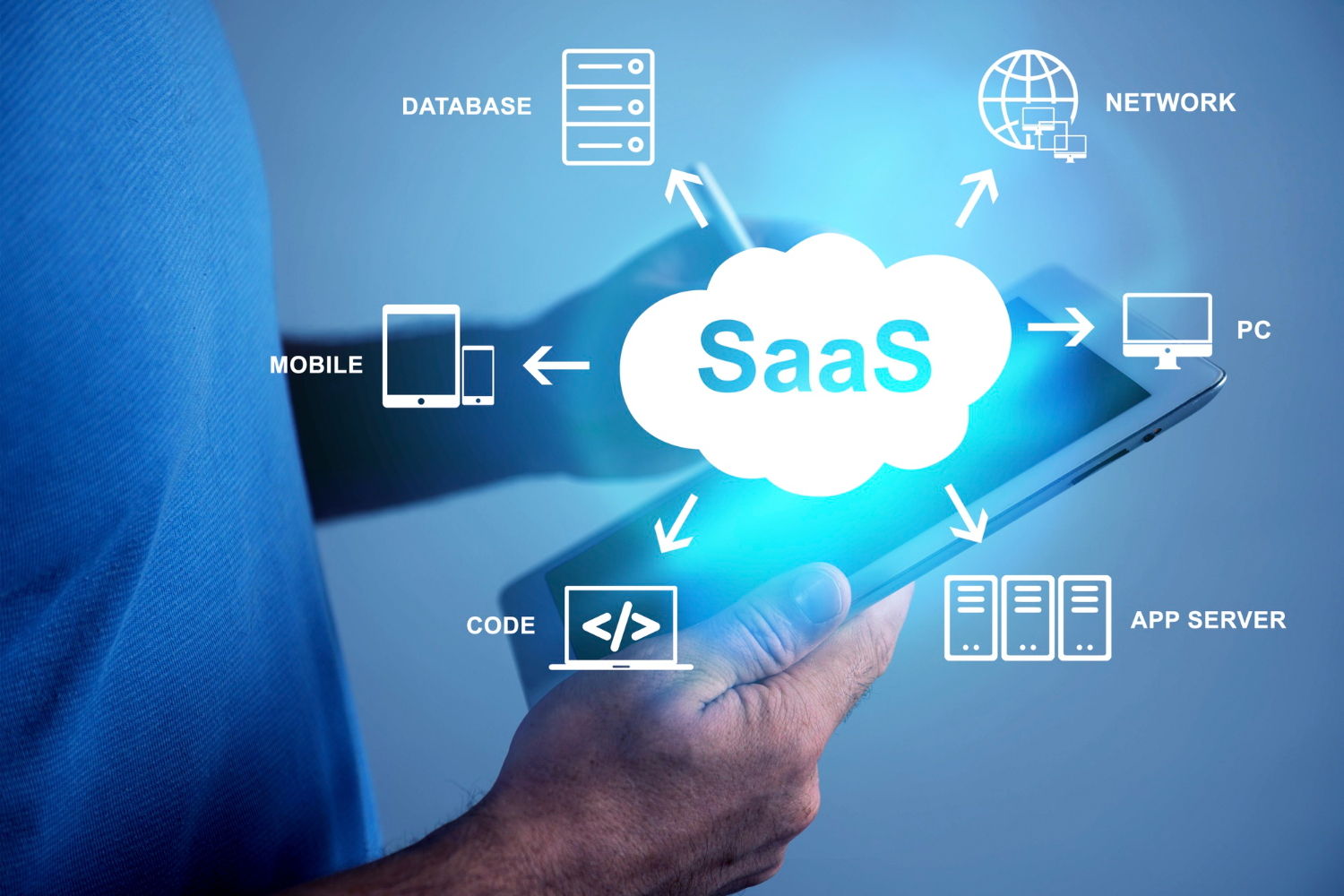
Cloud-based SaaS applications have become a game-changer for businesses and traditional software users across different industries by offering a highly convenient subscription-based software model. The SaaS software concept is gaining massive popularity due to its rich technical abilities and ability to meet users' needs in this high-tech era.
Whether you are just starting a startup or upgrading your existing platform, developing SaaS applications from a reputable SaaS development company is the key to your business growth. At ownAI, our SaaS development experts have decided to share the professional knowledge they got from our development background.
What technical advantages does SaaS application development provide, what are today's SaaS products about, and how do you build a cloud-based SaaS application? Let's find out!
What is Cloud-based SaaS Application?
Software as a Service (SaaS) is a cloud-based method of delivering software to users via the Internet. Any software provided based on the SaaS business model from the cloud is known as a Cloud-based SaaS App. It means users can get a solution with any required functionality that is hosted in the cloud. It doesn't occupy physical storage space and doesn't need to maintain and update and monitor the functioning of hardware software. SaaS applications are usually accessible through mobile and desktop applications and web interfaces.
Due to being cloud-based, the SaaS app enables users to access data from any device and web browser anywhere with an internet connection. Its subscription-based nature frees users from installing it on their devices and setting it up. A cloud computing provider typically maintains its infrastructure, performance parameters, security, and availability. The top SaaS application development companies like ownAI provide end-to-end solutions by developing your idea into a robust and scalable SaaS application.
Some popular and successful SaaS apps are Slack, Salesforce, Google Workspace, Microsoft, Canva, Netflix, Zoom, and Dropbox.
Overview of SaaS Market Stats
The overall SaaS market continues booming rapidly as companies around the world adopt SaaS products for various business functions. Experts claim that the market is growing by $20 billion each year. By the end of 2024, the global SaaS market is estimated to be worth $208 billion and reach $232 billion by 2024, with 86% of leading companies running purely on Software as a Service.
There is no surprise in this bigger jump in saas market cap. Here is the image made by yalantis outlining the difference between SaaS software and traditional licensed based software,
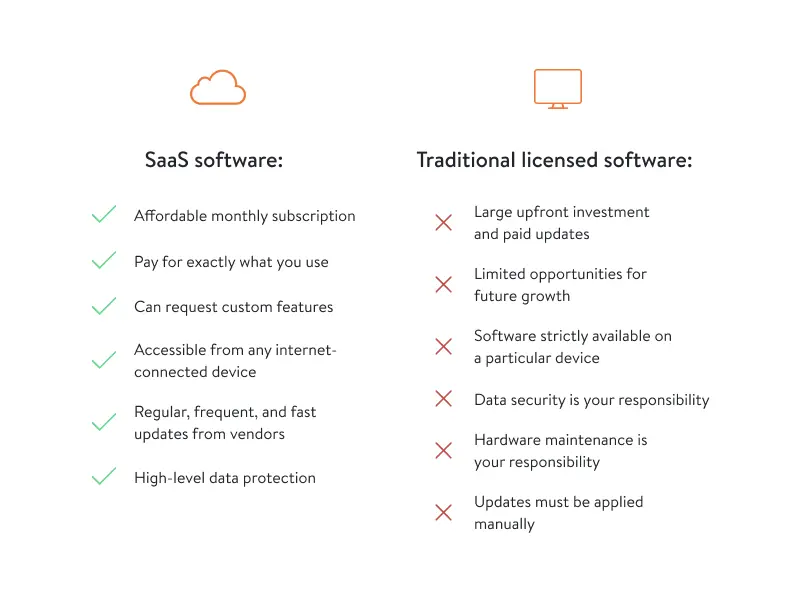
The cost-effective and flexible nature of SaaS applications and the rising need for remote software opportunities are major reasons for their popularity. As organizations and entrepreneurs realize how much more profitable SaaS products can be than traditional software, the number of SaaS providers expands accordingly. Consequently, building cloud-based SaaS apps for your business and customers can be a guaranteed way to create a competitive edge in the long run.
Benefits of Cloud-based SaaS Applications
As we can see from the above stats, the SaaS app development model makes both development and consumption more convenient, cost-effective, and long-term profitable. Cloud computing offers many new opportunities for businesses across different industries, and it'd be wise to take advantage of those options.
There are many significant reasons to develop a cloud-based SaaS app in 2024 from the best SaaS development company, and we'll discuss the prominent ones. Here are cutting-edge advantages you will get from SaaS application development.
Higher Performance
With cloud-based SaaS application development, everything happens on a single central server, so the communication between users and the system always runs smoothly. There are no bottlenecks, response delays, and data access problems like in traditional software development. Also, the software failure risk is zero.
Development Flexibility
With cloud-based SaaS applications, making tweaks and changing the system depending on your business needs becomes more effortless. SaaS solutions automatically provide updates to ensure your users have access to the latest features, upgrades, and security patches. Additionally, automatic updates ensure that your SaaS application is always compatible with the latest software and hardware platforms, increasing performance.
Cost Efficiency
The primary difference between SaaS products and traditional software solutions is that the former always runs from a predefined cloud environment. Therefore, you don't need to invest in expensive equipment and hire additional staff for post-development maintenance or customer support operations.
You get access to the entire functionality anytime and anywhere without hardware costs. As SaaS applications are subscription-based, your users can only pay for what they need, and you can add or remove users as required. As a result, this can lead to significant cost savings for your business.
Moreover, SaaS applications offer win-win pricing for both users and developers. Most SaaS application development companies offer multiple pricing tiers, so you can start from a smaller plan and scale up as the business grows over time. However, the main task is to precisely match the features set to the price plan as per users' needs.
Regular Income Stream
This advantage follows from the above one: the SaaS model allows you to turn your product into a stable source of income from subscriptions. Also, your sales and profit become more predictable because the users either subscribe monthly or pay annual subscriptions in one installment. Additionally, you can earn from in-app advertising.
With this overall perspective, consider the possible profit you could make if you develop your own cloud-based SaaS application and monetize it properly. Cloud-based SaaS applications can help you attract more users and build a strong client base. However, with effective management and product development, it'll be a large audience of loyal users, which is the foundation of any business's success.
Types of Cloud-based SaaS Applications
SaaS application development benefits both business-to-business and business-to-consumer products. Depending on the specific industry for which SaaS applications are created, they can be categorized into the following types.
- Customer Relationship Management (CRM)
- Enterprise Resource Planning
- Accounting Software
- Project and Task Management
- Communication Tools
- eCommerce Platforms
SaaS Application Development Specifics
To provide a comprehensive experience, SaaS apps should be developed differently than other online platforms. The features and functionality added to a SaaS application can vary depending on the application and target market needs. The following are the main features of SaaS applications determined by their nature.
- Single or multi-tenancy
- User authentication & access control
- Subscription-based model
- Data storage and management
- User-friendly interface
- Data security
- Integration with other tools
- Automatic updates
- Auto-scaling
- Elastic infrastructure
7 Steps to Build a Cloud-based SaaS Application
The process of developing a SaaS product, compared to traditional software development, is considerably narrowed down, but there are still a number of similarities. However, to offer an all-encompassing experience and a robust application, you require a reliable cloud provider who can provide fundamental capacities for creating and supporting a new SaaS architecture.
The first thing on your checklist should be to find a trusted, savvy cloud provider to host your SaaS platform. Once you find an established agency or a team of SaaS development experts, there are several project implementation stages to be handled.
Cloud-based SaaS application development varies depending on app type, budget, required features, etc. At ownAI, we'll look at the most common approach and crucial stages of SaaS app development.
Idea Validation
The most crucial step in developing any digital product is verifying the feasibility of your idea. SaaS application development success depends equally on using the correct technology stack and appropriately assessing the target market, audience, business requirements, end-user needs, etc.
The SaaS development company is responsible for technical aspects. However, as a business owner, you should create a SaaS idea and conduct extensive market research. With the help of qualified business analysts, research your competitors, evaluate their products, and identify industry trends. When you get an exact idea of your SaaS product, pool your efforts toward project estimation. All these steps are essential to do in order to ensure proper validation.
Project Discovery
At this stage, you have to turn your SaaS app idea into a detailed plan with the help of your tech partner to build a desired end product. This stage includes business analysis and creating documents of further SaaS application development workflow stages based on all gathered information.
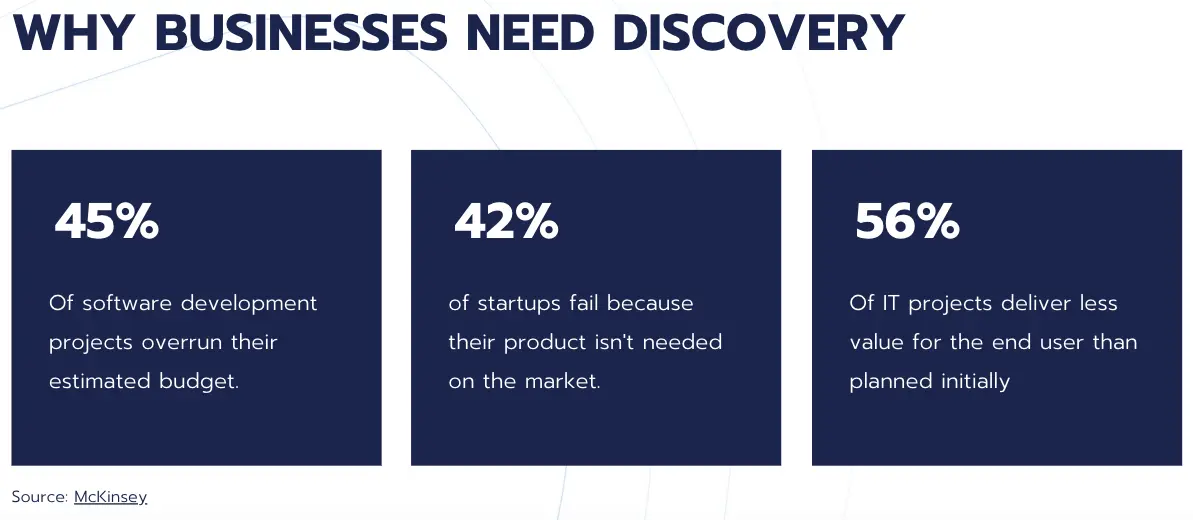
Image Source: Fulcrum
The project discovery step is a foundation of development because it includes major decisions, such as you have to choose the cloud provider and subscription model and outline the risk assessment, specifications, customized features and functions, and cost estimates.
Consider the cloud provider's pricing plans and other expenditures while setting the budget. In addition, more information, such as development methodology and cloud computing platforms, are also chosen. Planning is vital in outsourced software development as it helps prevent unnecessary costs.
UI/UX Designing
In this stage of Cloud-based SaaS app development, the (UI) user interface and (UX) user experience are created, as well as the architecture of the SaaS app is designed. This step includes everything from visuals to how UI and UX respond to user actions. UI should be intuitive and clear to make sure users can solve their tasks effectively. Also, seamless design plays an essential role in convenient interaction between users and the application, which is the foundation of audience satisfaction.
It's important to note that mobile-first SaaS is one of the key software development trends. Therefore, pay greater attention to mobile mockup designs. In addition to handy design, the application should have extra security and role-based access features.
Technology Stack Selection and Engineering
After designing the app, it's time to choose the right tools and approaches for front-end, server-side, and database development. MVP (minimum viable product) is built at this stage, depending on the SaaS application type. MVP means the simplest version of the app with basic features, which is enough for launching and offering to early users. It allows the developers to test the quality and viability of functionality quickly, spot shortcomings, and fix them before creating more complex features.
The development team chooses technologies that will be suitable for the project. A technology stack used for building a cloud-based SaaS application includes a combination of front-end and back-end technologies. Here is an efficient SaaS-focused tech stack, including gold-standard tools used for developing SaaS applications:
Front-end technologies include:
HTML/CSS and Javascript:The development and optimization of user-focused features is the basis of the user experience of the end product, which always takes place in a separate stage. However, it is impossible to overstate the importance of the classic combination of HTML/CSS with a Javascript framework such as Angular.js or React.
On the other hand, back-end technologies include:
Python, Ruby, PHP, or JavaScript - Server side:A server and database are both essential parts of any SaaS product; however, they should operate from somewhere. One of the common programming languages, such as Python, PHP, Ruby, or Javascript, can be used to code a fitting server-side environment. Moreover, using a compatible framework such as Django, Ruby on Rails, Node.js, or Laravel is essential. But the final decision on language and appropriate framework is taken per the project's complexity, particular goals, and the work methodology of the hired SaaS development team.
MySQL, PostgreSQL - Database management system:The database in SaaS app development is needed to store back-end data. You must choose from two popular databases: MySQL (a traditional relational database) or PostgreSQL (an object-relational database for more complicated operations with more complex data types).
Apache or Nginx- Web server:Depending on application type and development approaches, your software provider may choose either Apache (process-driven multi-threaded architecture) or Nginx (event-driven single-threaded architecture) as a central web server.
Amazon Web Services - Content Delivery Network: You will need a content delivery network (CDN) to connect servers to users' devices. A CDN such as Amazon Web Services helps provide an excellent user experience by delivering data from the closest server to user devices. AWS is one of the most popular and reliable CDN frameworks now.
Let us have a look at the tech stack chosen by Quora,
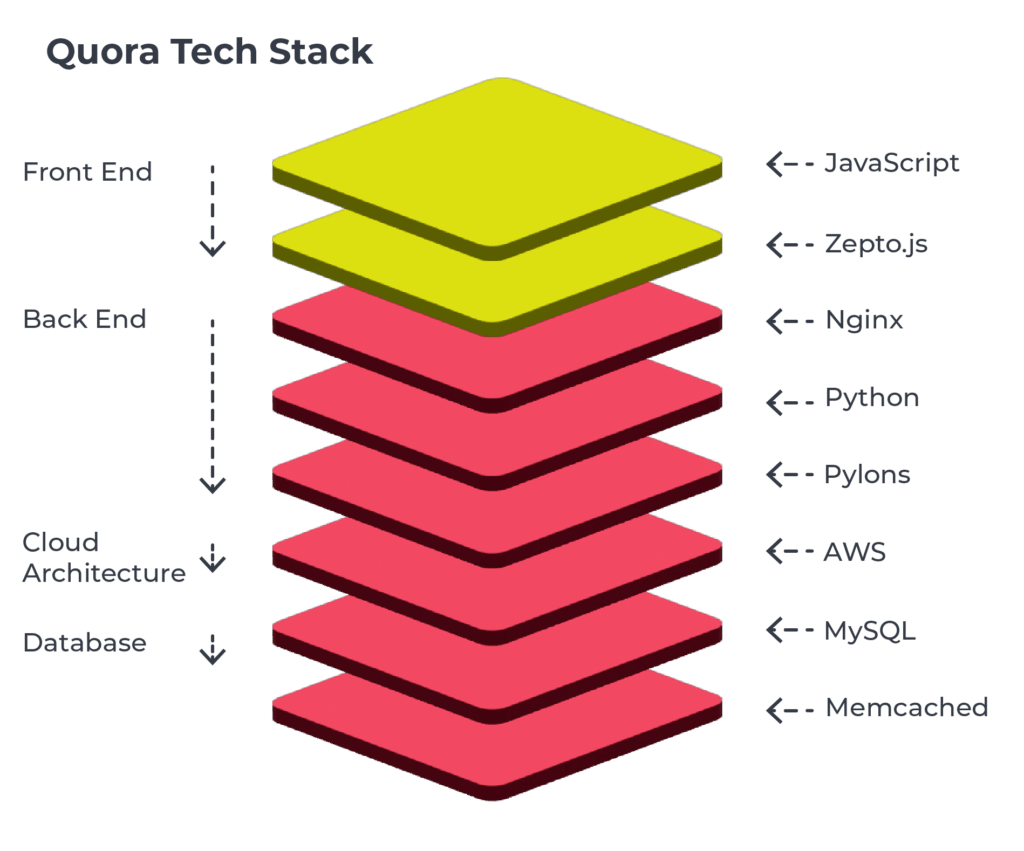
Image Source: https://cyclr.com/
After this, the engineering process starts. DevOps engineers are involved in this process to set up continuous integration, delivery (CI/CD) tools, and automation tools and also improve configuration management. And most importantly, the cloud solution type and provider are selected in this step.
Testing
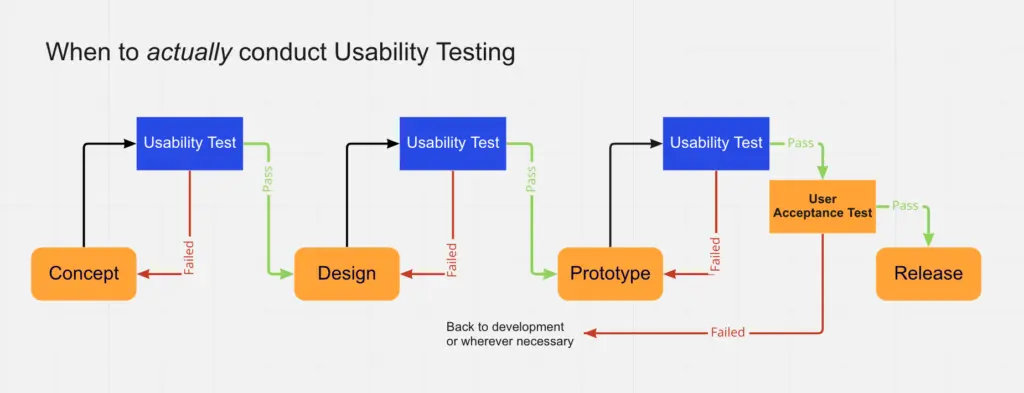
In most cases, testing takes place throughout the whole development process. However, before deployment, final SaaS application testing is all about ensuring the app meets user requirements and runs seamlessly. QA engineers perform various quality assurance tests such as performance testing, usability testing, and security testing to eliminate bugs and other shortcomings.
Some SaaS app development companies prefer incorporating both manual and automated testing in the QA process to fix errors and cover the SaaS solution entirely. Additionally, the QA team continuously monitors the product after launch to ensure its quality and performance.
Spotlight,
Deployment
Deploying your cloud-based SaaS application is the process of making the app available to end users and accessible with an internet connection. Once your app is developed, it is ready for deployment. Cloud-based SaaS development experts will host your app on a cloud platform such as Amazon Web Services (AWS), Microsoft Azure, and Google Cloud Platform (GCP). It allows users to access the app from anywhere via the internet.
Deploying a SaaS solution can be a complex process. However, working with experienced SaaS professionals for faster and more flexible deployment is vital to avoid any issues. At ownAI, our experienced SaaS developers are well-versed in the latest cloud platforms, making sure to streamline the development and deployment of your cloud-based applications.
Maintenance and Support
This is the last and final step in the process of building a cloud-based SaaS application in which the development team maintains, monitors, and optimizes its performance after the launch. It allows you to meet users' expectations and develop new features if needed. At this stage, there's a need to improve the interface, fix UX issues, track security gaps, and keep your application ready to scale quickly.
Find the Best SaaS Application Development Company
If you want to achieve proper end-product quality, you need a highly qualified team of developers that dive into your project. Being one of the best cloud-based application development companies , we can create a highly secure and cost-effective SaaS solution for your business. ownAI has a dedicated team of SaaS development specialists that are willing and ready to devote their in-depth experience and expertise to develop a robust cloud-based SaaS application.
Contact us today to start making your SaaS business idea a reality!
Final Thoughts
Building a cloud-based SaaS application is a multi-step process that requires a specific approach and unique expertise. The successful SaaS app development is powered by strong experience and a properly segmented strategy. The SaaS application model has become highly popular as it offers enormous advantages to business owners and customers. However, if you entrust your app development to a specific vendor, make sure they have the required expertise and use the most up-to-date tech stack.
Lastly, it is imperative to have a team of SaaS development experts who can monitor the smooth operation of the application, identify areas for improvement, and keep up with the rapid-changing market trends. We at ownAI would be delighted to assist you in developing a technically robust, scalable, and user-friendly solution.
Reach out to us today to set up a best-in-class development team for your cloud-based SaaS application development project! Let's make your SaaS business idea viable together!

Let’s discuss about your next AI, Cloud or Digital Transformation.
 AI-Skilled & Agile
 Transparent, Trustworthy &
Vetted team Not tech, but business &
customer first approach





 Turn your idea into MVP in 8-16 weeks