


Healthcare front desks are buried under more calls than any small or mid-size practice can realistically answer.
A typical clinic handles 80 to 150 inbound calls a day, and on busy mornings, up to 30% of those calls go unanswered. Every dropped call is a missed appointment, a delayed prescription refill, or a patient who quietly switches providers.
That pressure is exactly why so many healthcare leaders are now evaluating the best voice AI for healthcare front-desk automation.
Voice AI promises to answer every call, schedule patients in real time, verify insurance, and keep clinics covered after hours, without burning out the front-desk team.
Yet many healthcare organizations are not able to adapt the voice AI to automate their front-desk operations.
The catch is that most platforms look great in a polished demo and break the moment they meet real patient traffic, EHR rules, and HIPAA realities, which is why picking the right voice AI agent is very crucial.
Now the question is - how to find the right voice AI agent for the healthcare front desk? We’ve got you covered!
In this guide, you will understand:
- What voice AI for healthcare front-desk automation is
- Why are healthcare practices moving to voice AI?
- 10 best voice AI platforms compared side by side
- How to evaluate voice AI honestly
- Realistic cost ranges and where hidden costs hide
- A clear, step-by-step decision framework
By the end of this guide, you will know exactly which voice AI for healthcare fits your clinic, what questions to ask vendors, and how to avoid the mistakes.
What Is Voice AI for Healthcare Front-Desk Automation?
Voice AI for healthcare front-desk automation is software that handles real patient phone calls the way a trained receptionist would.
It answers inbound calls, books appointments, takes intake details, verifies insurance, and routes complex cases to a human, all in natural conversation rather than a rigid menu tree.
The core difference from traditional IVR is that voice AI listens to how patients actually speak. Someone calling to reschedule does not press 4 for appointments or 2 for changes. They simply say, "I need to move my Tuesday visit with Dr. Patel to next week," and the voice AI system understands the intent, captures the request, and updates the EHR.
Modern platforms combine speech-to-text, large language models, text-to-speech, telephony infrastructure, and EHR APIs into one operational stack.
Key Features of Voice AI Solutions for Healthcare
The best voice AI for healthcare front-desk automation comes with some advanced key features that separate it from generic conversational bots:
HIPAA compliance with signed BAA: Encrypted calls, secure storage, and a Business Associate Agreement before any patient data flows.
Real-time EHR write-back: Books and updates appointments inside Epic, Cerner, or athenahealth during the call.
Sub-200ms response latency: Keeps conversations natural and prevents awkward pauses that frustrate patients.
Multi-turn conversation handling: Holds context across follow-up questions, interruptions, and topic shifts in a single call.
Live-agent fallback with warm handoff: Transfers complex calls to staff with full context, so patients never start over.
Multilingual support: Handles English, Spanish, and other languages your patient population needs without losing accuracy.
Telephony depth with SIP and PSTN: Connects to existing phone lines and call routing without third-party glue.
Audit-ready logging: Tracks every call, transcript, and decision for compliance reviews and ongoing tuning.
Why Healthcare Front Desks Are Turning to Voice AI?
The shift to the best voice AI for healthcare front-desk automation is not driven by hype. It is driven by hard operational pressure that every clinic, dental practice, and hospital is feeling at once.
Here are some key reasons why healthcare leaders are moving fast on voice AI for healthcare:
Rising call volumes overwhelm staff: Mid-size practices field 80 to 150 calls a day, and front-desk teams cannot keep up without burnout or longer hold times.
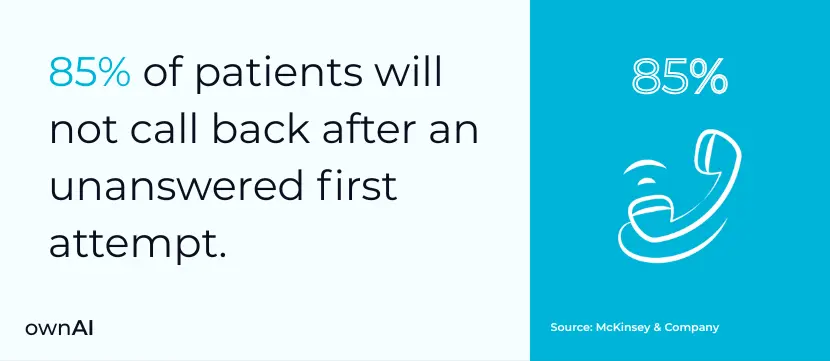
Missed calls leak revenue every week: According to Solv Health data on patient access, nearly a quarter of medical practice calls go unanswered, and a large share of patients hang up after long holds.
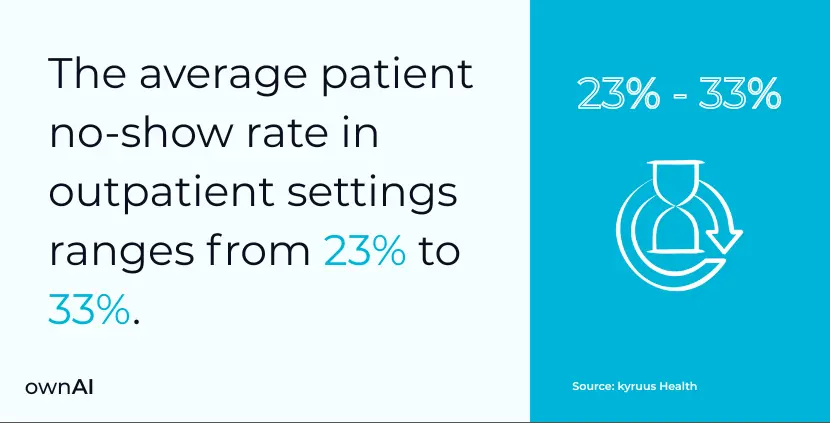
No-show rates damage scheduling and revenue: Manual reminder calls leave practices with high no-show rates, which translates to tens of thousands in lost revenue every month.
Patients now expect 24/7 access: A growing share of patient calls happen outside office hours, and voicemail is no longer acceptable as a fallback.
Insurance verification eats hours of staff time: Each call to a payor takes 20 to 30 minutes, and a single front-desk team can lose half its day to eligibility checks.
Multilingual care is a real access requirement: Many U.S. patients speak a language other than English at home, and equitable access depends on multilingual support.
The technology is finally production-ready: The best voice AI for healthcare front-desk automation has crossed the latency and accuracy threshold needed for live patient conversations, and platforms now hit medical-terminology accuracy levels suitable for production use.
Also Read: Pros and Cons of AI and Workflow Automation in Healthcare
Quick Answer: Top 10 Voice AI Platforms at a Glance
Before going deep on each tool, here is a side-by-side view of the 10 best voice AI for healthcare front-desk automation:
| Platform | Best For | Standout Feature | HIPAA / BAA | Pricing Range |
|---|---|---|---|---|
| Retell AI | High-volume inbound healthcare calls | Voice-first architecture with sub-200ms latency | Yes | $0.07 / minute |
| Hyro | Large hospitals and multi-department routing | Conversational routing across health systems | Yes | $2,000 to $5,000 / month |
| Synthflow | Small clinics and dental practices | No-code visual builder for fast deployment | Yes | From ~$375 / month |
| Talkie.ai | Specialty clinics needing trained AI | Specialty-tuned for dermatology, OB-GYN, orthopedics | Yes | ~$1,000 to $1,500 / month |
| S10.AI | EHR-driven clinics | 99% transcription accuracy with ambient documentation | Yes | From $99 / month |
| Sully AI | Hospitals need multi-agent suites | AI nurse, AI receptionist, and AI scheduler in one suite | Yes | $79 to $99 / provider/month |
| Voiceoc | Practices needing 24/7 omnichannel | Voice + WhatsApp + SMS in one platform | Yes | Custom pricing |
| Infinitus | Payor and insurance-heavy workflows | 100M+ minutes of payor calls automated | Yes | Custom enterprise |
| Notable Health | Pre-visit automation and intake | End-to-end pre-visit and intake automation | Yes | Custom pricing |
| Vocca AI | Appointment-heavy clinics | Voice-first agent tuned for booking and reminders | Yes | Custom enterprise |
Top 10 Voice AI for Healthcare Front-Desk Automation in 2026
Here is a deeper look at each of the best voice AI for healthcare front-desk automation platforms, what makes each one genuinely different, where it shines, and where it falls short.
1. Retell AI
Voice-first AI platform purpose-built for live phone operations.
Retell AI is one of the most talked-about best voice AI for healthcare front-desk automation tools in 2026, and for good reason. The platform is engineered from the ground up for live phone conversations, not retrofitted from a chatbot.
Healthcare teams use it to handle scheduling, intake, insurance prompts, and call routing, where latency and clarity directly affect the patient experience.
What makes Retell AI different is its obsession with telephony depth. Most platforms run inference in centralized cloud regions, which adds noticeable lag.
Retell AI co-locates inference closer to the call path, so response times stay sub-200ms even during peak hours. That single design choice is why patients on Retell AI calls rarely complain about robotic pauses.
Key Features:
- Voice-first agent design: Built for phone calls, not adapted from chat or text bots.
- Advanced telephony stack: SIP trunking, AI IVR replacement, warm transfers, and real call routing.
- Real-time appointment booking: Writes appointments into the EHR during the call, not after.
- High concurrency handling: Maintains call quality even when peak-hour volumes spike.
- HIPAA-ready infrastructure: Compliance controls suitable for regulated healthcare operations.
Best For: Healthcare practices that rely heavily on phone calls and need reliable, low-latency, compliant voice automation in production.
Pricing: Pay-as-you-go starting at $0.07 per minute, with limited free credits at signup.
2. Hyro
Enterprise-grade conversational AI for large health systems.
Hyro is the platform large hospitals reach for when patient calls span dozens of departments and locations. Among the best voice AI for healthcare front-desk automation tools, it is built for routing chaos: many entry points, many specialists, and a knowledge base that keeps changing.
Where Retell AI shines on direct call handling, Hyro shines on getting patients to the right place across complex organizational structures.
The platform leans into structured conversational flows tied to a managed knowledge base. That makes it strong for FAQs, department routing, and standard scheduling, especially across multiple Epic or Cerner-backed health systems.
Smaller practices rarely need this depth, but for enterprise health networks, Hyro handles call volumes and routing complexity that off-the-shelf tools struggle with.
Key Features:
- Conversational routing engine: Sends patients to the right department, location, or specialist based on intent.
- Enterprise EHR integrations: Native connections to Epic, Cerner, and Allscripts for scheduling and lookups.
- Knowledge-base driven answers: Pulls answers from maintained content rather than free-form generation.
- Structured scheduling flows: Books, reschedules, and confirms within enterprise scheduling rules.
- Multilingual support: Handles diverse patient populations across large service areas.
Best For: Large health systems with complex routing, multiple departments, and the operational maturity to maintain content governance.
Pricing: Roughly $2,000 to $5,000 per month, with enterprise contracts scaling higher.
3. Synthflow
No-code voice AI builder for small clinics and dental practices.
Synthflow takes the opposite approach to Hyro. It is built for teams that want a working voice agent live in days, not quarters, without any engineering effort. The visual call-flow builder lets a clinic manager design appointment-handling logic, FAQs, and reminder calls by dragging and dropping nodes.
Where Synthflow stands out is the speed of deployment for simple healthcare workflows. A solo dermatologist or a 5-provider dental practice can stand up an after-hours agent or an appointment-booking flow over a weekend.
It is not built for complex insurance or multi-department routing, but for small practices that simply need to stop missing calls. It is one of the fastest paths to value.
Key Features:
- Visual no-code builder: Drag-and-drop call flow design for non-technical teams.
- Calendar and CRM integrations: Connects with Google Calendar, Cal.com, and webhook-based systems.
- Appointment reminders: Outbound calls that reduce no-shows for small practices.
- Multilingual conversations: Standard support for English and Spanish out of the box.
- Webhook automation: Triggers downstream workflows when calls complete.
Best For: Small clinics, dental offices, and outpatient centers that want fast, no-code deployment for basic front-desk automation.
Pricing: Plans start around $375 per month, with bundled minutes and overage rates beyond that.
4. Talkie.ai
AI medical receptionist trained on real specialty workflows.
Talkie.ai is one of the few platforms that does not try to be everything for everyone. It is purpose-built as an AI medical receptionist, with models trained on real specialty workflows in dermatology, OB-GYN, orthopedics, and similar fields.
That training shows how naturally it handles specialty-specific intake, terminology, and scheduling logic.
The platform integrates well with healthcare-specific EHRs like athenahealth, ModMed EMA, and Elation Health.
Multi-provider clinics often pick Talkie.ai because it can switch context between specialists, handle prescription refill calls, and run after-hours coverage without sounding generic.
Key Features:
- Specialty-trained models: Pre-tuned for dermatology, OB-GYN, orthopedics, and adjacent fields.
- Healthcare EHR integrations: Native links to athenahealth, ModMed, Elation, and others.
- Multi-provider context handling: Switches between specialists without losing call context.
- Prescription refill routing: Captures refill requests and routes them to the right team.
- 24/7 coverage: After-hours scheduling and FAQ handling for specialty clinics.
Best For: Multi-provider specialty clinics that want an AI medical receptionist trained on real specialty terminology and workflows.
Pricing: Custom quotes, typically estimated between $1,000 and $1,500 per month.
5. S10.AI
EHR-native voice AI with 99% transcription accuracy.
S10.AI sits in a slightly different category. Beyond handling voice calls, it doubles as an ambient documentation layer that captures conversations, transcribes them with 99% accuracy, and writes structured data straight into the EHR.
For clinics where front-desk and clinical documentation overlap, this dual role saves serious admin time.
The platform connects with over 7,000 apps, including Epic, Cerner, athenahealth, and Practice Fusion.
Multilingual support is built in, and offline-capable documentation means it works even when connectivity drops. The trade-off is that the front-desk capability is one of several features, not the only focus.
Key Features:
- EHR-native scheduling: Books appointments directly inside Epic, Cerner, and athenahealth.
- High transcription accuracy: 99% real-time medical-grade transcription on every call.
- Multilingual handling: Supports diverse patient populations out of the box.
- Insurance verification capture: Collects payor and policy information during calls.
- 7,000+ app integrations: Connects with PMS, VOIP, CRM, and broader business tools.
Best For: EHR-driven clinics that want the best voice AI for healthcare front-desk automation paired with ambient documentation in a single platform.
Pricing: Basic plans start at $99 per month, with EHR-integrated tiers from $150 per month.
Also Read: 10 Best Voice AI Agents for Telecom and Utility Providers
6. Sully AI
Multi-agent AI suite with 19 languages and specialty agents.
Sully AI takes a multi-agent approach that other platforms avoid. Instead of one generalist receptionist, it deploys a coordinated team, i.e., an AI receptionist for inbound calls, an AI nurse for pre-visit triage, and an AI scheduler for appointments. Each agent specializes, and they hand context to each other when needed.
That architecture makes Sully AI a strong fit for hospitals and large enterprise health systems where front-desk work, intake, and triage overlap.
The platform supports 19 languages, integrates with Epic, Cerner, MEDITECH, and Allscripts, and runs voice, phone, and SMS through one stack. For organizations that want to consolidate multiple AI vendors, Sully AI removes the integration headaches.
Key Features:
- Multi-agent suite: Separate AI receptionist, AI nurse, and AI scheduler with shared context.
- 19-language support: Wide multilingual coverage for diverse patient populations.
- Multimodal input: Voice, phone, and SMS handled in one platform.
- Hospital-grade EHR integrations: Native links to Epic, Cerner, MEDITECH, and Allscripts.
- Pre-visit triage: AI nurse collects symptoms and intake details before the visit.
Best For: Hospitals and enterprise health systems that need a coordinated suite of AI agents across reception, triage, and scheduling.
Pricing: Pro at $79 per provider per month, Premium at $99, and Enterprise on a custom quote.
7. Voiceoc
Omnichannel patient AI across voice, WhatsApp, and SMS.
Voiceoc is the platform to consider when patients reach you on every channel, and you want one consistent AI handling all of them. It runs voice calls, WhatsApp conversations, and SMS messaging through a single agent.
A patient can start booking on WhatsApp, finish on a phone call, and receive a confirmation on SMS without losing context.
The platform supports English, Spanish, and Hindi out of the box, and it integrates with EMR systems, call center platforms, and SMS gateways.
For practices serving multilingual populations or running heavy after-hours volume, the omnichannel approach reduces dropped patients between channels.
Key Features:
- Voice + WhatsApp + SMS: One AI handling three channels with shared context.
- Trilingual support: English, Spanish, and Hindi out of the box.
- 24/7 patient call answering: Continuous coverage, including after-hours and weekends.
- Real-time scheduling: Books and reschedules without double bookings.
- Call summary logging: Captures structured details for staff follow-up.
Best For: Clinics that need 24/7 omnichannel patient communication across voice, WhatsApp, and SMS in multiple languages.
Pricing: Custom quotes only, with no public pricing tiers.
8. Infinitus
Safety-first AI for patient and payor calls at scale.
Infinitus sits in a different category of best voice AI for healthcare front-desk automation. It does not just answer patient calls; it makes calls to insurance companies on behalf of providers.
That single capability is a quiet revenue lever, since each manual payor call eats 20 to 30 minutes of staff time. Infinitus has automated more than 100 million minutes of those calls.
The platform leans hard on safety, validation, and bias testing, which matters because payor calls touch protected health information and complex eligibility logic. Beyond payor calls, it handles patient follow-ups, eligibility checks, and provider directory validation.
For revenue cycle and patient access teams, Infinitus is one of the few tools that touch both sides of the workflow.
Key Features:
- Outbound payor automation: Calls insurance companies for eligibility and benefits checks.
- Agentic AI for end-to-end tasks: Completes multi-step workflows, not just simple turns.
- Safety-first guardrails: Bias testing, validation, and HIPAA compliance built in.
- Massive scale automation: Over 100 million minutes of calls automated to date.
- Provider directory validation: Confirms data accuracy across networks and payors.
Best For: Payor-heavy and revenue cycle teams that need safety-first automation across patient and insurance calls.
Pricing: Custom enterprise contracts with platform fee plus per-call or subscription components.
9. Notable Health
End-to-end pre-visit and intake automation.
Notable Health takes a different angle from voice-first platforms. Its strength is the entire pre-visit workflow: scheduling, intake forms, insurance verification, and pre-authorization.
The voice AI sits inside that broader automation layer, so practices get appointment scheduling and reminders alongside digital intake and eligibility checks in one platform.
That bundling matters for practices where pre-visit work is the real bottleneck. Notable integrates with Epic, Cerner, and athenahealth, and it handles insurance verification with high accuracy.
The platform cuts the manual workload that swamps front desks before a single patient walks in.
Key Features:
- End-to-end pre-visit automation: Scheduling, forms, eligibility, and pre-auth in one flow.
- Digital intake forms: Patients complete forms before arrival, reducing check-in time.
- Real-time insurance verification: Confirms coverage during the scheduling conversation.
- EHR integrations: Native connections with Epic, Cerner, and athenahealth.
- Appointment reminders: Outbound voice and SMS reminders to cut no-shows.
Best For: Practices and groups where pre-visit intake and insurance verification are the biggest operational drag.
Pricing: Custom quotes only, scaled to practice size and integration scope.
10. Vocca AI
Voice-first agent tuned for appointment-heavy clinics.
Vocca AI rounds out the list with a sharper focus on appointment workflows. Where some platforms try to handle every call type, Vocca leans into one job: making sure scheduling, confirmations, reminders, and rescheduling run without friction.
For appointment-heavy clinics, that focus shows in how cleanly the platform handles repeat call patterns.
The platform supports GDPR, HIPAA, and SOC II controls, which matters for clinics with both U.S. and European operations.
Custom scheduling logic, eligibility checks, and integrations with leading EHRs and PMS tools sit at the core. That mix makes Vocca a strong fit for practices where appointment volume dominates call traffic.
Key Features:
- Voice-first scheduling automation: Books appointments, confirms, and reschedules patients.
- Multi-region compliance: GDPR, HIPAA, and SOC II controls in one platform.
- Custom scheduling logic: Handles complex provider rules and eligibility checks.
- Real-time analytics dashboard: Tracks call volume, success rates, and outcomes.
- Native EHR and PMS integrations: Connects with leading practice management systems.
Best For: Appointment-heavy clinics that want a voice-first agent purpose-built for scheduling, confirmations, and reminders.
Pricing: Custom enterprise quotes, with no public pricing tier available.
Cost of Implementing Voice AI for Healthcare Front-Desk Automation
Pricing for the best voice AI for healthcare front-desk automation varies widely depending on tool tier, customization, EHR integration depth, and total call volume.
Here is a realistic view of what healthcare practices spend across the four common deployment tiers:
| Deployment Tier | Typical Cost Range |
|---|---|
| Off-the-shelf SaaS (entry tier) | $300 to $1,000 / month |
| Mid-tier managed platform | $1,500 to $4,000 / month |
| Enterprise platform | $5,000 to $25,000+ / month |
| Custom-built best voice AI for healthcare front-desk automation | $20,000 to $150,000+ project + ongoing |
Also Read: AI Agent Development Cost in 2026: Complete Breakdown
5 Common Mistakes to Avoid When Choosing Voice AI for Healthcare
Even the best voice AI for healthcare front-desk automation platforms fail when the selection process skips the basics. Here are the five mistakes that quietly derail most healthcare voice AI projects:
Picking on demo polish instead of production behavior: Demos always look perfect because they run on clean, scripted calls. Your real patients will interrupt, change their minds, and use medical terms their own way, so test the platform on your actual call patterns before you sign anything.
Skipping BAA verification: If your vendor cannot hand you a signed BAA quickly, that is your sign to walk away. Compliance is not something you sort out later, and a slow legal process usually means the vendor is not truly built for healthcare like yours.
Underestimating EHR integration complexity: Reading from your Epic or Cerner setup is the easy part. The real test is whether the AI can write appointments back during a live call with clean audit logs, so ask the vendor to prove it in a real test environment, not a slideshow.
Ignoring escalation and live-agent handoff: When the AI cannot pass a call to your team smoothly, your patients feel it instantly. Test the warm handoff before you go live and make sure your staff gets the full context on every transfer, because cold handoffs break patient trust faster than anything else.
Choosing on price alone: The cheapest option almost always costs you more once setup, tuning, and scaling kick in. Look at the full 12-month cost of ownership before you decide, because that is where you will see which platform actually pays off for your practice.
Why Choose ownAI for Voice AI Development for Healthcare?
Healthcare voice AI is not a place for shortcuts. One missed compliance step or one weak EHR write-back, and you are back to manual work.
ownAI builds the best voice AI for healthcare front-desk automation from the ground up. Our team of experienced AI agent engineers designs and ships production-grade voice agents that integrate with your real workflows, not generic templates.
Here is what makes ownAI different:
- Healthcare-specific custom builds
- End-to-end delivery
- Production-grade engineering
- Global healthcare client base
- ISO-certified security practices
- No hand-off after launch
Still confused which voice AI platform is best? Book a free consultation with our AI experts today and get a clear, practical roadmap.
Conclusion
Voice AI is no longer a nice-to-have at the healthcare front desk. It answers every call, books appointments in real time, and gives your team the breathing room to focus on patients who actually walk in.
Practices that implement it well are answering every call, cutting no-shows, recovering revenue, and giving exhausted front-desk teams real relief. The ones that pick the wrong platform end up with another expensive tool that adds work instead of removing it.
We hope this guide helped you understand how the best voice AI for healthcare front-desk automation actually works, which platforms fit which scenarios, and how to evaluate them honestly against your real call mix.
Now it's your turn to audit your call data, define your priorities, and pick the platform that matches the way your practice actually runs.
If you want a clear roadmap built around your real workflows, book your free consultation with our AI experts today and get a clear, practical roadmap.
FAQs
1. What is voice AI for healthcare front-desk automation?
Think of it as a smart receptionist that never takes a break. It picks up patient calls, books appointments, handles intake, and checks insurance, all while sounding like a real person. When something gets tricky, it hands the call to your staff with the full story.
2. Is voice AI HIPAA compliant for handling patient calls?
That depends entirely on the vendor, not the technology. Before you let any patient data flow through it, ask for a signed BAA, proof of encryption, and a SOC 2 Type II report. No exceptions here.
3. How does voice AI integrate with EHR systems like Epic and Cerner?
It plugs in through secure APIs and talks to your EHR live during the call. So when a patient books a slot, it lands inside Epic or Cerner right then, with audit logs to back it up. No double entry for your team.
4. Can voice AI replace human front-desk staff in clinics?
Honestly, no, and you would not want it to. It quietly takes care of 60 to 80% of calls that drain your team's day, so they can focus on the patients who really need a human touch. It is a force multiplier, not a replacement.
5. How much does voice AI for healthcare front-desk automation cost?
Entry-level tools run $300 to $1,000 a month, mid-tier sits between $1,500 and $4,000, and enterprise platforms start at $5,000 and climb fast. If you need a custom build, plan for $20,000 and up, depending on how deep the EHR work goes.
6. How long does it take to deploy voice AI at a healthcare practice?
A simple off-the-shelf rollout takes 4 to 8 weeks, and a single-workflow pilot can go live in as little as 2 to 4 weeks. Custom builds with serious EHR work usually need 8 to 16 weeks before they are ready for real patients.
7. Will voice AI handle multilingual patients and complex accents?
The strong platforms cover English, Spanish, Hindi, Mandarin, Vietnamese, and a long list of others. Just do not take their word for it; run a live demo using your actual patient accents before you sign anything.
8. Should we buy off-the-shelf voice AI or build a custom voice AI?
If your call mix looks like everyone else's, off-the-shelf will serve you well. But if your workflows are unusual, your EHR setup is complex, or three vendors keep saying "that is on our roadmap," it is time to seriously consider a custom build.





 Turn your idea into MVP in 8-16 weeks