



Cloud native application development refers to the process of building and releasing software applications inside a cloud environment. In this article will explain everything you need to know about cloud native application development.
To be successful in today's rapidly evolving digital market, businesses need to make adjustments to how they develop, create, and utilize apps. The process of designing, developing, and running an application using a cloud computing zone is referred to as cloud native application development. This methodology may be used for the creation of new products as well as app modernization activities.
The global cloud-native applications market was estimated at USD 8.75 Billion in 2024 and is projected to reach USD 90.59 Billion by 2035, growing at a Compound Annual Growth Rate (CAGR) of approximately 23.67% from 2025 to 2035. (Spherical Insights)
In this article, we will discuss everything that is associated with cloud native application development, including: what cloud-native application development is, the advantages of using cloud-native apps, cloud-native implementation, and other factors to take into account while developing cloud-native products.
What Exactly is Cloud Native Application Development?
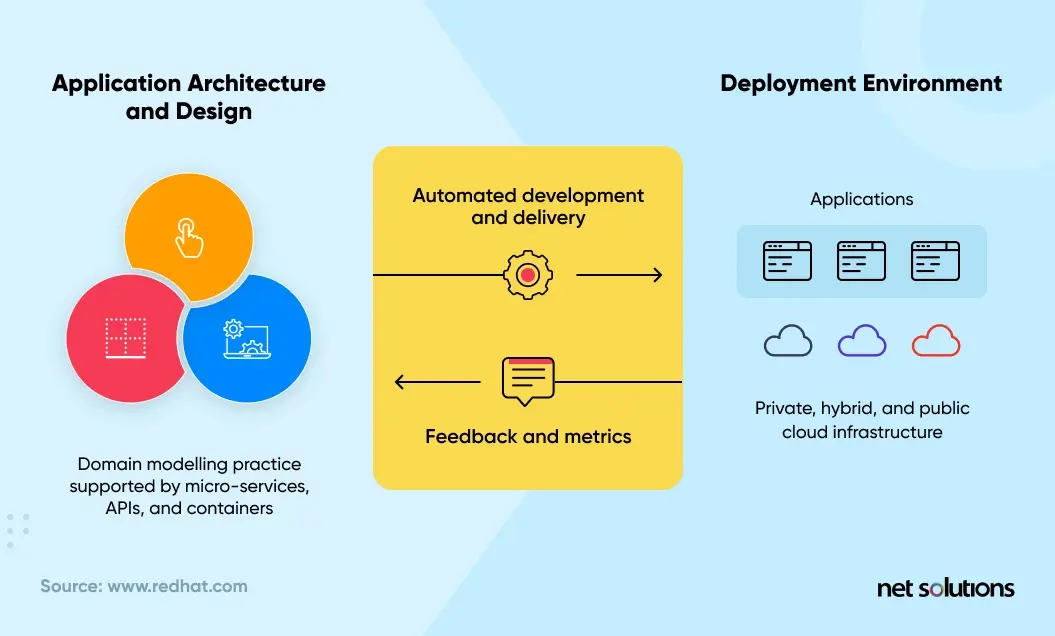
What exactly is meant by the term "cloud-native," and why does this concept relate to software development? An application (product or software) is said to be cloud-native if it is designed to operate in a cloud zone, whether it be private, public, or hybrid. This current method of designing applications for the cloud is known as cloud-native development. Cloud native application development makes use of the cloud's scalability, flexibility, security, and resilience.
For an application to be referred to be cloud-native, it is required that all of its databases, servers, and software be hosted on the cloud. On-premises refers to an application that is hosted and run at a physical spot owned and operated by the company and is the polar opposite of cloud-native.
Building apps from the ground up specifically for use in the cloud or modernizing existing ones are examples of cloud-native development. It builds applications rapidly by using main pillars (discussed below), with a particular emphasis on solutions that are the best in their class and on resilience.
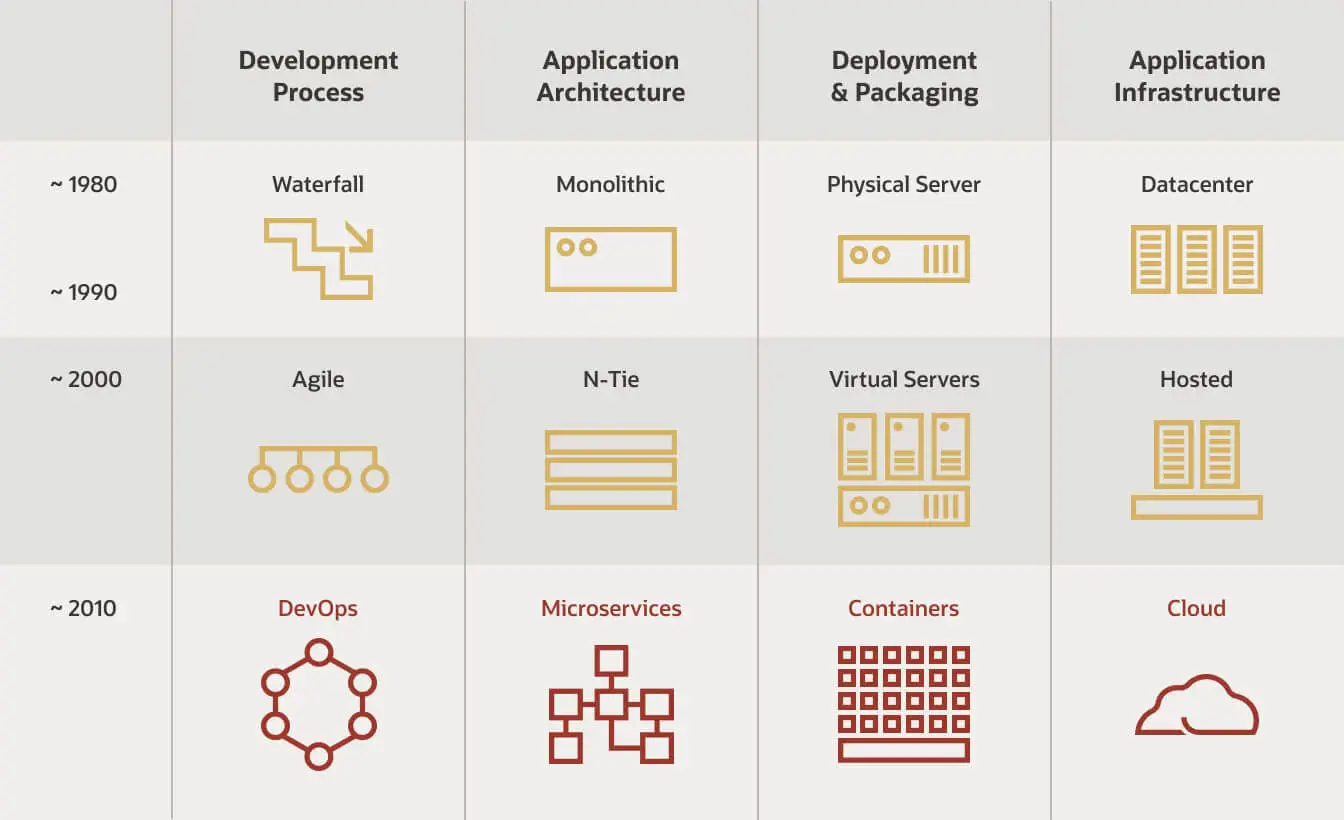
Image Source: https://www.oracle.com/
Difference between Cloud-Native, Cloud-Based, and Cloud-Agnostic
Although these three names sound similar, they each have a distinct meaning:
- Cloud-based: An application that runs in the cloud was originally developed to run on servers that are located on-premises, but it has since been reconstructed to operate in the cloud.
- Cloud-native: Because it is dependent on the capabilities of a particular cloud platform (such as Azure, Amazon Web Services, or Google Cloud), a cloud-native application can only be utilized on that particular platform (unless it is re-modified to function on another platform). A cloud-native app is created to run on the cloud and using cloud-based technologies.
- Cloud-agnostic: An application is said to be cloud-agnostic if it does not depend on the capabilities of a particular cloud platform. Instead, it is capable of operating in any cloud platforms, which enables you to migrate it from one service to another without encountering any problems. However, developing capabilities that are generally incorporated into cloud platforms need additional upfront costs.
Now that we have a clear understanding of cloud native application development, let's discuss its 4 main pillars.
4 Main Cloud Native Application Development Pillars
The 4 main pillars of cloud-native application development are as follows:
- Microservices: The app leverages the power of microservices, which are discrete and reusable modules or components. Each microservice is designed with a singular responsibility, contributing to the overall functionality of the application. Organizing services around specific business capabilities establishes clear boundaries that enhance the resilience of the application.
- Continuous Delivery: To guarantee an efficient, bug-free, and dependable product, developers using the continuous delivery (CD) methodology routinely push out updates to production without delay.
- Containerization: The term "containerization" refers to a method of software distribution in which an application's source code and associated libraries and data files are virtualized into a single package before being deployed. Tools like Kubernetes and Docker are widely used for containerization.
- DevOps: The phrase "DevOps" refers to tight cooperation between the teams responsible for software development and software operations. It also refers to a set of methods, a culture, and technologies that are intended to accelerate the pace of software development.
For example, there are numerous instances of cloud-native apps, and Gartner predicts that by 2025, cloud-native applications would be used to deliver 95% of all digital workloads. A great number of e-commerce shops are cloud-native apps, and they depend on microservices to provide functions like customer chat, search, and payment; each microservice may be switched out or expanded according to requirements.
Cloud Native Application Development Benefits
As we can see above how cloud-native apps are going to take over the internet's workload, let's find out some of the major reasons.
1. Increased scalability
In cloud-native app development, it is simple to adjust the size of the solution to fit the shifting requirements. With microservices, one component may scale independently, creating a solution that is both cost-effective and efficient.
2. Improved reliability
Microservices, which operate independently of one another, are the building blocks on which cloud-native applications are based. Because the remainder of the system is unaffected if one component fails or is being upgraded, the system's dependability is significantly improved. In addition, the modular structure contributes to an improvement in the overall performance of the system.
3. Improved resource utilization
Because it is possible to scale up only as much as is required, excessive investment in infrastructure may be avoided. Utilizing the inherent tools and microservices that come with a cloud platform is another way to save costs and save time.
4. Faster marketing
Because it makes use of the services and tools that are inherent to the cloud platform, a cloud-native application may be developed more quickly.
5. Increased security
Cloud providers like AWS, Azure, and Google Cloud have security baked into their platforms, employ large teams of security experts, and provide additional security features and services (such as locally stored, accessed, and monitored data) to ensure the safety of cloud-based solutions. Data, infrastructure, and applications still need to be safeguarded, however.
Need more help?
Talk to us to simplify and amplify your business with our cloud-based native application development services.
Cloud Native Application Development Implementation
Now that we know the many benefits of cloud-native app development, let's find out its implementation in 6 easy steps.
Step 1: System Evaluation
Product development may concentrate on how to construct cloud-native applications from the bottom up; several businesses are now re-architecting their already-existing applications to be cloud-native. Instead of shifting data to the cloud, which is effectively cloud-enabling, businesses take the core of a program and develop it from the bottom up to be cloud-native. This involves breaking apart old monolithic apps into smaller, more manageable microservice parts.
Step 2: Cloud-native architecture designing
Architectural choices include private, public, or hybrid cloud deployment, cloud providers, microservices already in place vs. those that must be developed, and the usage of various enabling technologies like containers.
Step 3: Decomposing the current setup
The key to sustaining composable architecture is the use of modular components that can be easily assembled and disassembled. When there are already in place systems, "decomposing" means dissecting a large, complex system into its component elements so that their modules or pre-packaged business functions may be understood.
Step 4: Constructing microservices
In cases when external integrations of microservices are unavailable, they may be developed in-house to serve as the foundation for further products or revisions.
Step 5: Microservices integration with a coherent system
After each microservice has been chosen or developed, it uses an API to connect and communicate with the other services. There is help available in the shape of API management platforms, and service mesh, which is nothing but infrastructure layers integrated into the application and used to record the interdependencies between its components.
In addition, continuous integration (CI) and continuous delivery (CD) methods make use of automation in testing to guarantee the components and system integrity while allowing for quicker building, deployment, and delivery. Incorporate capable team integrators by recruiting experienced professionals.
Step 6: Validation and Testing
Any architecture is as effective as the testing done on it; luckily, the absence of dependency in cloud-native apps lends itself nicely to testing, and testing can often be done by leveraging automation.
Nevertheless, the development of cloud-native apps is not without its obstacles.
Working with a firm like ownAI Solutions that is focused on the creation of cloud-native applications might thus prove to be quite beneficial. In addition to our wealth of expertise in the field of cloud application development services, we are also well-versed in the Azure, AWS, and Google cloud platforms.
That implies that we are familiar with how to make use of the cloud to construct individualized solutions that are tailored to your particular commercial objectives.
Cloud Native Application Development Challenges
Following are some of the challenges that you may encounter while the cloud native application development process:
1. Microservices' inherent complexity
Since there are so many microservices, careful monitoring of the individual services and code bases is essential to ensure that they continue to function as intended. Strong integrators and APIs are in high demand to facilitate this.
2. Microservices integration
To guarantee that they provide as promised, microservices need to be evaluated both independently and collectively. As the amount of microservices grows, testing may become more difficult.
3. State management in a microservices architecture
When an application has many moving pieces or performs asynchronous activities, it becomes increasingly difficult to maintain a consistent global state. The most important piece of advice is to not utilize the global state for every task; rather, choose the best tool for the job. Several state management libraries may assist.
4. Microservices validation and testing
It is of utmost importance to incorporate comprehensive testing that scrutinizes each microservice within the architecture, as well as integration tests for characteristics that are composed of multiple components. This meticulous approach guarantees that all aspects are functioning as anticipated, with due regard to security, and that the app remains devoid of any unintended consequences.
5. Lock-in
Although the flexibility provided by microservices mitigates the risk of vendor lock-in, cloud-native development still needs a commitment to a particular platform.
Here's How ownAI Solutions can be of Assistance
Many businesses are making the transition to cloud-native apps to improve their agility and flexibility as well as to better meet the demands of the market and maximize communication among DevOps teams. The continuation of digital revolutions inside enterprises will not diminish the significance of the apps and techniques.
The teams working in ownAI Solutions are aware that cloud-based technology is the solution to the most critical problems facing businesses today. We provide comprehensive services and can assist you with the design and development of cloud-native applications, which will enable you to achieve efficiencies, security, scalability, cost savings, and a variety of other advantages.
With our expertise in cloud-based application development, we can streamline and expand your company's operations. With our broad tools and development strategies, you can streamline operations, improve security, and create cloud-native applications hassle-free.
Contact us if you want to learn more.
Frequently Asked Questions (FAQs)
What exactly is cloud native application development?
An application that is designed, constructed, and deployed specifically for use in a private, public, or hybrid cloud environment is referred to as a cloud-native application.
What are the main ideas behind building cloud-native apps?
Microservices, containerization, DevOps, and continuous delivery are all components of the cloud-native architecture, which is used to develop applications that function inside a single cloud zone.
What is a typical list of cloud-native technology?
Containerization tools (such as Docker, and Kubernetes), APIs, cloud platforms (such as Amazon Web Services, Google Cloud Platform, and Microsoft Azure), and additional services to be in charge of these interactions are examples of commonly used cloud-native technologies.

Let’s discuss about your next AI, Cloud or Digital Transformation.
 AI-Skilled & Agile
 Transparent, Trustworthy &
Vetted team Not tech, but business &
customer first approach





 Turn your idea into MVP in 8-16 weeks