



Ecommerce development is a strategic move made by many business owners, entrepreneurs, and retailers to leverage the benefits of online shopping and generate a steady stream of revenue through a top-notch E-commerce online store.
Let’s have a look at the chart showing global e-commerce sales of the years 2021 to 2026…
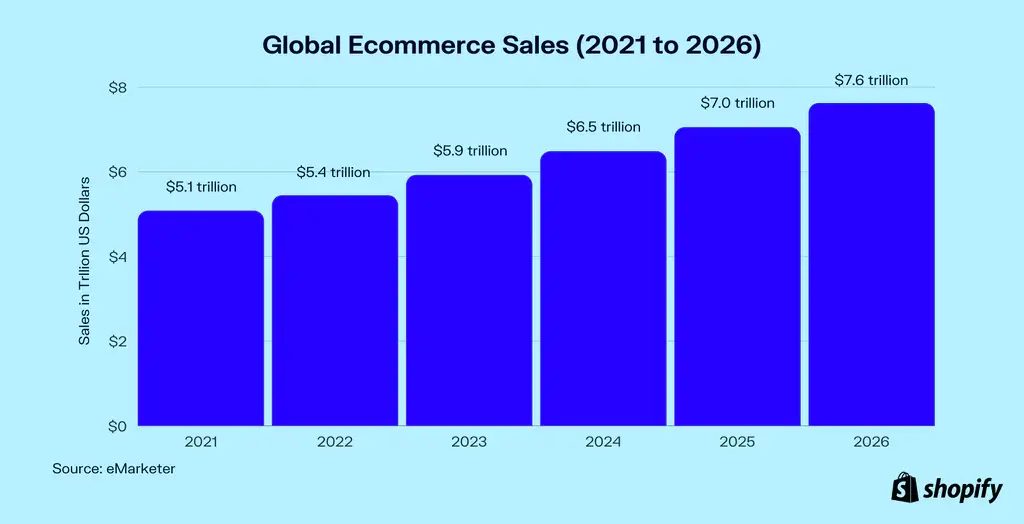
Spending time, effort, and money on developing an Ecommerce website so that customers can easily find, compare, and buy your products or services from the comfort of their homes using their mobile devices, tablets, or personal computers is a wise move if you want to see your business expand and generate more income.
Nasdaq predicts that by the year 2040, Ecommerce would account for 95% of all purchases.
E-commerce websites provide several distinct benefits including:
- Expanding your company's horizons by penetrating new domestic and foreign markets.
- Bringing in more customers and making more purchases by having a well-designed, always-open online store.
- Cutting down on the expenses needed to keep a physical store open.
- Understanding customer preferences via observation and analysis of "your Ecommerce store visitors' interests" can help you fine-tune your offerings and marketing strategies.
- Increasing chances to upsell or cross-sell by remarketing campaigns.
With a well-designed online shop that is tailored to your company's specific requirements and objectives, the possibilities for growth and success are unlimited.
Here are some successful e-commerce companies…
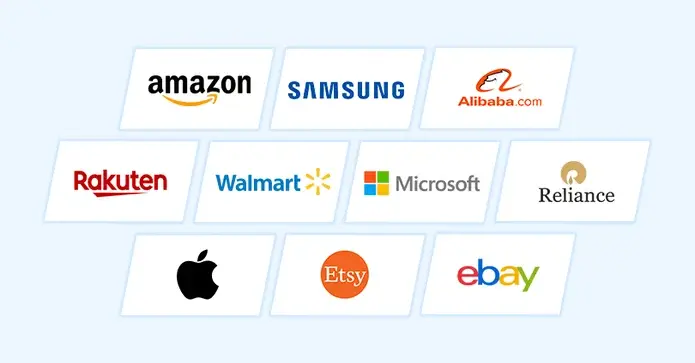
Image Source: https://www.clickpost.ai/blog/top-ecommerce-companies
But before we get into the design and Ecommerce development process, first, we'll examine its many kinds so that you may choose the one that's most suited to your requirements and objectives for flawless Ecommerce development.
The Main Kinds of E-commerce Websites:
- Business to customer (B2C): The most prevalent kind of e-commerce enterprises are those that have a website specifically designed to display and market things to end users. These can include businesses that sell furniture, mobile devices, computers, or clothing.
- Business to business (B2B): Here businesses offer their goods and services to other businesses using online E-commerce Platforms to broaden their customer base and expand into new international markets.
- Customer to customer (C2C): Third-party shops such as eBay make it possible for ordinary people and traditional businesses to market and sell their goods directly to end users over the Internet.
There are other sorts of online platforms, such as freelancing platforms, where people and professionals provide their skills to companies. These platforms normally do not meet the requirements of an eCommerce website, although there are exceptions to this rule. Following that, now we will go through the processes involved in the Ecommerce development.
12-Step Process for an Ecommerce Development
Understanding the industry you are going to enter is just the beginning of what is required to build a successful eCommerce online business. You also need to have a solid understanding of site design, content strategy, and branding. It could seem to be an overwhelming amount of labor.
We have broken this down into 12 phases that will simplify the process of developing your Ecommerce platform and help you work toward achieving your company objectives.
Step 1. Determine what you will be selling
Choosing a product line is the first order of business when creating an online store. Exactly what is it that makes you happy?
Creating an online store that caters to your interests ensures that you'll have fun managing the enterprise. You don't have to go further than your current interests to discover your niche, whether that's in the world of high-end watches, or home decor arts and crafts.
Of course, many companies have been begun for purely selfish motives. Perhaps you have identified a gap in the market and are eager to provide consumers with products that will help them with the issues they are facing.
No matter what you're trying to accomplish with your online store, you should always start with a thorough market and product analysis. This is crucial if you don't want to fail and be stuck with a surplus of products.
Research the industry you want to join. Learn from the successes and failures of other goods and the passing of fads. One of the challenges of managing an online store is anticipating future client needs and wants.
Furthermore, there is rivalry. It's going to be tough to make any impact if you join a sector already dominated by established companies with large marketing expenditures. If you can, try to fit into a category that allows for a little more space to maneuver. If you enter a market with a fresh idea, distinctive branding, and superior user experience, you may find success.
Step 2. Understand your target market
When you start an online business in a field that you are already acquainted with, one of the benefits is that you already have an audience since you are a member of that audience. However, every ecommerce company would benefit from putting in some effort to better understand its clients, even if they are already familiar with the company's products and services.
The process of developing an e-commerce platform requires you to have a comprehensive understanding of your prospective clientele at every stage. Everything about the user interface and user experience as well as the graphics of the site, design, content, and other aspects, has to be customized for your prospective clients.
Here are some of the stages of the customer journey that will help you in building a robust sales funnel…
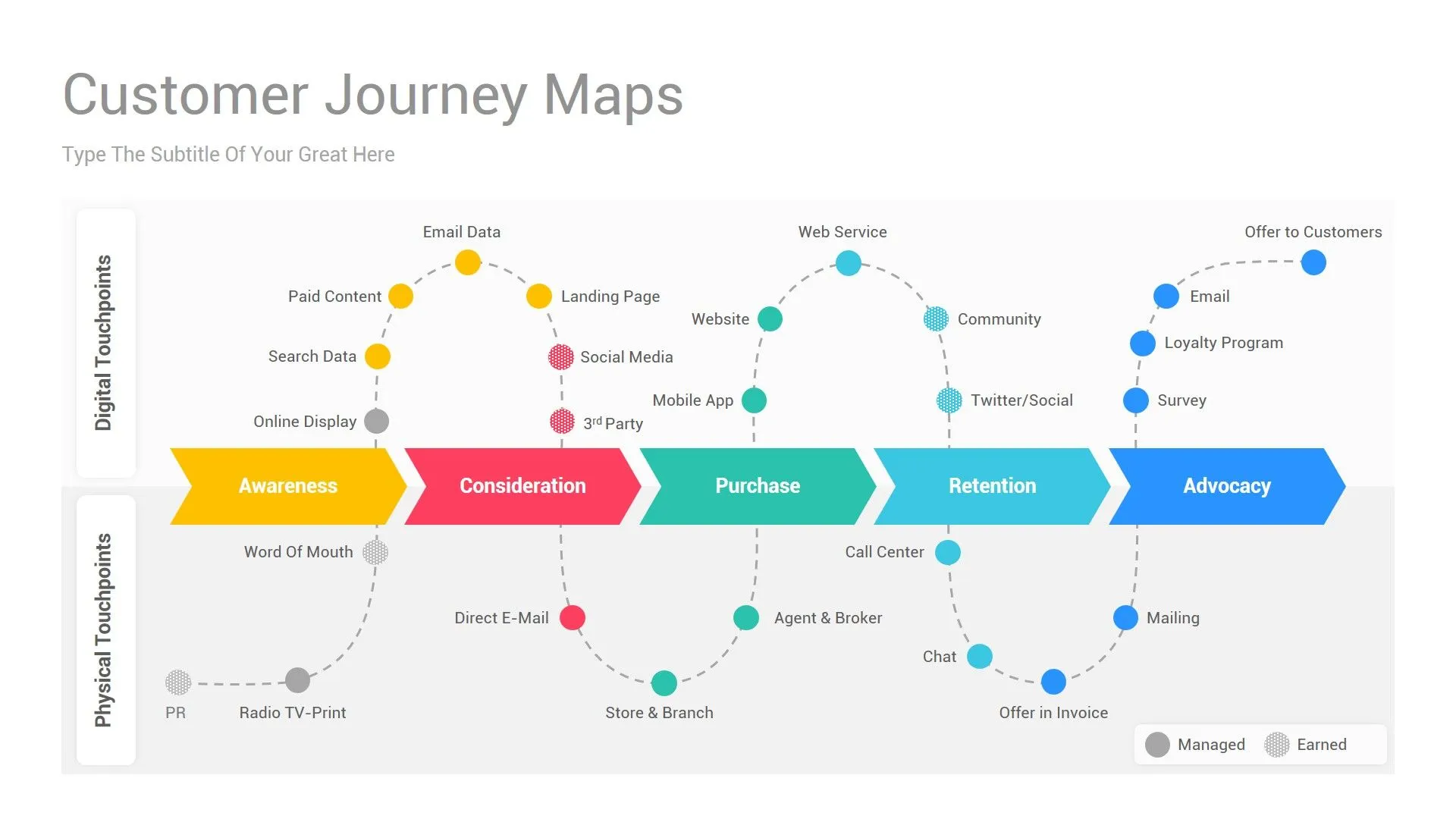
Image Source: https://debutify.com/
You need to have a solid understanding of the demographics of the people who could become your consumers. What is their prior experience? What is the range of their income? What is their age range? And which websites of your rivals are they most likely to make purchases from? You will be able to utilize all of this knowledge to design an e-commerce company that is customized to their preferences and requirements, therefore strengthening your relationship with them and providing a more satisfying experience for your customers.
Step 3. Pick a catchy brand name
Avoid giving your company a name that is too similar to those of other companies in your industry. You have to make yourself noticeable. Having a name that is distinct from everyone else operating in the same market sector is the best way to set oneself out from the competition.
Short names make better company names. Google, Apple, or Etsy; all three will tell you that a short name is a key to increased brand identification. People desire something that isn't too complicated and can be easily stored in their memories.
Regardless of how excellent a company's goods or services may be, a brand's reputation may be hurt by having a name that is unimaginative.
Also, let's not forget that having a distinctive brand name increases the likelihood that you'll be able to register the domain name of your choice. If your ideal domain name is already taken, you may get your hands on something quite similar to it with a little bit of creativity and wordplay on your part.
Step 4. Buy the domain name
So, you've finalized a name for your company and discovered an available URL, (you can check the availability of the URL on sites like GoDaddy). Now, first things first: before you even begin developing the e-commerce store, make sure to register/buy the domain name.
As your Ecommerce development process progresses to later phases, there is a greater chance that the ideal URL may be taken by another business. Buy a domain at this time to avoid having to worry about it in the future.
Step 5. Establish your brand's identity
For example, Coca-Cola, Apple, and Starbucks are just a few of the brands that have become ubiquitous in our daily lives. These businesses have a stronger connection with their customers than those with less distinct logos, visual identities, and ways of communicating.
Through effective branding, companies go from faceless corporations to the objects of our affection. It's the driving force behind customer loyalty. The logo, color scheme, and tone of an online store are just as important as the products themselves. When put together, these components of a website's design create an atmosphere that reflects the brand's value and identity.
Sharing your background and history is very important while promoting yourself. Customers of your ecommerce site should be familiar with the business's history and the people that run it. If you don't put a face to your company, people will see you as simply another faceless online resource. Most of us would rather not input our credit card information on an anonymous website that just provides us with barebones product details. Adding a human touch to your brand's marketing increases its credibility.
Here is the brand identity chart made by Jeff Whitlock outlining the important elements that creates a brand (Priority of elements are from left to right)…
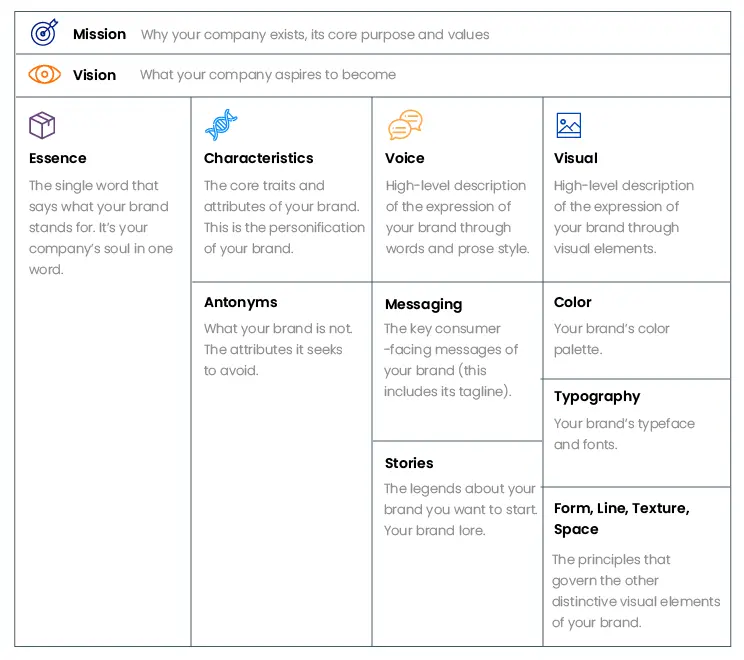
Image Source: https://rubygarage.org/
Your company must also be heard. Voice is the secret sauce that takes your work from boring monologue to lively conversation. The tone of your brand is one of the most important ways to set it apart from similar products on the market.
Compare and contrast other well-known brand like Gillette and Dollar Shave Club. Having a distinct voice is what gives a brand its recognizability. Everything from your ecommerce website's copy to your social media posts should be infused with this brand voice. You must always maintain uniformity and individuality.
Step 6. Choose the best Ecommerce platform
To manage your online store, you may use any e-commerce system, such as Shopify, Magento, or a WordPress plugin like WooCommerce.
Here is the chart showing the market share of some popular E-commerce platforms…
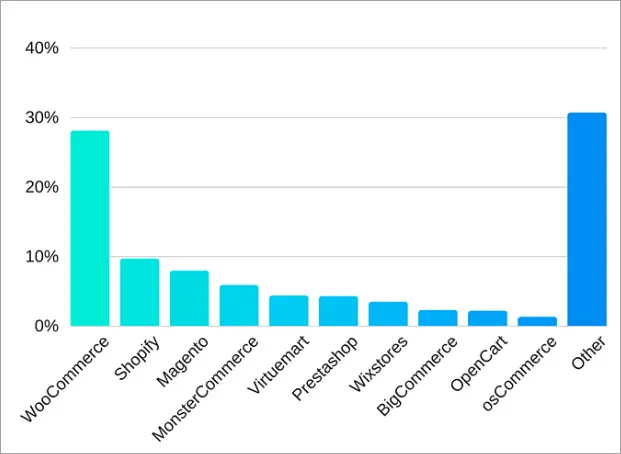
Image Source: https://www.twispay.com/en/
Each e-commerce product on the market comes with its own set of pros and downsides. Your choice of an e-commerce platform to run your website should have the following essential features:
- Responsive layout: The e-commerce platform should provide the same quality of service regardless of the device being used to access it.
- Product management: The process of adding, modifying, and managing stock should be straightforward. It's also important to be able to provide alternative product variations and sale or discount prices as required.
- CMS (content management system): Dynamic material, such as blogs as well as other recurring blocks of information in a design, need a content management system for easy updating and modification. Using a content management system (CMS) to regularly add fresh product-related material may greatly improve the user experience of your online store.
- Shopping cart: Possess the ability to personalize and style a shopping cart to ensure it blends in with the store's aesthetic.
- Checkout page: A non-customizable checkout page is as unacceptable as a non-customizable shopping cart.
- Payment processing: Accept traditional payment methods like credit cards, as well as more modern alternatives like Stripe, PayPal, Apple Pay, Google Pay, and others.
Need our help?
Let’s build your online e-commerce store.
We aim to provide you with a solution that is all-inclusive and provides you with everything you want to build, operate, and administer your online store without much hassle.
Step 7. Develop a content strategy
We believe that content should come before design. During the earliest stages of the ecommerce development process, having a website built with genuine content as opposed to filler allows for a more accurate portrayal of the final result. Things may get more complicated if you go backward and integrate the images, text, and other pieces later in the process.
A content strategy is something that has to be developed right from the start of the Ecommerce development process. This involves being aware of the types of material necessary to convey the narrative of your brand and describe the functions of your items. This may include written content, photographs, videos, infographics, and any other forms of material that you may need to provide the highest level of service to your consumers.
Understanding your target demographic is an essential component of content strategy. What are the most frequent questions that customers have regarding the items that you sell, and what kind of information do you think they would find helpful? You need to offer the answers to any fundamental questions that they could have, and you also need to supply knowledge that your rivals do not.
A content strategy for an e-commerce website helps establish what features and information are necessary, as well as the most effective manner to convey that information visually.
Your website's information architecture is directly influenced by your content strategy. You need to be aware of what it is that your consumers need, as well as the most effective way to provide the material to them.
Step 8. Do SEO (search engine optimization)
Web crawlers' perceptions of how relevant and helpful your material is will determine how much traffic you get from them. If you give search engine optimization some thought, you could move up in the rankings and get more free highly targeted visitors.
The following are some SEO recommendations:
- Conducting research using Google's Keyword Tool and Google Trends.
- Including focused keywords and phrases in the H1 and H2 headers, as well as the title and description.
- No keyword stuffing or not sounding like a robot in order to fill the content with your focused keywords.
- Checking Google Search Consol reports to better understand what’s working and what’s not to improve the content that's outperforming.
- Focusing on backlinks like getting your website mentioned on websites that are relevant to your industry or niche.
Here is a canvas showing how to structure your E-commerce Site…
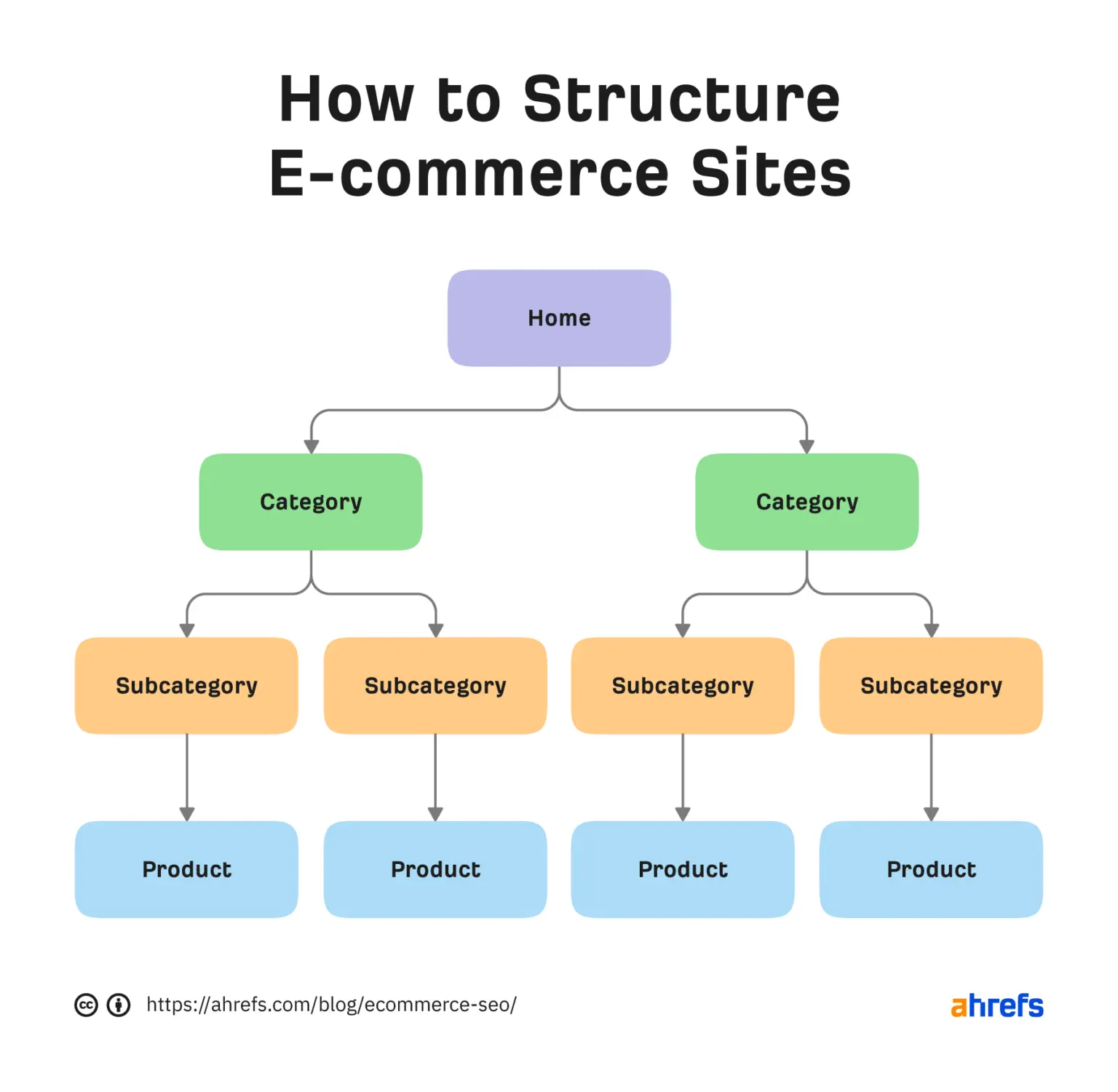
To know more about the SEO guidelines for E-commerce sites, follow this link, https://ahrefs.com/blog/ecommerce-seo/
These were some SEO fundamentals that you must not forget while your ecommerce development phase.
Step 9. Finalize product categories
Imagine for a moment that you are riding the elevator at a large department store. There is a brief explanation of what each level contains next to each button. On one story, you'll find the men's apparel, on another, the women's clothing, and on the top floor, you'll find the children's clothing. When you get off on a certain level, you will be sent to a room that is filled with signage that shows you each sector and further categorize all of the things that are on the floor.
The organization of an e-commerce website operates in a manner that is similar to this. Each section may include a collection of items that are connected in terms of the consumers for whom it is designed, the function it serves, and the characteristics that the individual products have in common with one another.
The calls to action, navigation, and other methods that allow visitors to access your items with the fewest amount of clicks possible are dependent on the product categories that have been specified.
Product categories must be succinct and to the point. Someone needs to be capable of recognizing and comprehending what exactly they are. Being imaginative is not appropriate at this phase. Customers want to see recognizable navigation that points them in the direction of the products or services they want.
Organize your shop and its categories in such a way that it is simple and quick to identify things that go together, and don't make it difficult for customers to do so. You will achieve a greater conversion rate by providing clear pathways for your items to your customers.
Step 10. Take high-quality pictures of your products
The majority of individuals with a decent camera and a little bit of skill are capable of taking nice photographs with a simple setup consisting of a tripod, a paper background, and a couple of lights. However, if you have the financial means to do so, it may be worthwhile to hire a professional photographer to get photographs of better quality.
Whoever shoots the images is responsible for ensuring that they are correctly focused, that the white balance is accurate and that the colors accurately represent the items. If you are skilled in picture editing, you may further improve these photos, which will result in them being an even more accurate portrayal of your items.
One of the drawbacks of shopping online is that prospective buyers do not have the opportunity to inspect or handle the items live. To compensate for this, the product images you use ought to capture all of the essential aspects of the item being sold. Customers will have a much easier time understanding the things you sell if you can provide as much information as possible about them via photographs and videos that include a variety of perspectives and close-ups.
Step 11. Write compelling product descriptions
Buyers may learn all they need to know about a product by reading its description. It emphasizes the qualities of an item as well as the positive aspects of using that thing. It provides the individual with all of the directions that they need to make them add the product to their cart.
The specifications and characteristics of a product must be included in the product description; nevertheless, the description cannot just be a dry recital of the information. They have to be motivated by empathy and engage on a human level with prospective clients.
When writing product descriptions, it is important to keep the end user in mind and convey how a certain item will assist in the resolution of their issues and improve their quality of life.
Step 12. Choose the appropriate shipping software
When the appropriate software is used, order fulfillment and shipping become a much simpler process. Having an efficient shipping program that can handle all of the complexities of this last step is essential, particularly when sending greater quantities of orders. This software should be able to keep track of all of the relevant information.
Shippo includes a lot of useful capabilities, some of which include shop integration, the ability to print shipping labels, tracking data for customers, and return labels. They have an excellent reputation and are well-suited for usage by businesses of any size as a result of the fact that Etsy, OfferUp, and Tuft & Needle all utilize Shippo as their fulfillment platform. They also make it feasible to utilize several carriers, such as the United States Postal Service (USPS), United Parcel Service (UPS), FedEx, and DHL Express, and provide you alternatives for whatever carrier you wish to use.
ShipStation is a web-based system that enables a speedy setup, the capacity of printing hundreds of labels all at once if necessary, and also, a convenient mobile app for shipping purposes. It is also another great tool that might be useful, regardless of the size of the firm.
Final Thoughts
The development of a successful e-commerce website is a crucial aspect of building your e-commerce store and should be approached with something other than levity.
You must assess your company's requirements and objectives before commencing the blueprint and implementation process. This is because every choice you make, ranging from your domain name to the decision of engaging a third-party developer, will hinge on these performance indicators.
Here's How ownAI Solutions Can Help You
The e-commerce industry presents a plethora of opportunities for individuals seeking to establish their presence in the digital realm of the internet. We as one of the most reputed Ecommerce development service providers are pleased to have you on board.
We are delighted to offer e-commerce solutions that empower business owners with fully operational websites online. Our comprehensive range of services encompasses everything from designing interactive and animated interfaces to introducing new product lines.
We have successfully paved the way for e-commerce and are committed to enabling you to establish an online e-commerce store that aligns with your vision.
Click here to let us know your vision. We're delighted to hear from you.

Let’s discuss about your next AI, Cloud or Digital Transformation.
 AI-Skilled & Agile
 Transparent, Trustworthy &
Vetted team Not tech, but business &
customer first approach





 Turn your idea into MVP in 8-16 weeks