



If you want to build software for your company, you must decide how to set up the development process. So the question is, which is better: in-house or outsourced software development?
Before delving into the details of each option, let's quickly overview these concepts. The primary difference between outsourced and in-house software development is the collaborative approach.
In-house software development refers to building software solutions within the company using the organization's internal resources, such as a dedicated team of software developers. Outsourcing involves working with external vendors or freelancers with specialist skills to develop software solutions quickly and efficiently.
Both approaches have advantages and disadvantages, and the choice depends on various factors such as budget, expertise, time scale, communication, project requirements, and strategic goals. At ownAI , this blog will explore the pros and cons of in-house and outsourced software development to help you make an informed decision about your organization. Let's get started!
What is In-house Software Development?
As the name suggests, the in-house software development technique requires you to build your team from scratch. It is the same as recruiting new permanent staff. This team will be responsible for your apps or IT software. It involves a lengthy process of job posting, reviewing job applications, screening the applications, scheduling and conducting interviews, and selecting qualified people.
You should list the necessary team members, such as a designer, developer, quality assurance (QA), content creator, etc., and then recruit each position through separate job advertisements. Hiring in-house specialists gives large digital companies like Amazon, PayPal, and others complete control over the project at an increased cost.
Advantages and Disadvantages of In-House Software Development
Let's discuss the benefits and drawbacks of in-house software development in detail!
Advantages of In-House Software Development
Building an in-house team allows you to develop your products. Here are the significant advantages of this popular approach.
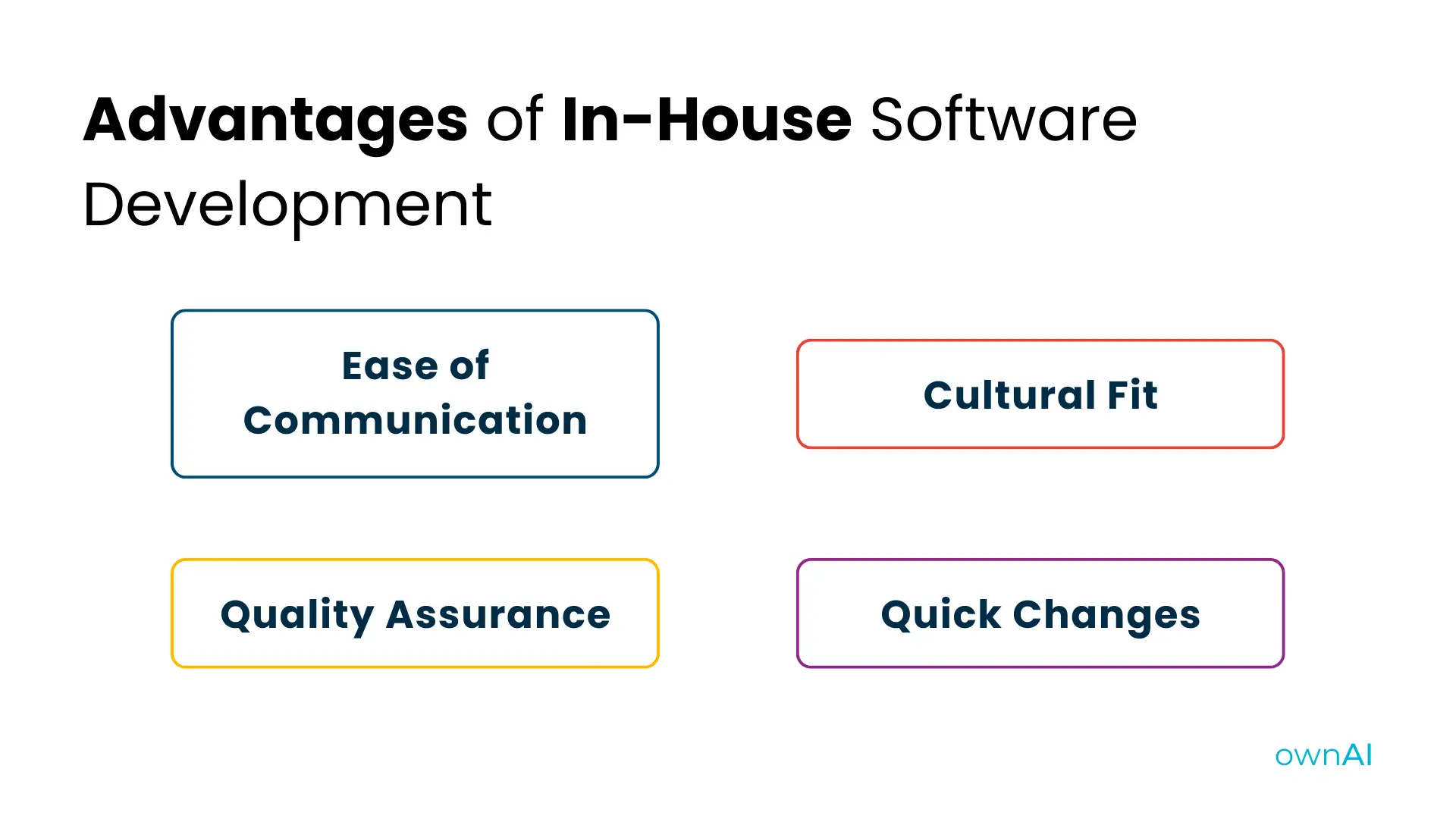
Ease of Communication
Internal software developers collaborate. They understand the basic guidelines of a project and have a vested stake in its success as company staff. In-house teams will already be acquainted with feedback methods and workflow processes. Language barriers are often not an issue with in-house software development.
Quality Assurance (QA)
Implementing QA standards across the board with an in-house software developers team is easier. Having all your developers housed under one roof simplifies monitoring the quality of individual assignments and ensuring all coding standards are followed. In-house development also allows you to oversee compliance and verify that Payment Card Industry (PCI) Data Security Standards (DSS) and European accessibility criteria are met.
Cultural Fit
In-house team developers focus considerably more on an organization's specific requirements. There is no requirement for personnel onboarding as there is with an outsourced business, and developers can start working immediately. It implies that internal developers are driven to produce the most-effective solutions and add the most value.
Quick Changes
Having in-house developers allows you to swiftly update or add features to the project and review their technical backgrounds. Developers can also process bugs more quickly.
Disadvantages of In-house Software Developers
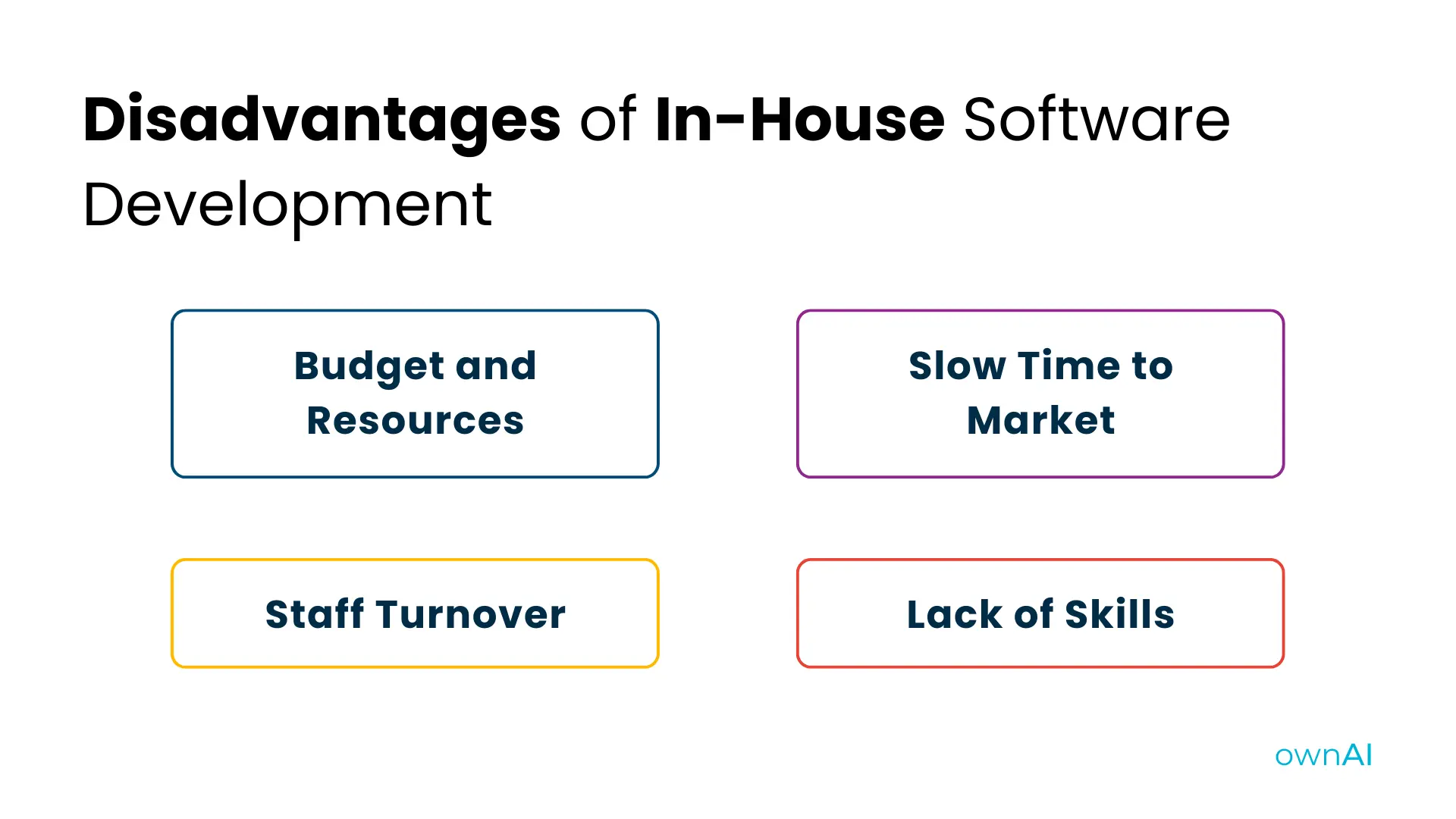
Lack of Skills
Lack of in-house expertise is one of the leading causes for which businesses outsource their software development. Skills shortages result in challenging learning curves and overworked workers. Assessing your team's capabilities before beginning a software development project is crucial. Once you have identified your team's strengths and shortcomings, you can utilize this information to assess their influence on your project.
Budget and Resources
In-house software development can be expensive and time-consuming for businesses. Employing full-time workers can be costly and labor-intensive, especially in today's competitive job market, if skill shortages need to be addressed. Annual salaries, benefits packages, employee pensions, ongoing training, rent, and taxes training are all standard.
According to PayScale, the salary of an average software engineer is over $83,000, demonstrating the high cost of recruiting full-time employees. Similarly, there is no room for new work when an entire team is focused on a single project.
Staff Turnover
The workplaces of software developers tend to shift rather frequently. It occurs because there is a great need for experienced developers, and competing businesses often provide better working conditions. As a result, you can run into labor problems and waste some time. Your project's development may be interrupted or slowed since finding a new developer takes time.
Slow Time to Market
It may take longer than expected for in-house software development. If staff members are at full capacity, internal developers might have to increase projects and work extra hours to meet demand.
The average software development project involves 11,414 hours of work and takes slightly over 11 months to finish, according to analytics firm QSM. Companies must release their products rapidly to the market in today's competitive business climate, or they'll lose out to rivals.
When to Use In-house Development
Building your own in-house development team has an apparently high cost, but there are some compelling reasons to create your team.
You are ready to pay more. Hiring an in-house development team will provide you with all the advantages and minimal drawbacks if you are not running a bootstrapped business and have sufficient capital.
Planning a long-term project. Building your own in-house development team makes sense if you are a product-based business seeking to generate a long-term product with various updates, future scalability, etc.
You must have total control. You can't tolerate having any control over the problems and risks arising during development. With an internal team, you can immediately make all choices that affect the product's development. As a result, every problem is resolved as soon as it occurs.
In-house Software Development Examples
Salesforce
Business owners might want total control over developing products when working with confidential data or company secrets. In this situation, in-house development is ideal since it allows daily progress monitoring, prompt problem-solving, and security against information hacking.
This may be why Salesforce, the company that created the renowned CRM system, chose in-house software development over outsourcing for its projects.
Netflix
Software that is closely related to the company's main goal should be built in-house. Netflix is an excellent example of this strategy.
By making major investments in machine learning (ML) and data analysis programs for its user layouts, Netflix sets itself apart from the competition. Additionally, Netflix needs total control over it as it is the main platform the company uses to offer movies and television series.
Despite its commitment to in-house development, Netflix never hesitated to outsource and did so to survive the recession of 2004.
Amazon
As mentioned in a previous example, the in-house development team has an increased understanding of the organization's systems, procedures, and culture, which is crucial for major companies like Amazon.
However, the company was compelled to spend 700 million on training its staff, which usually required more technical knowledge and expertise.
What is Outsourced Software Development
On the other hand, outsourced software development refers to hiring a third-party vendor to develop software applications or systems on behalf of an organization. Companies that don't have enough resources and competence to produce software themselves actively use this approach.
If you decide to outsource software development, you must find a provider with strong experience and positive customer reviews. After that, a team of experts will develop an application that complies with your specifications and help you deploy it.
Additionally, outsourcing provides access to a pool of software developers with domain knowledge, practical experience, and skills required to complete these tasks.
ISG Research claims that 92% of the Forbes Global 2000 companies employ IT outsourcing, while 59% use business process outsourcing, claims ISG Research.
The IT outsourcing industry turnover is predicted to reach $587.30 billion by 2027, according to Statista research . As a result, many companies nowadays use outsourcing software development services to save costs and time and hire competent employees. Google and Slack are two well-known companies that outsource their IT development.
Advantages and Disadvantages of Outsourced Development
Let's discuss the advantages and disadvantages of hiring a software development provider.
Advantages of Outsourced Software Development
The benefits of outsourcing the development of company software solutions are undeniable, making this software development approach one of the most popular.
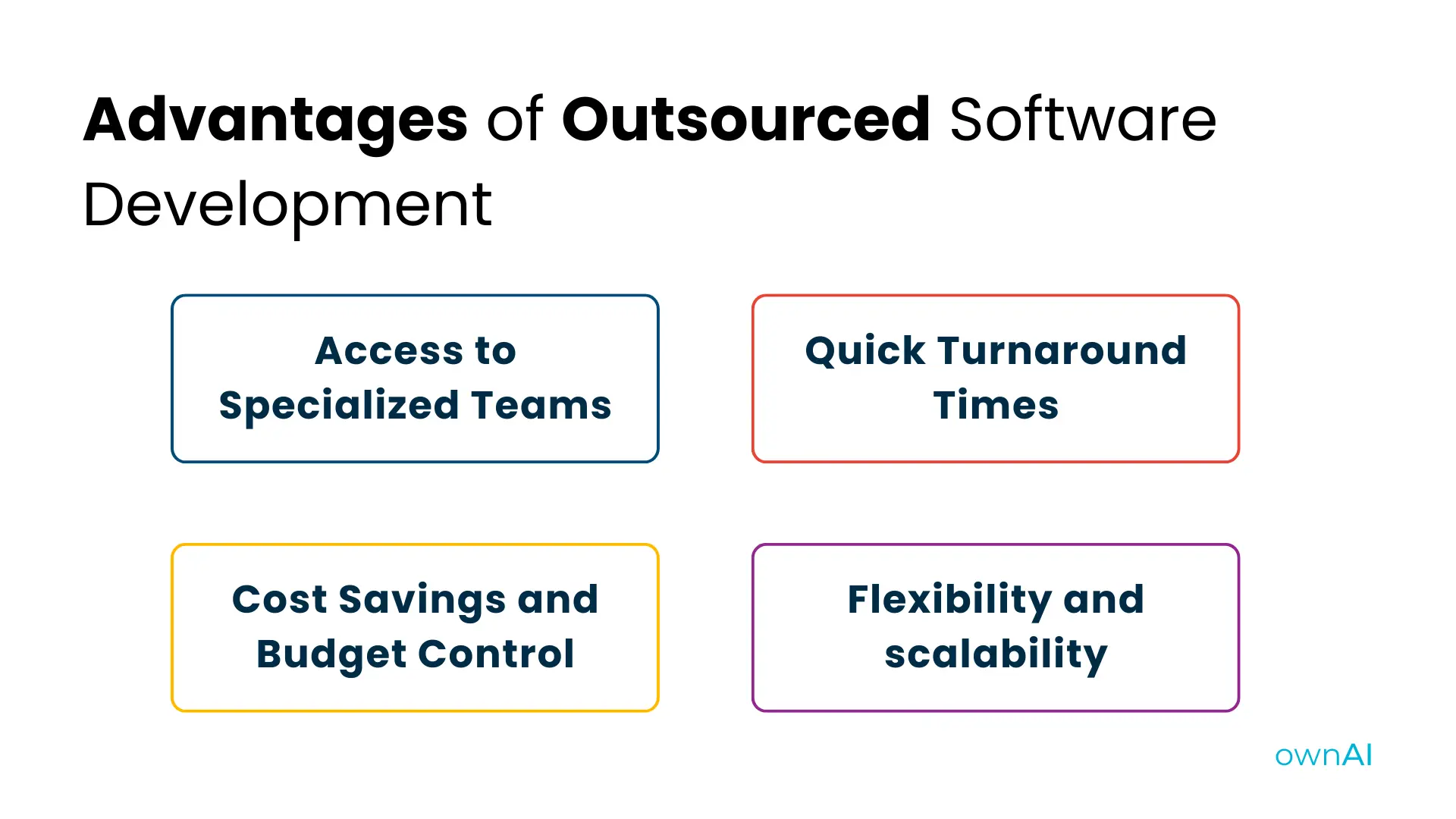
Access to Specialized Teams
Every company wants to make development accessible and work with those who are experts in their industry. Outsourcing gives you access to various specialized skills and expertise that may not be available in-house. Vendors often have extensive experience in specific technologies or industry domains, which enables them to bring unique and innovative software solutions to the project.
Workflows will be in place for experienced software teams to meet project milestones. For example, ownAI's workflow is distinguished by a clear mindset and a five-step approach to software development: understand, design, develop, launch, and improve & scale.
Quick Turnaround Times
Having a project finished on time is one of the main advantages of outsourced software development services. Outsourcing helps fast the development process, as vendors are usually equipped with the resources to launch a project quickly. Additionally, they can allocate specialized teams to work entirely on the development, accelerating the time to market and giving businesses an advantage over rivals.
Cost Savings and Budget Control
Outsourcing software development can provide cost benefits, especially for smaller companies with limited budgets. By outsourcing, organizations can avoid substantial upfront investments in staff and infrastructure and, instead, opt for flexible pricing models, such as fixed-price or time-and-materials contracts.
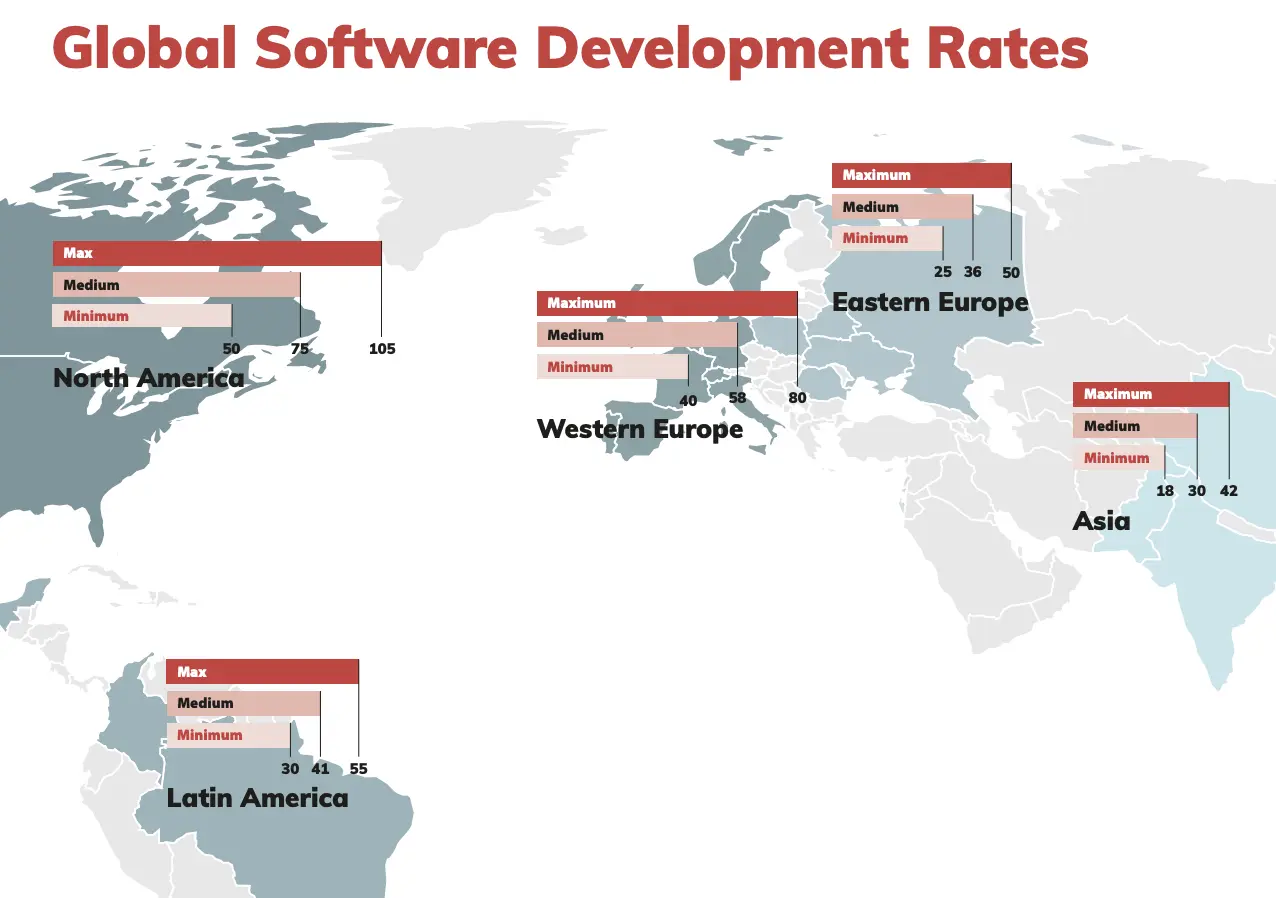
Image Source: aloa
Flexibility and scalability
Outsourcing allows businesses to scale up or down based on project requirements quickly. Vendors can offer extra resources when required, ensuring effective workforce access and minimizing the risk of being understaffed at peak times.
Disadvantages of Outsourced Software Development
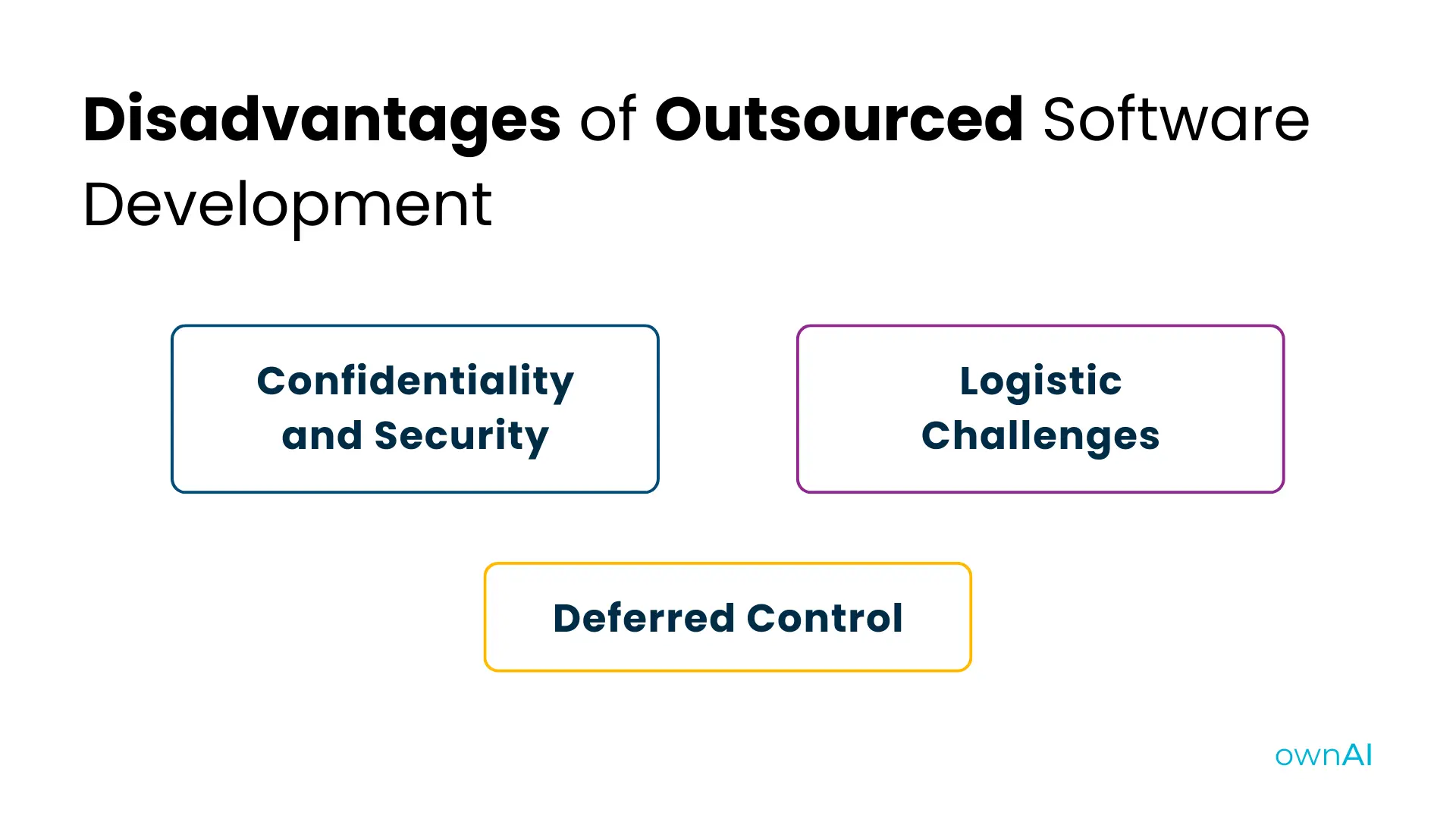
Logistic Challenges
Negotiating several time zones is occasionally necessary when working with an outsourced software development team. This does not always slow down the development process, but it can make meeting organizations more complex. Due to time zone differences, organizations may not have rapid access to outsourced developers if errors or bugs need to be rectified quickly. However, many leading outsourcing companies like ownAI offer unrestricted 24/7 access.
Confidentiality and Security
Outsourced software development involves entrusting personal information to your partner. It is essential to have an NDA in place that outlines the project's confidential terms. You should also ensure that your outsourced team has strong security measures to protect against cyber-attacks.
Deferred Control
Sometimes, customers have little control over the process when working with full-cycle development companies. This usually gives them time to concentrate on other business-related tasks, but sometimes it makes quality control challenging. A competent software development service will have project management services in place so that both parties can provide regular feedback and updates.
When to Use Outsourced Software Development
Outsourced development is the best choice in the following circumstances.
There is a budget constraint. Like many businesses, you have a limited budget and need help to support a full-time staff. You can be more adaptable with your cash flow by outsourcing. Additionally, you are not bound by a commitment of monthly salaries.
There are not many specialists accessible. It seems impossible to find the proper skills in your city. You would be better off contracting a third-party IT vendor to complete the work than investing months in training someone in-house.
The launch dates are very close. If you lack previous expertise in software development, frequent stumbling hurdles may catch you off guard. Hiring a professional IT vendor can help you prevent delays that you cannot afford to have when you are on a tight deadline.
Outsourced Software Development Examples
Several companies have outsourced their software development and gotten substantial benefits.
Alibaba
The global eCommerce & tech giant is now probably as well recognized as the Great Wall of China while undoubtedly being considerably more accessible from abroad. When the company was founded in 1999, companies increasingly built websites for customer relations.
To establish a website that would attract the public at home and throughout the English-speaking globe, the founder, Jack Ma Yun, hired American web developers. Additionally, they hired remote developers with the knowledge and experience to build the largest online marketplace. This elevated Ma Yun to magnate status, with Alibaba generating $56.152 billion in global revenue in 2019.
Slack
Slack, one of the most widely used remote communication solutions, helps bridge the gap between offshore and in-house teams.
Slack was founded by a small team of four bright people in its early stages. At the time, it was merely a private team collaboration tool. When the team decided to advance their creation, they encountered problems with the tool's visual features and others.
The Slack team hired a design company to rebuild the company's website, app, and logo to address these issues. Today, most of what users see while interacting with messaging services is because of it.
Outsourcing of beta testing and web designs enabled Slack to get valuable feedback and unbiased opinions on the project. It also allowed them to improve and stand out from the competition. There are approximately 3 million paying users and 8 million overall app users.
Differences Between In-house and Outsourced Software Development
Let's list the key differences between in-house and outsourced development.
Cost
You will pay more for in-house software development because it requires more hiring, resources, and equipment. Consequently, outsourcing is less expensive since you will only pay for the team's effort. Additionally, you can select a location with lower hourly wages, which would considerably minimize the cost of app development.
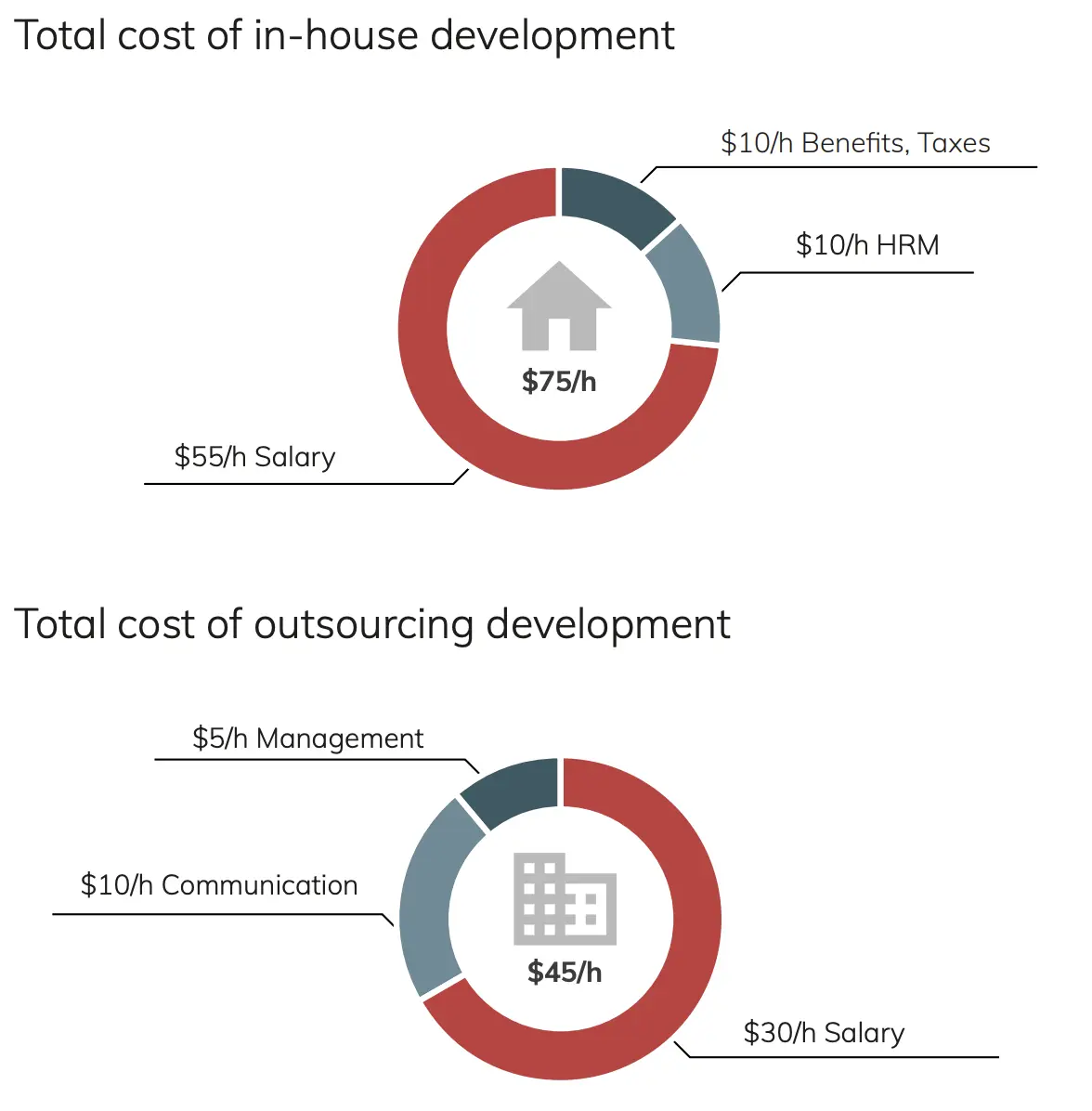
Image Source: aloa
Expertise and Knowledge
When working with an in-house development team, you're limited by your staff's skills and technology. In contrast, while working with an outsourcing development team, you can request more specialists or deploy a technology that had not been originally envisaged without wasting time looking for the proper expert.
Development Time
Due to the team size restrictions, in-house software development may need extra time. In contrast, outsourced teams may produce software more quickly because they can access all the necessary experts to deliver your product idea—from planning to development and implementation.
Flexibility and Scalability
It takes a long time to assemble an in-house development team, so if you require more professionals to finish the project faster, you'll have to spend even more time looking for them. On the other hand, outsourcing entails increasing the staff on demand, allowing you to scale it up or down based on your needs simply.
Communication and Management
Personal communication makes it easier to manage your workers, so if you hire internal developers, you can handle the process more effectively. You might face language barriers or time zone issues when working with an outsourced development team. Experienced software development services providers, such as ownAI , make individualized communication plans with clients to schedule meetings at times that are convenient for the customer. Furthermore, our specialists are competent in English, so you can be confident that our team will know what is required of them.
Security
Working with an internal team will always provide you control over the organization's data protection. On the other hand, managing outsourcing providers is difficult. To ensure security, you might pick software vendors who operate under Non-Disclosure Agreements (NDAs). For example, the ownAI team always agrees with the client's request to sign NDAs.
Why Hire Software Developers at OwnAI?
ownAI is a professional software and mobile app development company with over years of market experience. We have vast experience in various services, from developing custom software solutions to servicing and updating legacy software. ownAI provides highly skilled developers at fair hourly rates.
- Our developers and project managers speak English fluently, making communication simple and comfortable.
- If we are in different time zones, our project managers will update you by following your schedule.
- Developers use modern technologies to create applications and websites. They frequently attend workshops, conferences, and other events to broaden their knowledge.
Summary
The benefits of working with an outsourced development team, such as cost-effectiveness and faster development time, are attracting more and more company owners to outsource. In-house development is a smart solution for those requiring complete product development control. Our general suggestion for choosing the optimal development model is to evaluate your circumstances from various perspectives. Remember that outsourcing handles the majority of software development execution and planning, allowing you to focus on more business-critical tasks.
If you have decided that working with an outsourcing firm is the best answer for you, we are ready to consider your request and discuss the project details. Let’s Get Started!

Let’s discuss about your next AI, Cloud or Digital Transformation.
 AI-Skilled & Agile
 Transparent, Trustworthy &
Vetted team Not tech, but business &
customer first approach





 Turn your idea into MVP in 8-16 weeks