


Automation used to be about saving time. Now it is about competitive advantage.
In fact, a recent study shows that 9 out of 10 organizations use AI for competitive advantage.
The tools you choose today will shape how your team scales, how intelligently your systems operate, and how much operational control you retain in the long run.
Whenever any business is planning for automation, n8n vs Relevance AI always comes up at the top.
Both promise AI automation, integrations, and AI capabilities. But in reality, they solve very different problems.
n8n is an open source tool that connects apps and automates tasks using custom workflows. On the other hand, Relevance AI is a platform built to create and run AI agents that handle tasks using language models.
If you pick the wrong foundation, you may struggle with complexity, unpredictable costs, or limitations as your automation needs grow.
That is why choosing the right one is a crucial step, and this guide will help you make that decision.
In this guide, you will understand:
- What is n8n?
- What is Relevance AI?
- The pros and cons of both
- An in-depth comparison between Relevance AI or n8n
- Which tool is best to consider
So, without any further delay, let us dive in.
n8n vs Relevance AI: Quick Comparison
Here’s the quick comparison between Relevance AI vs n8n AI review:
| n8n | Relevance AI | |
|---|---|---|
| Main Focus | General workflow automation and data mapping | AI agents and LLM-powered applications |
| Best For | Developers and technical users who want control | AI researchers, data teams, and rapid prototyping |
| Approach | Visual, node-based, low-code builder | Low-code, agent-based, prompt-driven system |
| Hosting | Self-hosted free option or managed cloud | Fully managed SaaS cloud platform |
| Integrations | 1,100+ integrations with custom JavaScript support | 2,000+ integrations, model-agnostic (OpenAI, Claude, Gemini) |
| AI Features | No built-in AI by default; AI nodes must be added manually | Built-in vector store, RAG, and AI agent capabilities |
| Debugging | Clear error logs, failed nodes turn red, and specific steps can be re-run | Strong “Run test” mode with simulation and tool approval features |
| Pricing | Free if self-hosted; cloud pricing is execution-based | Usage-based pricing with actions and AI credits |
| Cost Control | Predictable pricing per workflow execution | Credit-based system can be harder to estimate at scale |
| Key Strength | Full control with detailed API access and workflow logic | Fast creation of specialized AI agents with built-in knowledge systems |
| Key Limitation | AI setup requires manual configuration and external model setup | Can struggle with very long or highly complex workflows |
What is n8n?
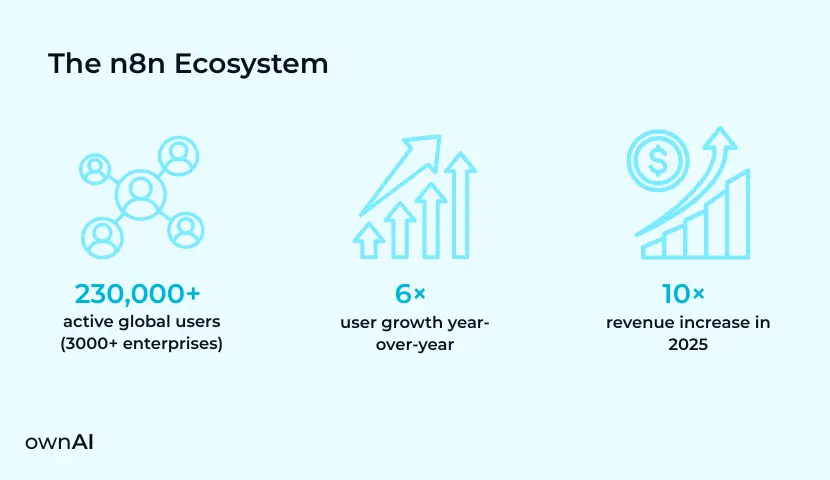
n8n is an open source workflow automation tool that connects apps, databases, and APIs to automate tasks and move data between systems.
It uses a visual, node-based builder where you design triggers, conditions, and multi-step logic.
You can handle complex workflows, map JSON data, and add custom JavaScript when needed.
A major advantage of n8n is self-hosting. You can run it on your own server for full control over data, privacy, and infrastructure, or use its cloud version with execution based pricing.
Key Features
Visual Workflow Builder: Build automations using a drag-and-drop, node-based editor that supports complex logic, branching, and real-time testing.
Self-Hosting Option: Run n8n on your own infrastructure to maintain full control over data security, privacy, and compliance requirements.
Extensive Integrations: Connect with hundreds of apps, databases, and services to automate processes across your entire tech stack.
Custom Code Support: Add JavaScript or Python inside workflows to handle advanced logic, data transformation, and custom automation needs.
Flexible API Access: Use the HTTP request node to connect with any external API, even when a native integration is not available.
Advanced Error Handling: Set up retry rules, failure alerts, and fallback paths to keep workflows reliable and production-ready.
Pros and Cons of n8n
| Pros | Cons |
|---|---|
| Can be self-hosted for full data control and privacy | Requires technical knowledge to set up and manage properly |
| Cost-effective for high-volume automation | Self-hosting requires server maintenance and DevOps effort |
| Allows deep customization with JavaScript and API access | A smaller number of ready-made integrations compared to larger platforms |
| No limits on workflow steps or complexity | Not beginner-friendly for non-technical users |
| Supports AI workflows with dedicated nodes | Performance can slow down with very large or complex data processes |
| Visual workflow builder makes complex logic easier to manage | Advanced team permissions are limited in the free version |
What is Relevance AI?
Relevance AI is a no-code platform that helps businesses create and manage AI agents to automate complex tasks.
It works like a central system where you build specialized AI agents that can handle activities such as research, content generation, data analysis, and customer support without needing a heavy technical setup.
Key Features
No Code Agent Builder: Create AI agents by describing what you want them to do, without writing code.
Multiple AI Agents Working Together: Build a team of AI agents that handle different parts of a task and work as a group.
2,000+ App Integrations: Connect with popular tools like Gmail, Slack, HubSpot, and Salesforce for full business automation.
Knowledge-Based AI (RAG): Let agents use your company documents and data to give accurate and context-aware answers.
Supports Multiple AI Models: Switch between models like GPT 4, Claude, and Google depending on your needs.
Human Approval Option: Set rules so agents ask for approval before taking important actions.
Pros and Cons of Relevance AI
| Pros | Cons |
|---|---|
| Easy-to-use interface that works well for non-technical users | Credit-based pricing can become expensive and harder to estimate over time |
| Allows multiple AI agents to work together on complex tasks | Building effective agents requires structured thinking and planning |
| Supports major AI models like GPT-4, Claude, and Gemini | Agents may sometimes loop, slow down, or face technical glitches |
| Connects with tools like HubSpot, Salesforce, Slack, and Google Docs | Reporting and analytics features are limited |
| Agents can be customized for different business needs | Customer support and documentation may not always be fast or detailed |
| Helps automate multi-step workflows to save time | Advanced features are often available only in higher pricing plans |
n8n vs Relevance AI: In-Depth Comparison
Choosing between n8n vs Relevance is not about features alone. It is about understanding how each one thinks, operates, and scales with your business.
These are some key factors that help you clearly make the right choice between n8n vs Relevance:
1. Core Focus: Workflow Automation vs AI Agents
n8n:
n8n is designed to automate structured business operations. It connects applications, moves data between systems, and executes clearly defined multi-step workflows based on rules and logic. It behaves like a process engine that follows exact instructions, making it ideal for operational automation where precision and control matter.
Relevance AI:
Relevance AI is built around AI agents powered by large language models. Instead of focusing on step-by-step system connections, it focuses on reasoning tasks such as research, analysis, classification, and content generation. It is optimized for intelligent task execution rather than strict workflow mapping.
2. AI Capabilities
n8n:
n8n supports AI through dedicated nodes that allow integration with language models and retrieval systems. However, AI functionality requires manual configuration and structured setup. It provides flexibility, but AI is an extension of workflows, not the foundation of the platform.
Relevance AI:
AI is the core architecture of Relevance AI. It includes built-in vector search, retrieval augmented generation, and multi-model support such as GPT-5, Claude, and Gemini. The platform is structured specifically to create and manage AI agents that analyze and generate outputs with minimal manual wiring.
3. Self-Hosting and Data Privacy
n8n:
n8n offers a self-hosting model that allows businesses to run the platform on their own infrastructure. This provides full control over data handling, privacy policies, and compliance requirements. It is particularly valuable for organizations with strict security standards.
Relevance AI:
Relevance AI primarily operates as a cloud-based SaaS platform. This makes onboarding fast and maintenance simple, but infrastructure control remains external. It prioritizes convenience over infrastructure ownership.
4. Technical Complexity and Target Users
n8n:
n8n is built for developers and technical operators who want deep customization. While it provides a visual builder, building advanced workflows often requires understanding APIs, structured data, and occasionally JavaScript. It rewards technical expertise with flexibility.
Relevance AI:
Relevance AI is designed for low-code AI development. It enables faster creation of agents using templates and guided configuration. It is more accessible to AI engineers, analysts, and business teams seeking AI-driven automation without heavy coding.
5. Integration Ecosystem
n8n:
n8n offers a broad set of native integrations across traditional business tools, databases, and developer platforms. It also supports API and webhook connections, allowing it to adapt to evolving system requirements.
Relevance AI:
Relevance AI focuses on integrations that support AI-driven workflows and productivity platforms. It supports major business tools and API connections, but its ecosystem is more specialized around AI use cases.
6. Pricing Structure
n8n:
n8n generally uses execution based pricing for its cloud offering and remains free when self-hosted. This creates predictable cost modeling, especially for structured and high-volume workflows.
Relevance AI:
Relevance AI pricing operates on a usage-based model tied to AI agent activity and language model consumption. As agent complexity and task volume increase, costs can scale more dynamically.
7. Workflow Design and Data Handling
n8n:
n8n uses a visual, node-based editor that supports complex branching logic and structured data manipulation. It is well-suited for deterministic workflows where every step must follow clearly defined rules.
Relevance AI:
Relevance AI uses an agent-driven interface focused on analyzing large volumes of unstructured data and coordinating AI tasks. It excels at intelligent processing rather than managing deeply branched operational logic.
In simple terms, n8n gives you precise workflow control, and Relevance AI gives you intelligent task execution. The better choice between n8n vs Relevance depends on what your business needs most.
n8n vs Relevance AI: Which Tool Should You Choose?
Relevance AI vs n8n, both tools are powerful, but they serve different needs. Here is how to decide which fits yours.
Choose n8n if:
You need full customization and control: You want to build complex, multi-step workflows using JavaScript, custom nodes, and detailed logic control.
Self-hosting and data privacy matter: You need to run the platform on your own infrastructure for compliance, security, or ownership reasons.
You are connecting diverse systems: Your focus is on integrating APIs, databases, and SaaS apps across your entire tech stack.
You want predictable and cost-effective scaling: You prefer avoiding credit-based pricing, especially for high-volume automation.
You are building advanced AI systems manually: You need to construct RAG or agent-style systems with full control over memory and orchestration.
Choose Relevance AI If:
Your main goal is building AI agents: You want LLM-powered agents for research, sales, analytics, or customer support tasks.
You work heavily with unstructured data: You need to process PDFs, websites, and large text datasets efficiently.
You prefer low-code AI development: You want to build and iterate on AI workflows without deep technical setup.
You want built-in AI capabilities: You prefer ready-made AI search, analytics, and agent tools instead of building from scratch.
You prioritize speed and convenience: You want a SaaS platform that allows rapid deployment without managing infrastructure.
Conclusion
Choosing between n8n vs Relevance AI is not about picking the more popular tool. It is about choosing the right foundation for how your business wants to automate.
If your priority is structured workflows, deep system integrations, full customization, and infrastructure control, n8n gives you that precision.
If your focus is on deploying intelligent AI agents, working with unstructured data, and launching AI-driven workflows quickly, Relevance AI offers a faster and more AI native path.
Both platforms are strong. They simply solve different problems.
We hope this guide helped you clearly understand the differences between n8n vs Relevance AI, their pros and cons, and which one is better to choose.
Still have doubts? Why not consult with an expert to get the right guidance?
Book a free consultation with ownAI experts today and get expert guidance for the next step.
FAQs
1. What is the real difference between n8n and Relevance AI?
The biggest difference comes down to how they work. n8n helps you build structured workflows where you control every step and integration. Relevance AI helps you create AI agents that can analyze, think, and complete tasks using language models. One is rule-driven automation. The other is AI-driven execution.
2. Which tool is better for building AI agents?
If your main goal is to build AI agents for research, sales, support, or analysis, Relevance AI is the more natural fit. It is designed around agents from the start. n8n can support AI workflows, but you will need to set them up manually.
3. Is n8n better for complex integrations?
Yes, especially if you are connecting multiple systems, APIs, and databases with custom logic. n8n gives you more control when workflows become detailed and highly structured.
4. Which platform is more predictable in terms of cost?
n8n tends to be easier to estimate, especially if you self-host or use execution based pricing. Relevance AI pricing is usage-based, which can increase faster depending on how heavily your agents are used.
5. Which one is easier for non-technical teams?
Relevance AI is generally easier to start with. Its low-code approach and ready-made agent setup make it more accessible. n8n is more suitable for developers or teams comfortable working with APIs and structured workflows.
6. How should I decide which tool is right for my business?
Choose n8n if you need full control over automation and infrastructure, as self-hosting allows your team to fix bugs or issues quickly without vendor dependency. If your priority is AI agents and unstructured data on a managed platform, Relevance AI is the better fit.





 Turn your idea into MVP in 8-16 weeks