


Agile vs waterfall is an age-old debate in the software development industry. Choosing the right model is the first decision to make when developing software. Interested in this debate and want to know which methodology is best for your software development project? This article will help you make the right decision.
Agile methodology is flexible and focuses on iterative project progress, whereas the waterfall is the rigid and sequential approach. Agile methodology is the most popular compared to traditional waterfall methodology, but the debate doesn't end here. At ownAI, the first decision we face when developing a digital product is which development methodology we should use.
Each model has pros and cons, which make it a better fit for different development projects. We are not here to dispute which model is best; instead, we want to help you choose the right one for your projects. Which methodology is best for your digital product development project will depend on multiple factors, such as your organization's team, skills, culture, and type of project. In this article, we will do an in-depth comparison of both models to help you find the suitable model for your project.
What is Agile Methodology?
An agile methodology is an adaptive approach that promotes continuous iteration of development and testing throughout the software development cycle. This practice allows software development teams to adapt to changing project needs and produce excellent results in shorter time frames. This methodology is frequently used in the software development lifecycle.
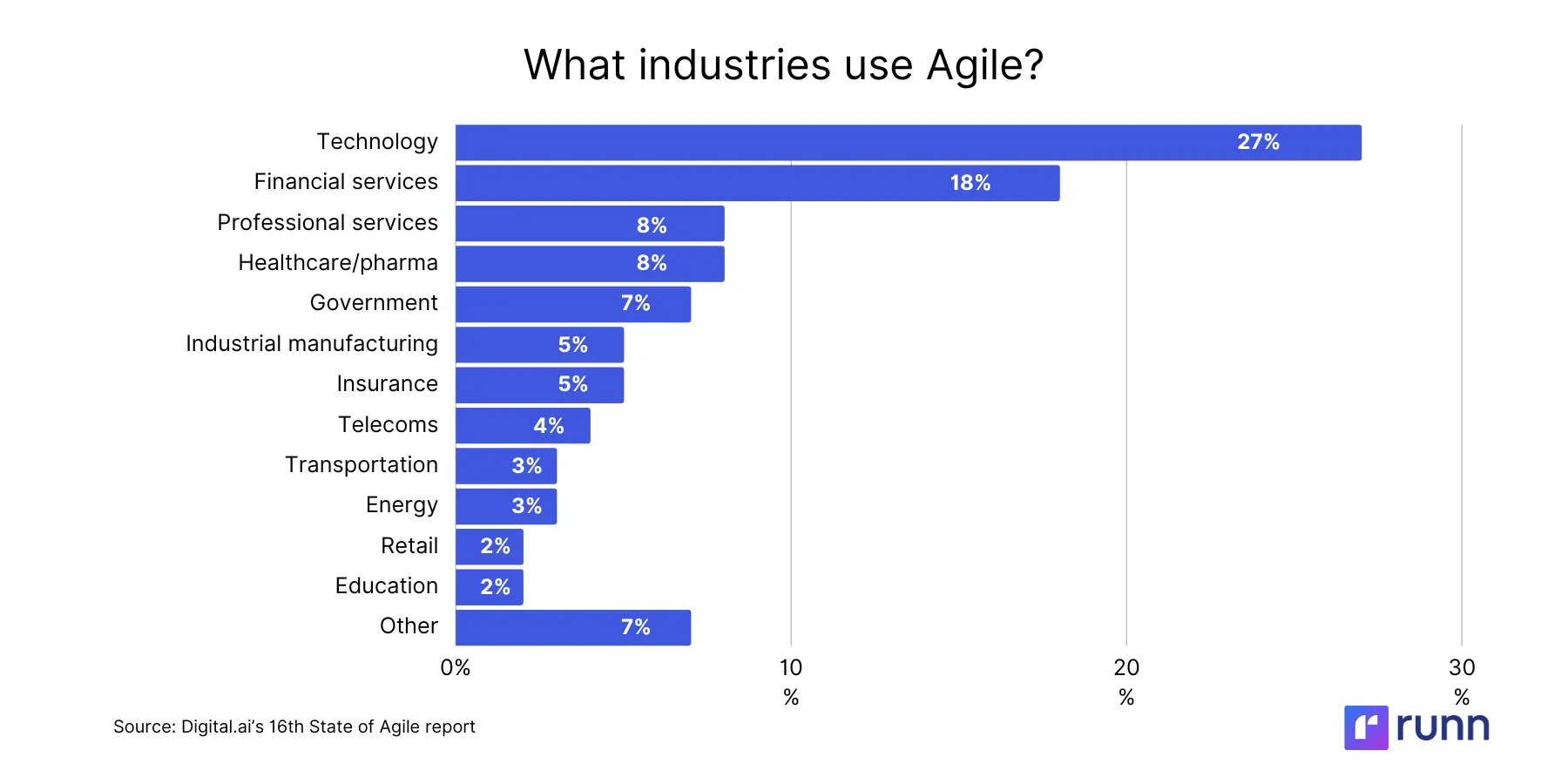
According to Atlassian's State of Agile 2023 Report, Agile methodology dominated project management, with 63% of projects adopting Agile practice in 2023, which is a significant increase from 42% in 2018.
In agile methodology, the project is divided into short incremental development cycles, known as sprints. Agile gets its name from the famous Agile Manifesto, written by software developers, though its roots date back to 1950. Agile methodologies emphasize teamwork, continuous improvement, customer satisfaction, and breaking large projects into manageable pieces. Also, it enables the team to pivot and adjust to evolving customer needs by prioritizing communication and collaboration.
Related Read: Top Benefits of Agile Software Development for Your Business
Stages of Agile Methodology
Agile development methodology consists of the following processes:
Planning
This is an initiation phase in which the team, key stakeholders, and client get together to conceptualize, define priorities, brainstorm, resource, and budget a project before it is approved and initiated. They figure out how to start developing the plan.
Design
UI/UX experts collaborate with a client, product management team, and other stakeholders to determine the product design and the desired features.
Development
Once the design is finalized, the software development team starts working on the build phase. The team works through multiple sprints to create a high-quality digital product that meets the client's needs.
Testing
In this phase, the developed product is tested to detect defects and ensure the product aligns with requirements. If any bugs are found, the product goes through the development phase again to fix the issue before being tested again. The testing continues until the product is completely error-free and meets the desired goals.
Release
Once the product is tested and refined, it is released and deployed to the end users.
Feedback
After launch, teams review the user feedback to evaluate what improvements need to be made to the product. Then, the latest version of the product is released after necessary adjustments and upgrades.
Pros of Agile Methodology
- It is a client-focused process, ensuring the client is constantly involved in the project at each stage.
- Agile development teams are able to produce better results in digital product development projects because they are highly self-organized and motivated.
- This methodology ensures that the quality of product development is maintained.
- Agile methodology is known for its flexibility. It is an ideal approach in development to deal with evolving customer needs.
- The agile model is transparent, and it is entirely based on incremental progress. As a result, the development team and customer are fully aware of what is happening in the project. This practice reduces risk in the software development process.
- In the agile project, the testing is done continuously. This allows the team to detect and correct errors early, enhancing the quality of deliverables.
Cons of Agile Methodology
- The agile development process often demands additional time and resources for ongoing iterations. Therefore, the cost of implementing an agile model can be higher than other models.
- This model is not so useful for small development projects.
- The agile development process involves a lot of discipline and commitment, which needs a team that is proficient in all agile concepts.
- The flexibility of this model can expand the project scope without any clear boundaries.
- The agile method lacks a proper structure, so the project can sometimes become challenging and requires a highly skilled software development team to manage.
If you're looking for the best software development team with great expertise in Agile methodology, ownAI is a perfect choice!
What is Waterfall Methodology?
Waterfall methodology is a linear model that is ideal for projects with predictable timelines and well-defined scopes. Waterfall is the oldest software development methodology. It was initially documented in a 1970 paper by Winston W. Royce titled "Managing the Development of Large Software Systems."
This model is followed in sequential order, meaning the development team only moves to the next stage of development if the previous step is completed successfully. Teams execute and complete each process in the precise same order. It requires rigorous planning to keep the project on track. The project progress is tracked closely during the waterfall development process.
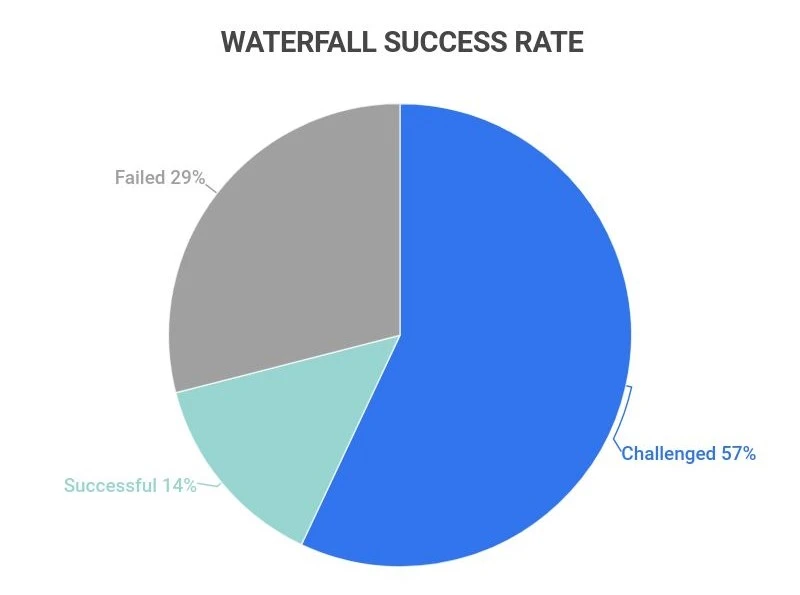
Source: zippia
Stages in Waterfall Methodology
The waterfall model is divided into the following phases:
Requirements Gathering
This phase includes gathering information from clients and key stakeholders about functional, technical, and system requirements to be used in a project, understanding those requirements, and documenting them.
Design
Following the requirement gathering, they are analyzed, and a system design is created. UX experts work with clients and product teams to prepare the overall system appearance.
Implementation
The input from design is then used to develop a product in small units or programs. Next, these units are tested for their functionality.
Integration and Testing
The developed units are tested and integrated into a system. After integration, the entire product is tested for any failures or flaws. If any bugs or errors are detected, they are addressed before deployment.
Deployment
Once the testing is complete and the product meets the requirements, the product is delivered to the client and deployed in the market.
Maintenance
After product delivery, the customer may request changes to be made and approved. However, they will result in extra costs and time.
Pros of Waterfall Methodology
- The waterfall methodology is simple to manage. Although the cycle is formal and sequential, the ordered stages are easy for teams to navigate.
- The model works great for small projects where requirements can be easily understood.
- Progress tracking is easier because the start and end of the project are predefined.
- The final cost is already calculated before the project initiation, so there are no changes afterward.
- After the requirements phase, customer involvement is not strictly required except for approvals, reviews, and project status meetings.
- The client and development team agree upfront on what will be delivered, which simplifies the development process.
Cons of Waterfall Methodology
- This model is not ideal for large-size projects.
- In the waterfall cycle, product development is usually slower due to its sequential nature and dependency on the completion of the previous phase.
- Scope changes are unlikely to occur because all requirements are approved at the start of the project.
- The testing phase starts only after the completion of the development phase. This increases the chance that bugs will be discovered later, and fixing them will cost more money.
- It is difficult to go back and make changes in previous steps.
Differences between Agile and Waterfall Methodologies
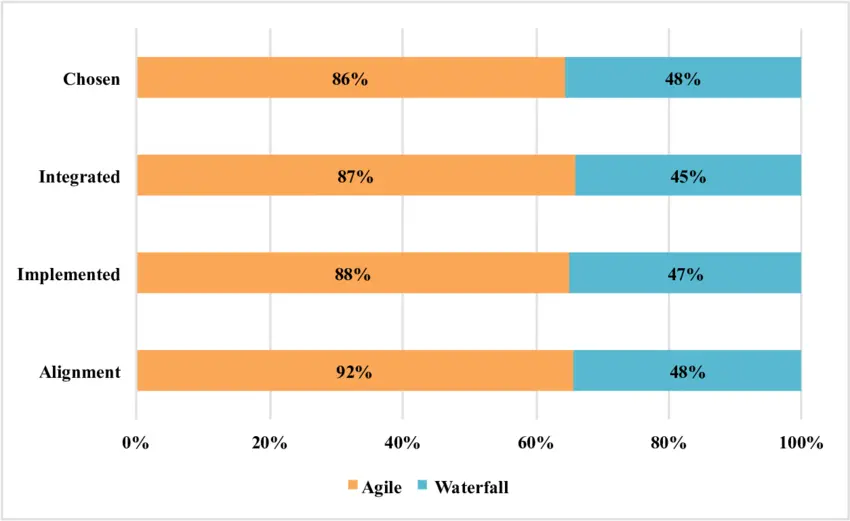
Let's compare both models to help you differentiate between them more clearly, which will help you choose the best approach for your project.
Source: Researchgate
Here are the differences between agile and waterfall methodologies, depending on multiple factors.
Planning
In the agile model, planning is a continuous process in the project's life cycle that is adjusted as new requirements or information emerge.
Planning in a waterfall model is a linear process that is done at the start of the project, and all requirements and goals are outlined upfront in detail.
Rigidity
The agile model is flexible, allowing teams to respond quickly and adapt to changes throughout the development process.
The waterfall model is rigid and highly structured. There are low chances for changes to be made after defining the project's scope.
Projects
Agile projects are delivered more rapidly. This model is ideal for projects where requirements are anticipated to change and evolve.
The waterfall model is best suited for projects with clear requirements and low expectations of changes.
Timeframes
The agile model uses short sprints to deliver the product, enabling the team to modify plans over time.
The waterfall approach is for long-term projects with specified completion dates. The project is completed in a linear manner, and each phase depends on the previous one.
Communication
The agile process includes informal communication and regular interactions between the development team and the customer or stakeholders. It encourages constant customer involvement throughout the project.
The waterfall approach restricts customer involvement to the project's early phases. In this model, communication is formal, and the team shares a comprehensive communication plan and progress report with customers to participate.
Testing
In agile methodology, incremental testing is essential and is done simultaneously with development to detect and resolve issues as soon as they arise.
In the waterfall model, testing is a separate phase, and it is often done at the end of the project.
Which Projects are Best Suited for Agile Methodology?
The agile methodology is ideal for:
- Large, complex, and undefined projects
- Projects that demand client involvement or teams that work closely with clients and stakeholders
- Expert and high-performing software development teams
- Situations where there is room for changing requirements
- Organizations that prioritize continuous improvement and high-quality deliverables
- Software development teams that prefer to get quick feedback on deliverables rather than waiting for a project to be finished
Which Projects are Best Suited for Waterfall Methodology?
The waterfall methodology is most suitable for:
- Simple, smaller, and well-defined projects with simple requirements
- Projects with a fixed budget, time, and scope
- External organizations where customers can't collaborate frequently
- Development teams that have a fixed budget and require a sequential project timeline
- Companies that are tolerant of taking risks or making changes
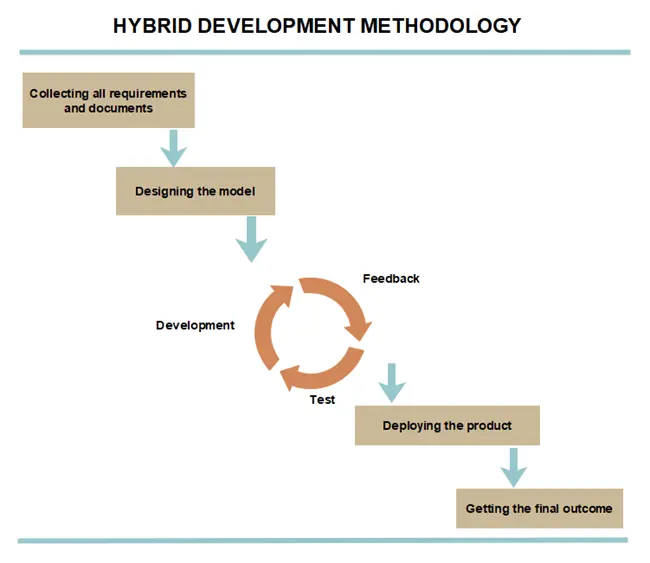
Is it Possible to Combine Both Agile and Waterfall Methodologies?
Source: EdrawMax
Yes, you can combine both models by using one methodology for a specific set of development phases and another one for the remaining phases. Combining both agile and waterfall methods is known as a hybrid approach.
Both agile and waterfall have pros and cons. Therefore, companies use a combination of these models for multiple phases. Additionally, it is not always simple to fully implement agile approaches. The agile model may not be a good fit for clients who prefer a fixed scope, project timeline, and budget. This is where the hybrid model can help.
The agile model prioritizes collaboration, while the waterfall model chooses a rigid development structure. However, successful digital product development employs both methodologies.
Final Thoughts: Which Methodology Should You Choose?
Agile and Waterfall are prominent project management methodologies used in the software development landscape. With its flexible approach, Agile is an ideal model for larger projects with high risk, unknowns, or constantly changing requirements. However, the Waterfall's structured approach is effective for smaller projects with precise requirements and a clear end goal.
You must now be familiar with the basics of the Agile and Waterfall Models. The differences between both models will help you choose the one that is a better fit for your project. You can choose the ideal methodology for your development project by considering the size of your project, complexity, duration, clients or stakeholders, and team expertise. The right methodology will help you build the product effectively and efficiently.
Streamline Your Digital Product Development with ownAI
At ownAI, we use both Agile and Waterfall methodologies to consistently deliver high-quality projects on time and within budget. ownAI provides flexible SaaS solutions that help you stay on budget and time.
Contact us to discuss your project. We will carefully consider your project's needs and choose the methodology that best meets those needs to deliver excellent results. Whether you need to develop a high-performing SaaS app, well-designed website, custom software, e-commerce store, or any digital product, we are here to help you. As a leading digital product development team, ownAI offers top-notch development services to turn your idea into reality.

Let’s discuss about your next AI, Cloud or Digital Transformation.
 AI-Skilled & Agile
 Transparent, Trustworthy &
Vetted team Not tech, but business &
customer first approach




 Turn your idea into MVP in 8-16 weeks